


Table of Contents
Why business cards are still a fundamental tool
Business cards are among the smallest communication tools we use, yet they are also among the most meaningful. In just a few centimetres, they need to convey who you are, what you do and how you want to be remembered. For this reason, creating business cards is not just a graphic exercise, but a process that involves content, design, materials and printing.
Unlike a digital contact, a business card is a physical object: it is handed over, touched and kept. It is often the first tangible element a person associates with a professional or a brand, and it is precisely this physical presence that makes it a tool that is still relevant and effective today.
The business card as a communication object
A business card does more than simply share contact details. It communicates identity. Its value lies in the perception it creates. Holding a printed item, such as custom business cards, can convey order, attention to detail and visual consistency.
A well-designed business card strengthens the image of the person who hands it over. A poorly designed or confusing one, on the other hand, can create a negative impression, regardless of the quality of the service offered.
What an effective business card should include
To work properly, a business card needs to be immediate and easy to read. The goal is not to say everything, but to say the essential things well.
The elements that should never be missing are:
- Name and surname (or brand name), clear and clearly visible
- Role or specialisation, to immediately contextualise the activity
- One main contact detail, chosen according to the card’s purpose
- A visual element consistent with the brand, such as a logo or distinctive colour
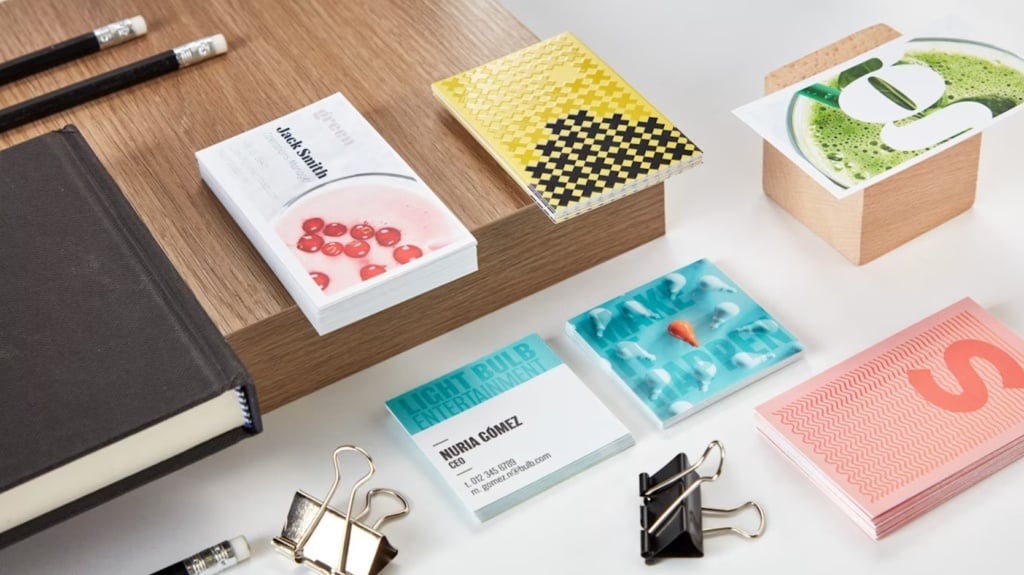
These details are most effective when organised on well-designed business cards, where each element has space and a clear hierarchy.
Sizes and formats: the standard and the alternatives
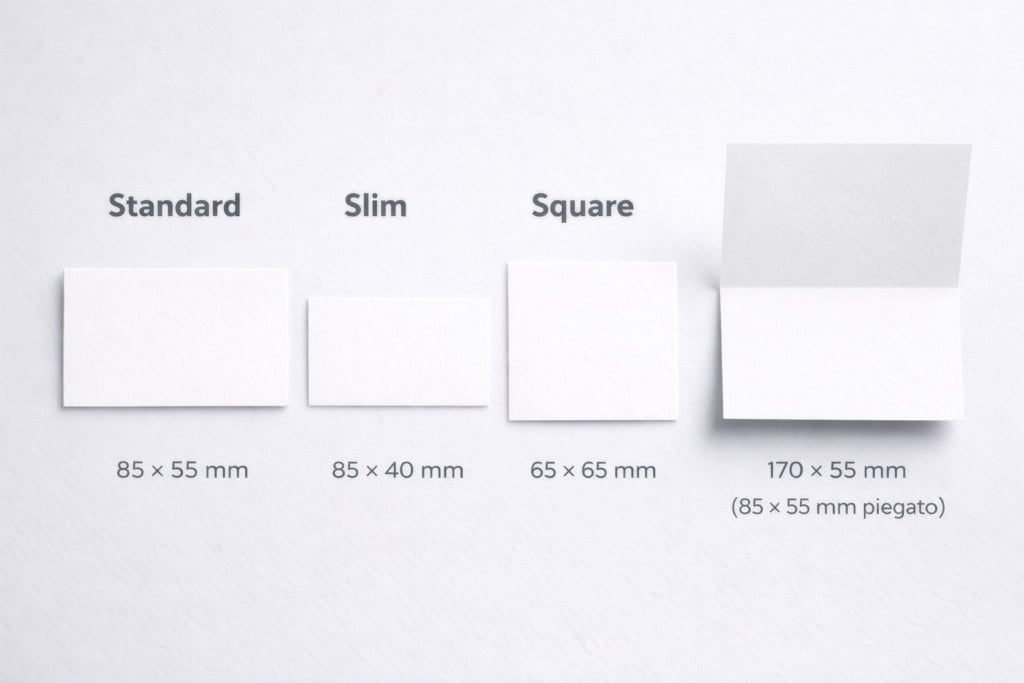
The standard business card size in the UK and across Europe is 85 × 55 mm. It is the most common choice because it is practical, recognisable and easy to store.
Alongside the standard format, there are alternative options that can work well in specific contexts:
- Standard format (85 × 55 mm): ideal for most professional business cards
- Slim format: longer, elegant and minimalist
- Square format: distinctive, suitable for creative brands
- Folded format: useful when more information is required
The choice of format should always start from how the card will be used.
Designing a business card
When it comes to business cards, clarity comes before aesthetics. A good design makes the key information immediately readable, while also taking into account from the outset the technical rules of printing, which are essential for achieving print-ready business cards.
Visual hierarchy and readability
Typography, text size, spacing and colours should work together to guide the eye. The name or brand should stand out first, followed by the role and main contact detail. Overly thin or decorative fonts should be avoided, as they can lose definition on paper, especially at small sizes.
A good practice is to maintain a minimum text size that ensures readability and to use sufficient contrast between text and background.
Safety margins, bleed and borders
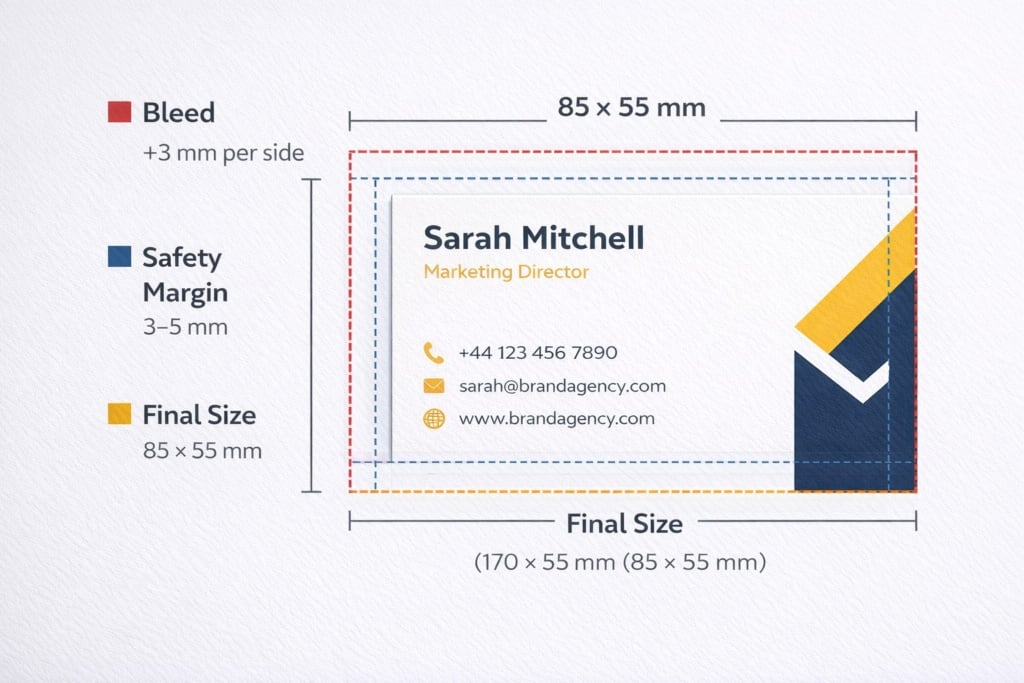
When designing a business card for print, it is essential to consider a few technical measurements:
- bleed: extend backgrounds and images at least 3 mm per side beyond the final size
- safety margins: keep text and logos at least 3–5 mm from the edge of the finished format
- borders and frames: best avoided, or kept well away from the edge
These precautions help ensure a clean, professional result when printing business cards.
Front and back: when to use them
Using both sides can be a good option when you want to separate visual elements from information. If there is limited content, a single-sided card can appear cleaner and more effective.
Paper, thickness and finishes: when the card becomes an object
A business card also communicates through touch. Paper type, thickness and finishes have a direct impact on how a brand is perceived.
When choosing materials for custom business cards, you can consider:
- coated papers
- uncoated or natural papers
- higher grammages
- matt or soft-touch finishes
How to create a business card: possible approaches
There is no single correct way to create a business card, as every project starts from different needs. The approach depends on the time available, design skills and the desired level of customisation.
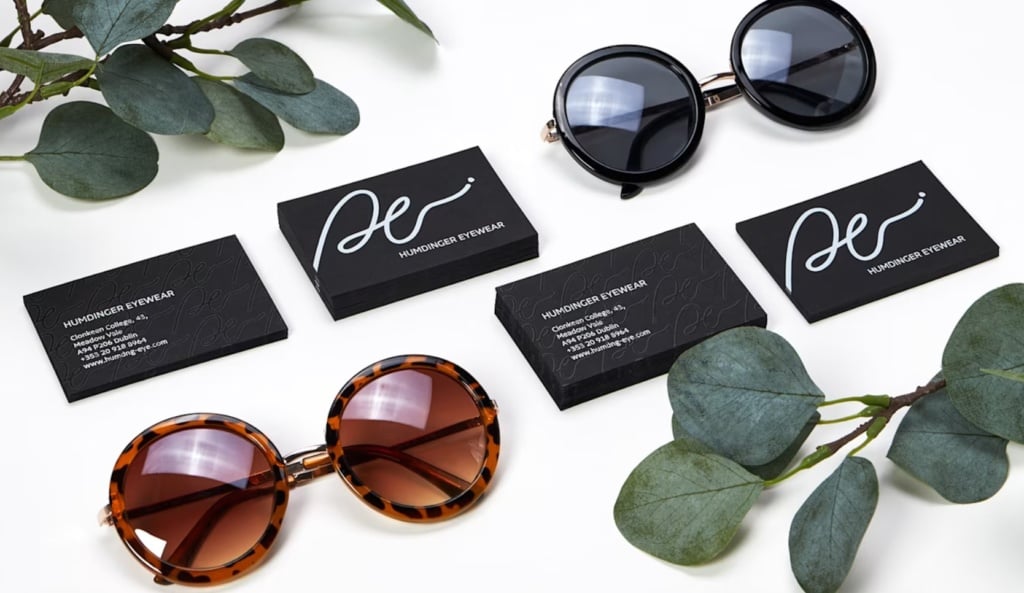
Some prefer to start from a fully custom design created with professional software, while others need a quicker but still well-crafted solution. In these cases, adapting an existing layout or working from a template allows you to focus on content and style without worrying about technical details.
Whichever approach you choose, it is essential to design the card with printing in mind from the very beginning. Considering format, margins and paper behaviour helps ensure a coherent and functional result.
Preparing the file for print
File preparation is a crucial stage in creating business cards and is often underestimated. Even a well-designed layout can look unprofessional if the file does not meet the correct print specifications.
Safety margins, bleed and image resolution ensure a precise result after trimming. Text placed too close to the edge, low-resolution images or incorrectly extended backgrounds can lead to visible defects in the final product.
Paying attention to these aspects helps avoid reprints, wasted time and disappointing results, ensuring high-quality business cards from the first order.
Ordering and printing business cards online
Once the design is complete, you move on to the ordering and printing stage, where all previous decisions take shape. Format, paper, finishes and quantity directly affect the final result and how the card is perceived.
Online printing allows this step to be managed simply and with full control, reviewing each option before confirming the order. You can upload a print-ready file, create the card directly online or start from a pre-designed template, configuring the product according to your professional needs.
A careful review at this stage helps prevent errors and ensures the final result meets expectations.
Common mistakes to avoid when creating business cards
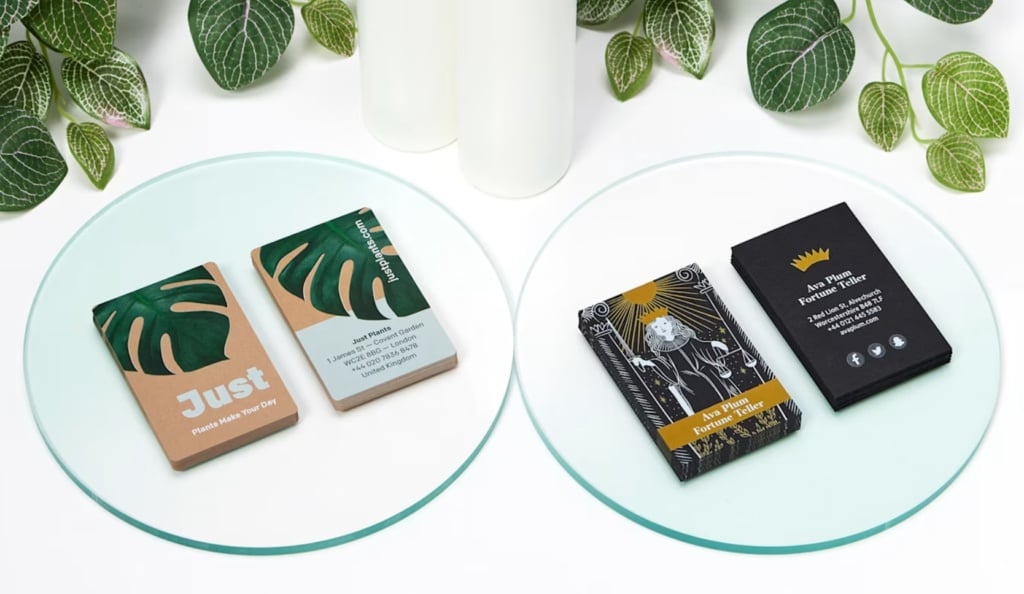
Many business cards are ineffective not because of printing issues, but due to poor or rushed design choices. These are often simple mistakes, yet they have a direct impact on readability and professional perception.
The most common ones include:
- Including too much information in too little space, making the card hard to read
- Using fonts that are too small or overly decorative, which lose clarity on paper
- Insufficient contrast between text and background, reducing legibility
- Placing text and logos too close to the edges, risking unwanted trimming
- Choosing original but impractical formats, which are awkward to store or use
Avoiding these mistakes immediately improves the perceived quality of a business card.
Final checklist before ordering
Before proceeding to print, it is always worth taking a moment to double-check everything. This final stage allows you to catch errors while they are still easy to fix.
A simple checklist helps turn ordering into a conscious step and reduces the risk of issues after printing. Before confirming, make sure that:
- Contact details are correct and up to date
- The text is readable at a glance, even on a small format
- The chosen format suits the intended use
- The file respects safety margins and bleed
- Paper and finishes are consistent with the brand identity
This final check significantly increases the chances of receiving professional, ready-to-use business cards from the very first order.
FAQ – Frequently asked questions about business cards
What is the standard size for a business card?
The standard business card size in the UK and Europe is 85 × 55 mm, as it is practical and easy to store.
What information should be included on a business card?
It is advisable to include a name, role and one main contact detail. Too much information can reduce readability.
Is it better to have a single-sided or double-sided business card?
This depends on how much information you need. Double-sided cards are useful for separating content; if there is little information, a single side may be enough.
How can I create a business card without design skills?
You can start from customisable templates or use online tools that help maintain correct layouts and print settings.
What are the most common mistakes in business card printing?
Text too close to the edge, low-resolution images and poorly legible fonts are among the most frequent issues.

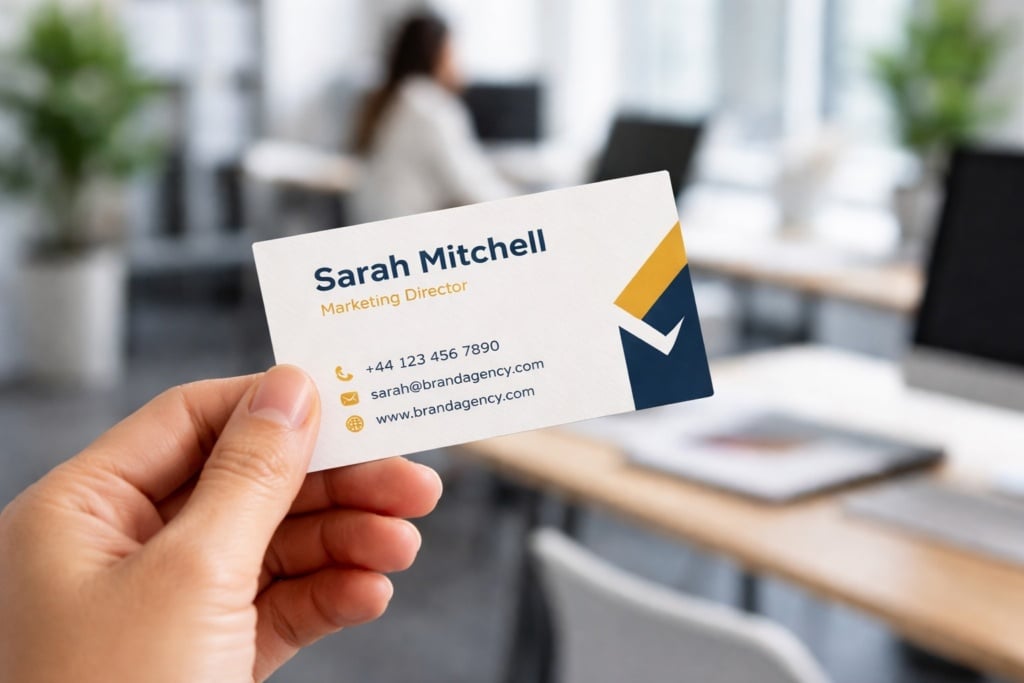
A business card ready for print
Creating an effective business card means finding the right balance between content, design and print quality. Every decision, from format to paper, from text layout to file preparation, contributes to the final perception.
Approaching the process with method and awareness allows a simple printed item to become a concrete communication tool, capable of accurately representing your professional identity or brand. To design and print your custom business cards, you can rely on the experience of Pixartprinting.