

Table of Contents
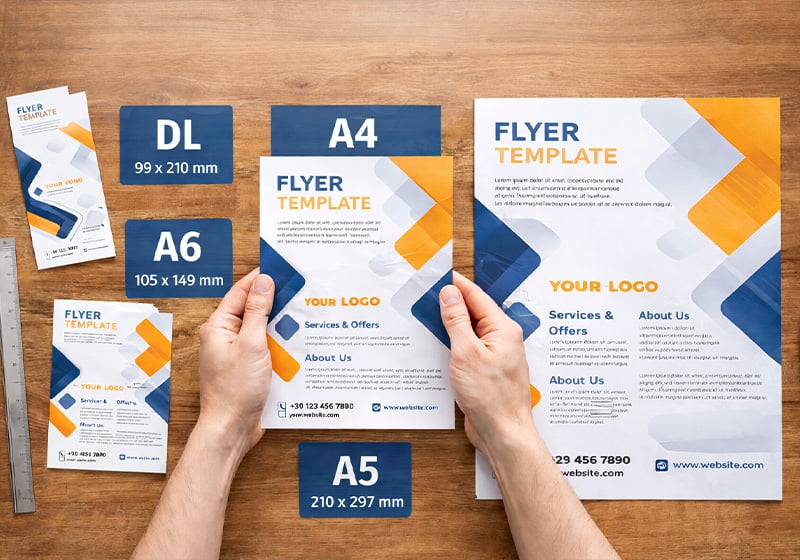
Choosing the right flyer size is more important than it may seem. The format affects the available space, readability, printing costs, distribution and even how effective your message is. The main formats are A6, A5, A4 and DL, which are widely used for promotional flyers, events, vouchers and local marketing.
👉 Not sure which one to choose? In many cases, A5 offers the best balance between space, usability and cost.
What are the standard flyer sizes?
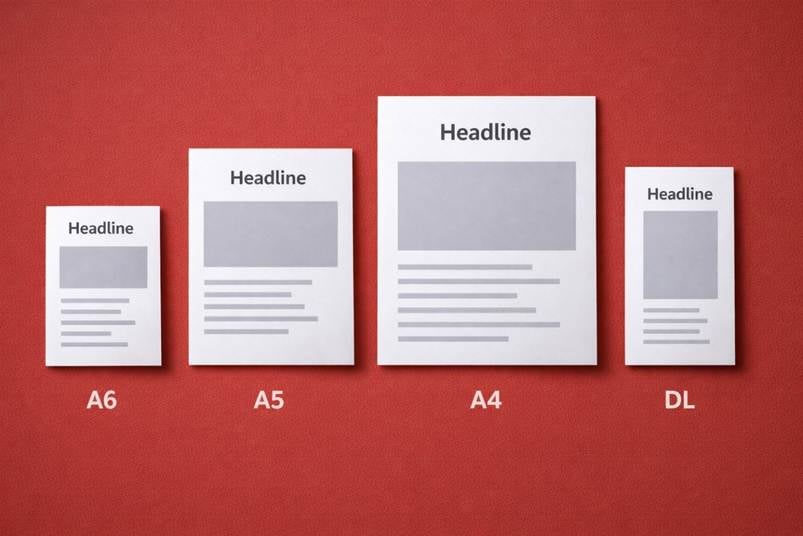
The most common flyer formats come from ISO A-series standards, along with the DL format.
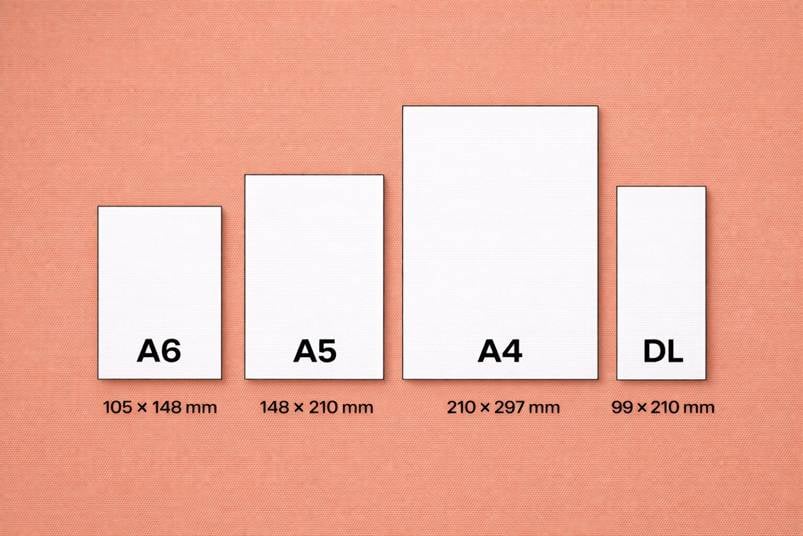
Flyer size chart
| Format | Dimensions (mm) | Typical use |
| A6 | 105 × 148 | Vouchers, quick promotions |
| A5 | 148 × 210 | Standard flyer, general use |
| A4 | 210 × 297 | Menus, price lists, detailed content |
| DL | approx. 99 × 210 | Invitations, envelopes, premium communication |
Let’s take a closer look at each format.
If you want to compare formats in a practical way and quickly understand which one best suits your project, you can use an online configurator to preview sizes, layouts and printing options in real time.
A6 flyer: 105 × 148 mm
The A6 format is small, compact and easy to distribute. It is often used for vouchers, invitations, quick promotions, handouts or inserts inside bags and packaging. Its main advantage is practicality; its limitation is the reduced space.
It’s the right choice when:
- you want to communicate a single offer;
- your message is short;
- you need fast distribution at a low cost.

A5 flyer: 148 × 210 mm
A5 is the most balanced format. It provides enough space for a headline, image, essential text and a call to action, while remaining easy to handle and distribute. Many guides describe it as the classic and most versatile format for most use cases.
It is ideal for:
- promoting shops, openings, sales or events;
- presenting services clearly;
- achieving a good balance between readability and cost.
A4 flyer: 210 × 297 mm
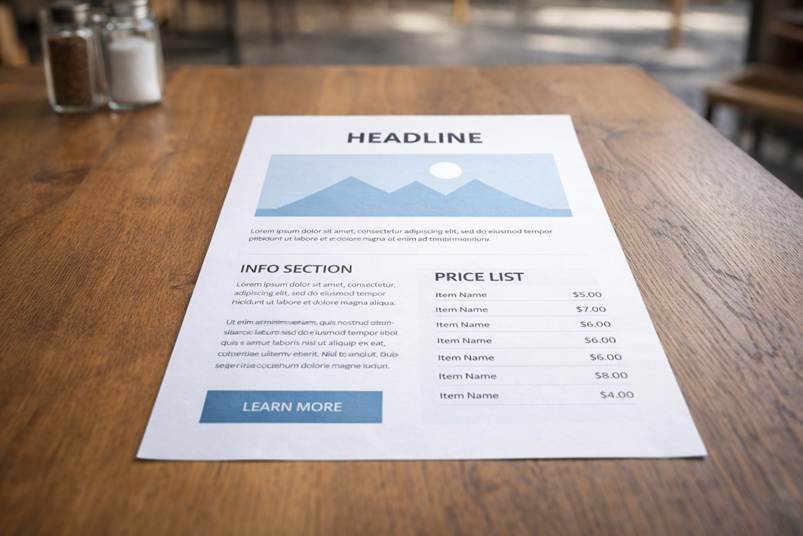
A4 is the largest among the most commonly used formats. It is suitable when you need to include more content: price lists, programmes, menus, service details, multiple offers or structured communication with several sections. For this reason, it is often recommended for richer materials or content intended for more in-depth reading.
It makes sense to choose it when:
- you need more space;
- you want easier reading;
- you plan to display it on notice boards, shop windows or information points.
DL flyer: 99 × 210 mm
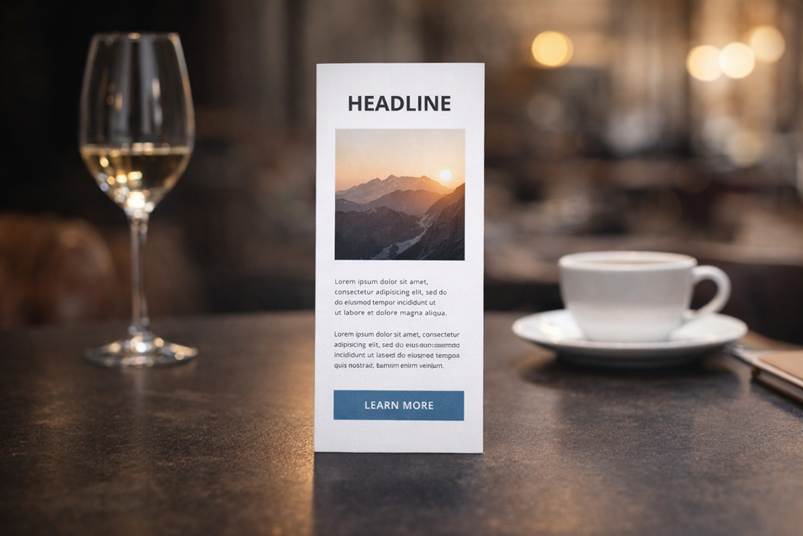
The DL format is narrow and vertical. It is often associated with invitations, elegant promotions, counter displays or flyers designed to fit standard envelopes. Its less common shape compared to A5 and A4 makes it more distinctive.
It is suitable if:
- you want a more refined format;
- you are working with vertical or sequential content;
- you distribute your material via envelopes, display stands or reception desks.
Square and custom formats
In addition to standard formats, there are also square or custom options. Some guides mention formats such as 10.5 × 10.5 cm, 15 × 15 cm or 21 × 21 cm, mainly used for creative or branding purposes. These are less standard and should be carefully evaluated, as they can affect costs and production efficiency.
How to choose the right flyer size
The right choice mainly depends on four factors:
- content
- distribution
- objective
- budget
The format is not just a visual detail, but a strategic decision.
Quick decision table
| Goal | Recommended format |
| Short, immediate message | A6 |
| General, versatile use | A5 |
| Detailed and content-heavy | A4 |
| Elegant or envelope-based communication | DL |
Based on content
If you only need to include a promotion, a date and a call to action, an A6 may be enough.
If you need to properly present an offer, service or event, A5 is often the cleanest solution.
When content increases significantly, it’s better to move to A4 rather than compress everything into a format that is too small.
👉 Practical rule: less text = smaller format; more information = larger format.
Based on distribution
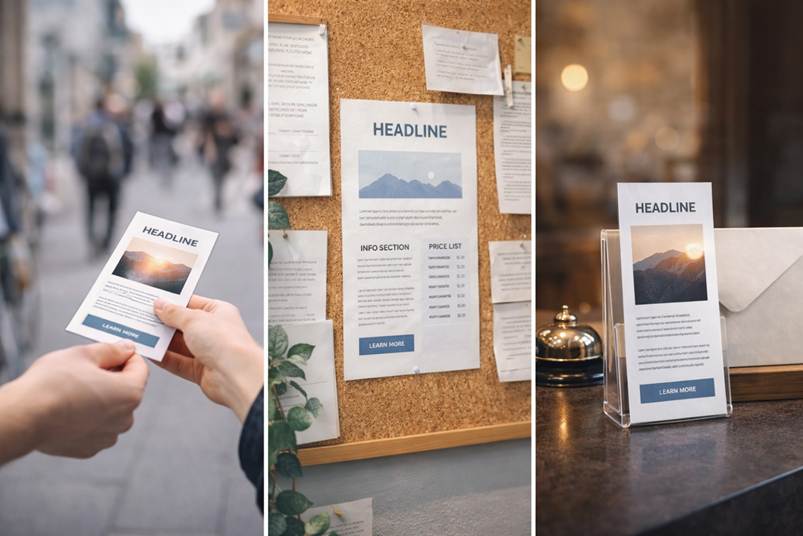
For hand distribution, small and medium formats are usually more effective, as they are easy to receive and keep.
For notice boards, shop windows or information points, A4 ensures easier reading even from a distance.
If the flyer needs to fit into an envelope or a narrow display holder, DL is the natural choice.
Based on printing budget
The format affects cost, especially in terms of paper usage and print sheet optimisation. Industry experts often highlight that choosing standard sizes helps reduce waste and production costs.
In other words, sticking to common formats is almost always the most efficient choice.
Based on communication goals
If you want to maximise quick readability, a small format with a single message works best.
If you want to explain, persuade and provide more detail, you need more space.
If you’re aiming for a more “premium” feel, DL or a custom format may work better than a standard A4.
What is the best flyer size?
In most cases, A5 is the best option. It provides enough space to communicate effectively, costs less than A4, is easy to distribute and doesn’t compromise readability.
Pros and cons table
| Format | Advantages | Disadvantages |
| A6 | Cost-effective, practical, quick | Limited space |
| A5 | Balanced, versatile | Limited for long content |
| A4 | Spacious, highly readable | More expensive |
| DL | Elegant, distinctive | Less versatile |
That said:
- choose A6 for quick offers, vouchers and mass distribution;
- choose A5 for promotions, services, events and general use;
- choose A4 for menus, price lists, programmes or detailed content;
- choose DL for invitations, reception use, envelopes or more refined communication.
Technical specifications for printing a flyer without errors
Size alone is not enough: to achieve a good result, the print file must also be prepared correctly.
Resolution and colour
For sharp printing, images should be set at 300 dpi. The file should also be prepared in CMYK, not RGB, as printing uses the CMYK colour model.
Bleed and safe margins
It’s best to add 3 mm bleed on each side and keep important content at least 5 mm from the edge. This reduces the risk of inaccurate trimming or elements being cut too close to the border.
Front/back and readability
If you have a lot of content, double-sided printing is often a better solution than squeezing everything onto one side. This keeps the layout cleaner and easier to read. Font size also matters: text that is too small reduces the flyer’s effectiveness, even if it technically “fits”.
Common mistakes to avoid when choosing flyer size
One of the most common mistakes is choosing the format based on personal preference rather than actual use. The format must be consistent with your objective, content and distribution method.
Common mistakes include:
- choosing a format that is too small for the amount of content;
- using A4 when A5 would be more readable and cost-effective;
- ignoring the distribution method;
- preparing files without bleed or in RGB;
- filling every available space instead of creating a clear visual hierarchy
To avoid printing errors, many online platforms provide ready-made templates with bleed and safe margins already set up, so you can work directly on print-ready files.
Conclusion
Flyer size is not just a technical detail: it directly affects how your message is seen, read and remembered.
The most commonly used formats are A6, A5, A4 and DL, but the best choice depends on three simple questions:
- how much information you need to include,
- where the flyer will be distributed,
- what kind of impact you want to achieve.
Industry guides agree that A5 is often the most versatile format, while A6, A4 and DL are more suitable in specific contexts.
👉 Quick rule:
- short message = A6
- general use = A5
- content-heavy = A4
- elegant or envelope format = DL
Once you’ve chosen the right format, you can move straight to creating your flyer using online tools that let you upload your design, configure the print and preview the final result.
FAQ
What are the standard flyer sizes?
The most common are A6 (105×148 mm), A5 (148×210 mm), A4 (210×297 mm) and DL (approx. 99×210 mm).
What is the best flyer size?
In most cases, A5 is the most versatile option.
When should you choose an A4 flyer?
When you need to include a lot of content such as menus, price lists or programmes.
What is the difference between A5 and DL?
A5 is more universal; DL is narrower, vertical and more elegant.
What specifications are needed for printing a flyer?
300 dpi, CMYK colour mode, 3 mm bleed and safe margins.