


Table of Contents
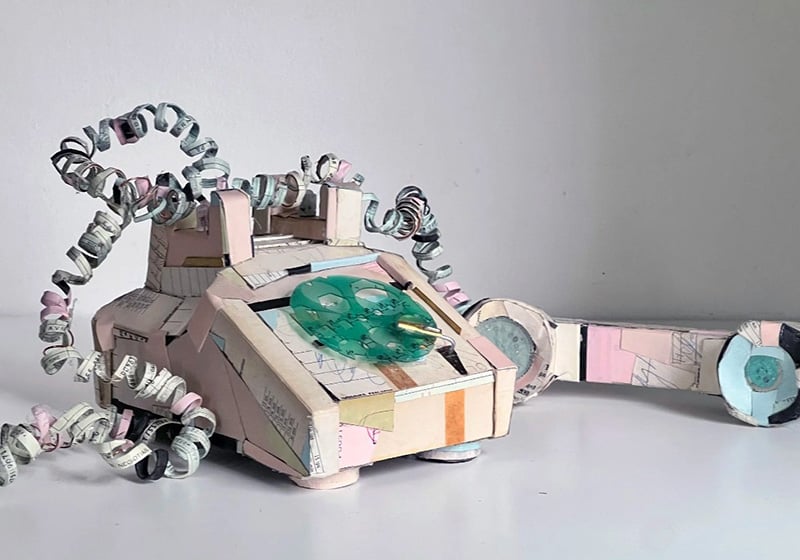
Old receipts, tangled wires, candy wrappers, broken pencils, buttons, tattered pieces of fabric, empty boxes, crumpled scraps of paper. For most of us, these items would go straight into the trash to avoid mess and clutter. But for Lydia Ricci, these are the key materials behind her wonderful sculptures of small-scale everyday moments.
The Pennsylvania-born artist attributes her instinct to create from nothing as something she cultivated from an early age in her family environment. Her mother was an Ukrainian immigrant who could improvise anything in times of need, which was often. And her Italian father never threw anything away in case it could one day be fixed or prove to be useful. She had already spent 30 years inheriting, collecting and stealing waste materials for her work.
From graphic designer to miniature sculptor
Lydia Ricci graduated in graphic design from Carnegie Mellon University in Pittsburgh, and has also studied photography and printmaking in the US and at universities in European countries such as Switzerland and Italy. During her early career, she worked as a freelance graphic designer, mainly focused on packaging and brand design. At the same time, she also dedicated herself to personal projects to explore her creativity.
This is how her first sculpture, The Dodge, was born: a green car loaded with symbolism, since at the time she had moved to an area on the outskirts of the city and often had to deal with her fear of driving. Since then, cars continue to be a prominent feature in her works.
Creative process in the midst of chaos
The American artist’s studio is total chaos, filled to the brim with knick-knacks from her father’s house, second-hand shops, garage sales, even from her neighbourhood landfills. In between pieces she cleans the room, but even then it’s easy to get lost and be unable to find anything.
Interestingly, this messy creative process is fully in harmony with the appearance of her work, covered in stains, tears, wrinkles, uneven surfaces, glue residue and mismatched colours. She doesn’t even disinfect her materials, but it is precisely this rawness that makes them so alive and important, just like our memories.
Lydia Ricci’s miniatures also allude nostalgically to the past. From table football to a vacuum cleaner, a piano, a hairdryer, a fax, a cash register, an arcade machine, a Ferris wheel, a sofa bed and an old-fashioned dining room.
Animations that tell stories with humour
Lydia Ricci’s sculptures have been exhibited in numerous museums and art galleries, in both solo and group shows, and her work has appeared in prestigious publications such as The Guardian, The New York Times, The Huffington Post, Hyperallergic and Vice.
But the artist has also won acclaim at festivals, as she often activates her miniatures using stop-motion animation, adding fragments of text to tell stories with a touch of humour. For example, in the short film “I Will Always Love You”, she explores the evolution of a relationship through their daily dramas.
“Pantyhose” explores her move to San Francisco and how she got her first job.
Whether it’s through graphic design, sculpture or cinema, Lydia Ricci transforms the ephemeral into tiny tributes to times gone by.