


Table of Contents
“There is no such thing as an original idea.” This resounding statement is usually attributed to the US writer Mark Twain, going on to say that ideas come from combining older ones in a creative way, like some sort of “mental kaleidoscope.” In the same way, Morgana Wallace draws inspiration from Norse and Japanese mythology to create her incredible fantasy worlds. The Canadian artist conjures up scenes with colourful characters, often adorned in masks and elaborate costumes, all with one thing in common: the use of paper as a tool.
An avid reader
Her interest in illustration and painting began from a very young age. Wallace, born in Winnipeg, capital of the province of Manitoba, was raised in an artistic environment, as her mother was a musician and her father a visual artist. Both fostered her curious and creative spirit. For example, she remembers that when she came home from school, her mother would read her children’s stories with beautiful illustrations.
Back then, she would never have imagined that, when she grew up, she would be the one to create them. Her interest began when she was studying at the Victoria College of Art, specifically in a monotype class – a printing technique that consists of etching an image on a material, such as paper, canvas or wood, through a drawing or painting. She has been professionally creating works using paper cutting techniques since 2008.
Technique and narrative in illustration
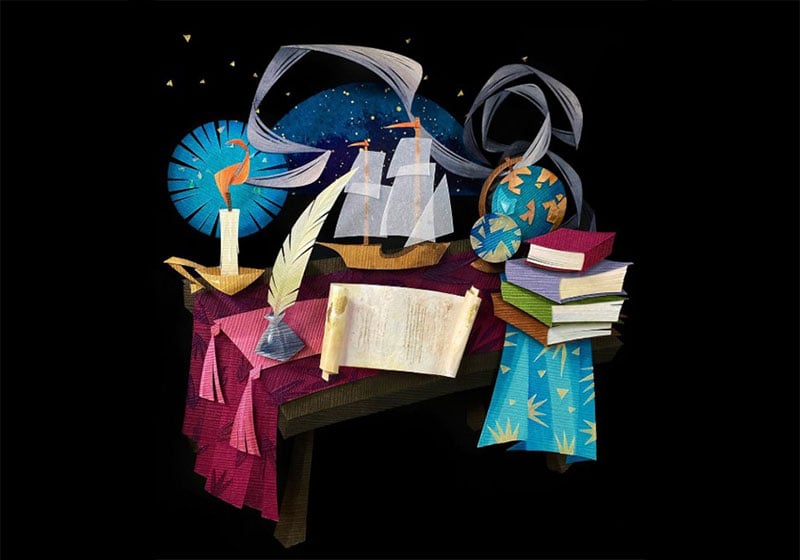
The Canadian artist creates female heroines and mystical beasts with additional details such as layers, crowns, leaves, feathers and birds from layers of paper with varied textures – from Japanese linen paper to cardstock – giving them a three-dimensional appearance. This meticulous work also incorporates watercolour, goauche, inks and coloured pencils, materials she uses to add the illusion of shading and depth to the figures.
Wallace’s illustrations not only demonstrate superb technical mastery, but also reveal a profound commitment to the power of storytelling to immerse us in imaginary worlds. Curiously, the artist does not usually decide on a particular story as a starting point – instead, the process begins with a small idea, such as a face, and the rest emerges intuitively. It is almost like a kind of trance, in which she stays connected to her childhood memories.
Women who changed history
This journey from her early years, when she read with her mother, has also been reflected in her beautiful illustrated books. “Hedy and Her Amazing Invention” tells the story of the Austrian actress and inventor Hedwig Eva Maria Kiesler, known in Hollywood as Hedy Lamarr, and considered on of the most beautiful women of the time – she had one of the first nude scenes in the history of cinema. While living as a star in the public eye, she was secretly working on a “frequency hopping” technology to prevent enemy torpedo protection shortly before the United States entered World War II. This is why the final page of the book does not depict her beautiful face – instead, we see her from behind as she diligently gets to work.
In “In One Ear and Out the Other”, Wallace illustrates the obstacle-filled life of Dutch conductor and pianist Antonia Brico, who became the first woman to conduct both the Berlin and the New York Philharmonics.
For the Canadian artist, who has said she suffers from social anxiety, her illustrations, which can be purchased online have been a form of escape, a way to explore other places, even if they hare made of paper.