


Table of Contents
In today’s business landscape — marked by speed, complexity, and constant interconnectedness — knowing how to work in a group has become an essential skill. We are not just talking about “being collaborative”: teamwork is a true engine of innovation, productivity, and professional growth. Yet many organizations fail to harness its potential, often due to a lack of practical knowledge, an unsuitable corporate culture, or inadequate tools.
In this article, we explore what group work really is, why it represents a competitive advantage, the forms it can take, and how to develop it in a practical way. We also dedicate a detailed section to team-building, an essential practice to strengthen harmony among team members and improve performance.

What is group work (and why is it so important today)
Group work is the set of dynamics, behaviours, and processes through which people with different skills collaborate to achieve a shared goal. Its defining characteristic is not just the division of tasks, but interdependence: each member actively contributes to the result, influencing and supporting the others.
The growing importance of teamwork stems from several factors:
- increasingly complex projects, requiring cross-functional skills;
- rapid market changes, which call for flexibility and responsiveness;
- the spread of hybrid and distributed work, making structured collaboration essential;
- the enhancement of human capital, a key lever in corporate strategies.
In short, no organization can innovate or grow without teams capable of working together harmoniously and efficiently.
Why working in a group makes a difference: concrete benefits
Working effectively in a team is not just “nice to say”: it generates measurable, data-backed advantages. Here are some interesting insights supported by research and studies.
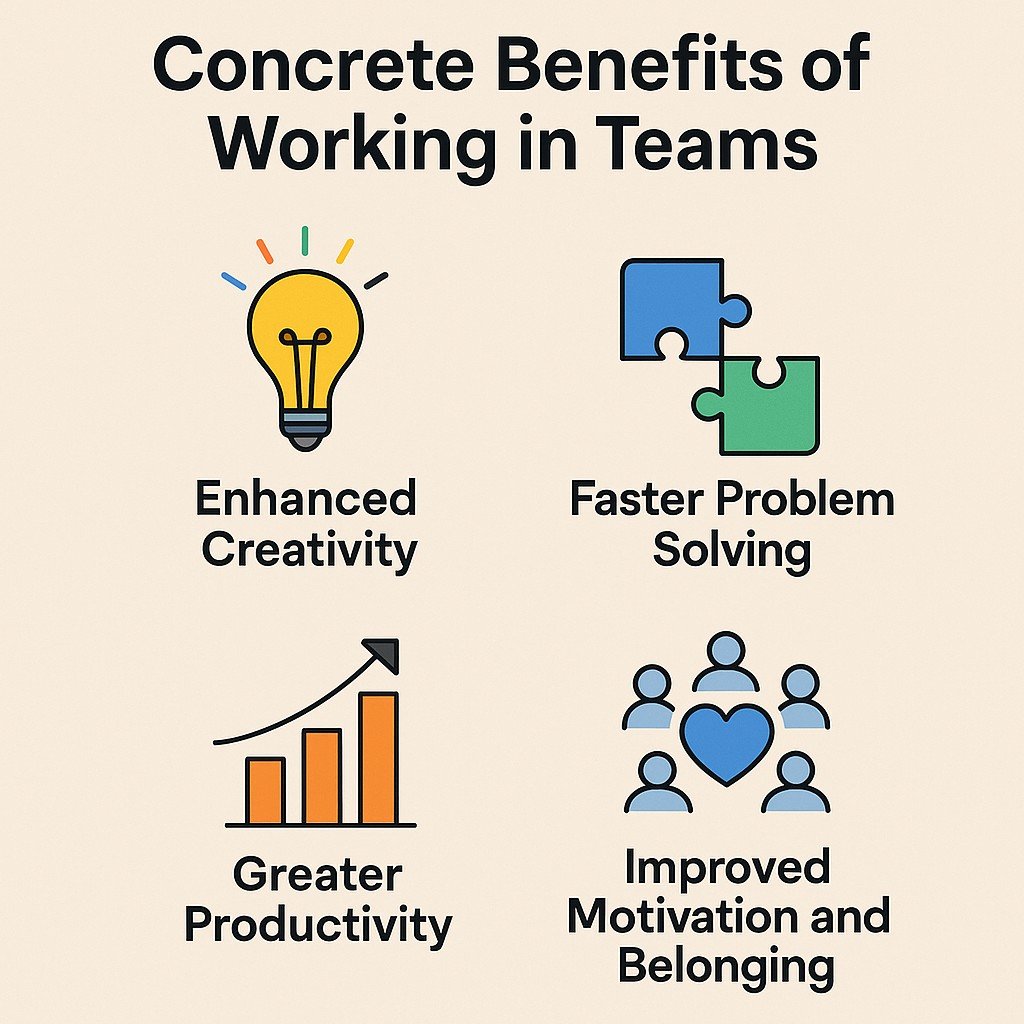
Enhanced creativity
When people with different backgrounds and viewpoints interact, more original ideas and richer solutions emerge. Constant exchange reduces rigid mental patterns and encourages innovative thinking.
Faster and more effective problem solving
Several studies confirm that organizations focused on teamwork solve problems more quickly, innovate faster, and detect errors more promptly. One recent study states that team-oriented companies “innovate faster, identify errors more quickly, find better solutions, and achieve higher productivity”
(source: IEM University – Teamwork & Productivity).
Increased productivity
Working in a team not only improves process quality but also increases overall productivity. A study published on ResearchGate identified a 0.592 correlation between teamwork and employee productivity — a value that shows a significant link between the two factors
(source: ResearchGate – Teamwork & Productivity).
Other studies confirm that well-structured group work contributes to the effectiveness of the entire organization
(source: ScienceDirect – Teamwork & Organizational Effectiveness).
Well-being, motivation, and sense of belonging
Working in a cohesive team increases engagement and reduces stress. People feel supported, empowered, and part of a shared vision, developing greater professional satisfaction.
Continuous professional growth
Collaboration fosters the development of soft skills such as effective communication, active listening, negotiation, and conflict management. These skills are increasingly in demand and crucial for career advancement.
The different types of group work (and when they are useful)
Teamwork is not the same in every situation. There are several forms of collaboration, each useful in specific contexts:
- Operational teams, managing daily activities or ongoing processes.
- Project teams, created for time-bound objectives such as product launches or campaigns.
- Cross-functional teams, bringing together people from different departments for more complete decision-making.
- Creative or innovation teams, dedicated to ideation and experimentation.
- Agile/Scrum teams, small autonomous groups working in iterative cycles.
- Communities of Practice, informal groups sharing knowledge on common professional areas.
Each type has specific dynamics and benefits: knowing them helps build more effective teams.
The essential skills for working well in a group
A team performs well only when its members share certain key skills. Among the most important:
- Clear and transparent communication, to avoid misunderstandings.
- Active listening, essential to embrace ideas and needs.
- Empathy and emotional intelligence, crucial for building trust.
- Conflict management, to turn differences into opportunities.
- Collaborative decision-making, to involve everyone in critical processes.
- Shared responsibility, to ensure steady commitment.
- The ability to give and receive feedback, essential for continuous learning.
Together, these abilities make the team stronger, more resilient, and more productive.
How to create and encourage effective teamwork
Building a collaborative culture does not happen by chance: it requires method, organization, and consistency.
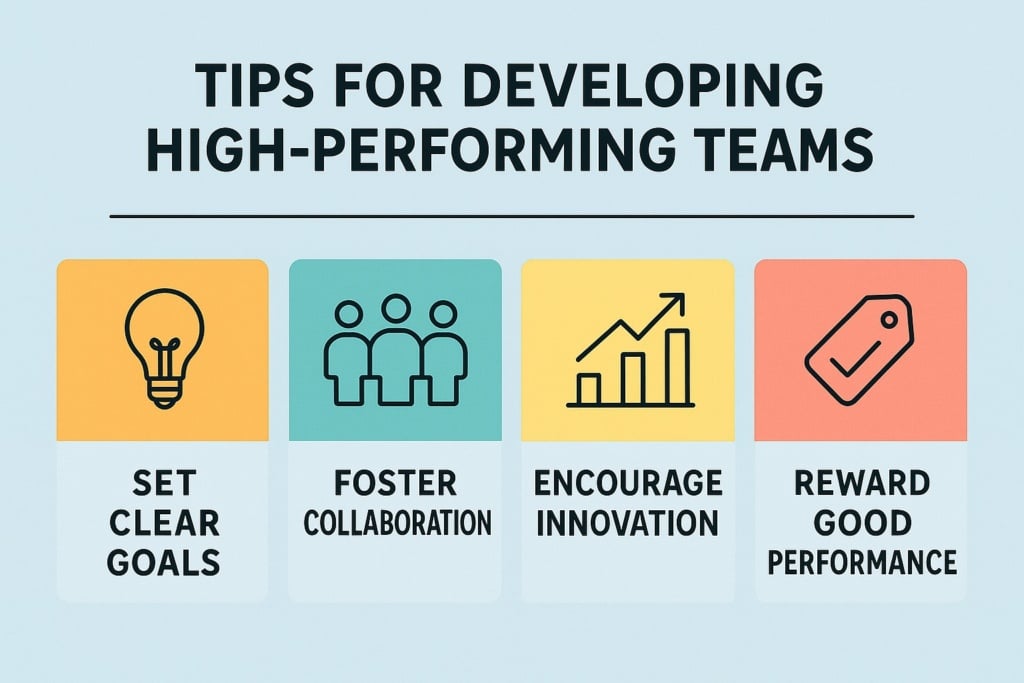
To develop effective teamwork:
- Define clear, shared objectives: everyone must know what they are working toward.
- Assign transparent roles and responsibilities: clarity equals efficiency.
- Create alignment rituals: short meetings, weekly updates, regular check-ins.
- Encourage open communication: ideas must circulate freely.
- Use collaborative tools: task managers, file-sharing platforms, digital whiteboards.
- Build trust through shared experiences.
- Reward team results, not just individual performance.
These practices create a healthy and productive long-term environment.
Team-building: strengthening harmony and cohesion
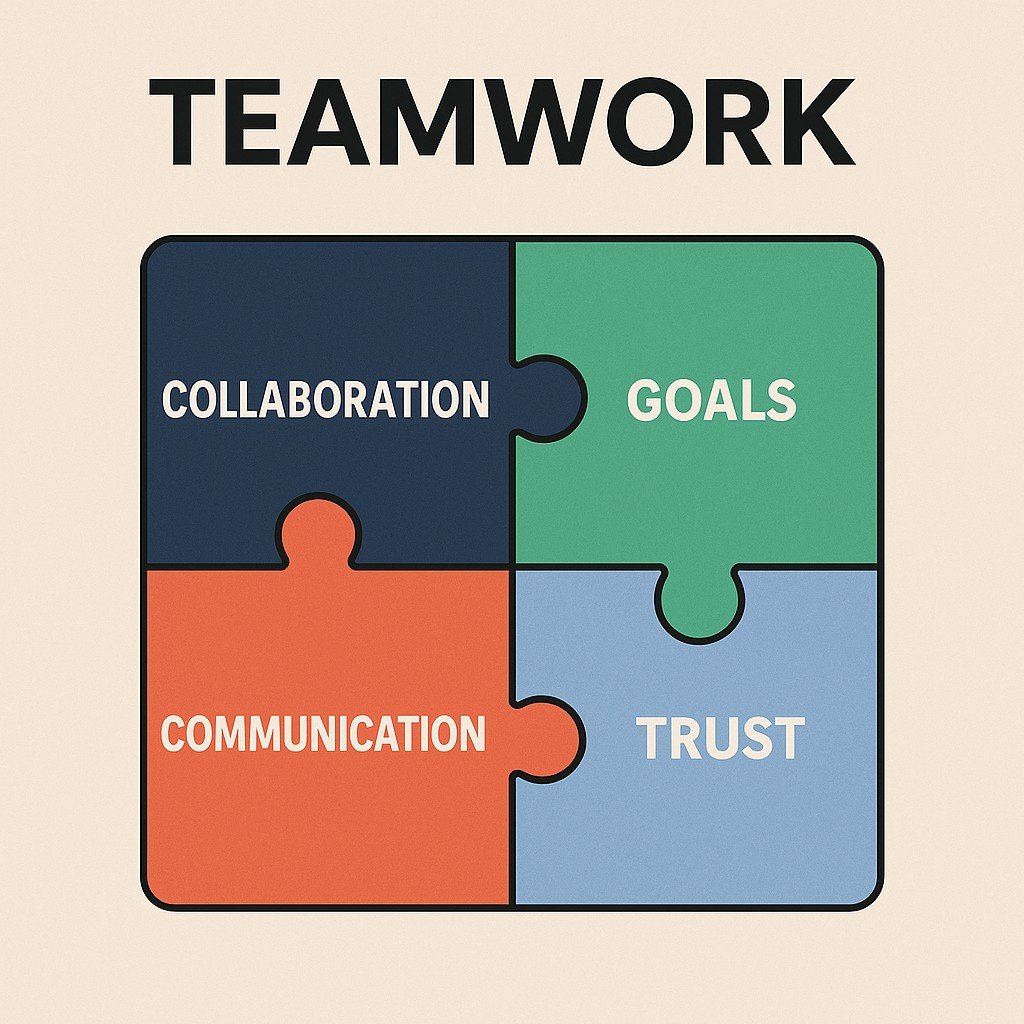
A crucial component of teamwork is team-building, the set of activities designed to improve trust, communication, and collaboration within the team. It is not just “fun”: it has a concrete impact on performance.
Why team-building is effective (with scientific evidence)
An academic review highlights that team-building “improves collaboration, trust, and knowledge sharing among employees, fostering competitive advantage and increasing overall performance”
(source: IIARD Journals – Impact of Team Building).
A 2024 meta-analysis published in Frontiers in Psychology further showed that team-building interventions significantly enhance team cohesion, with positive effects on workplace performance
(source: Frontiers in Psychology – Team Building Meta-analysis).
Concrete examples of team-building activities
To increase team cohesion, many companies use activities such as:
- Experiential workshops: hands-on sessions or outdoor activities to practice collaboration and problem solving.
- Challenges and gamified projects: internal competitions with shared objectives.
- Periodic retrospectives: formal moments to discuss what works and what needs improvement.
- Internal mentoring and job rotation: useful for strengthening connections and shared knowledge.
- Ice-breakers and personal storytelling: ideal for creating a climate of trust.
When to implement it
Team-building is effective:
- at the beginning of a new project or team;
- during organizational changes;
- as a regular practice once or twice a year;
- when there are conflicts or drops in motivation.
The key is to follow each activity with operational actions that turn the experience into real improvement.

How group work increases productivity (with data and insights)
Teamwork increases productivity through several mechanisms:
- improved decision-making thanks to diverse skills;
- reduced individual workload and greater operational efficiency;
- fewer errors thanks to continuous feedback;
- increased motivation and sense of shared responsibility.
A study published on ResearchGate showed a significant correlation (0.592) between group work and employee productivity
(source: ResearchGate – Teamwork & Productivity).
McKinsey also confirmed that “healthy” and cohesive teams generate benefits for the entire organization
(source: McKinsey – Healthy Teams Study).
Other academic studies show how leadership, organizational culture, and work climate directly influence team effectiveness.
Every factor that strengthens teamwork and collaboration provides productivity advantages for the company.

Mistakes to avoid when working in a group
Even a good team can lose effectiveness if common pitfalls are not addressed, such as:
- lack of shared objectives;
- micromanagement that limits autonomy and motivation;
- unclear or overlapping roles;
- long, unstructured meetings;
- unhealthy internal competition;
- lack of feedback and opportunities for discussion.
Managing these aspects is fundamental for maintaining harmony and focus.

Conclusion: group work as a strategic lever for the company
Teamwork is not an abstract concept or a mere organizational requirement: it is a powerful tool that drives innovation, productivity, and professional growth. Cohesive teams generate better ideas, solve problems more quickly, and create more motivating work environments. When applied thoughtfully, team-building becomes a key accelerator of trust and cohesion.
Companies that truly invest in collaboration — not just in words — gain concrete and lasting advantages.
Working in a group is therefore not just a way of working: it is a way of improving the environment and the very meaning of work.