


Table of Contents
Wikipedia, the world’s best-known encyclopaedia, was launched 25 years ago.
On 15 January 2001, its two founders – Jimmy Wales and Larry Sanger – uploaded the first page of what would become the quintessential online encyclopaedia and the site that for several years has been lauded as ‘the last best place on the Internet‘.
‘Ah, the early 2000s! Those were the days!’ Veteran internet users tend to remember this period with a large dollop of nostalgia… and indeed, the era when Wikipedia first appeared – at the dawn of the century and the new millennium – was undoubtedly a special period for the internet. The web was teeming with forums, ad boards, chatrooms, and attempts to communicate and share ideas, some freer and more decentralised than others. Shortly afterwards, the first social network – Facebook – was launched. It was a time of great upheaval.
Nowadays, however, things have changed. Ok, the web is still evolving rapidly, as we’ve seen with the spread of AI! But there is much more awareness and concern surrounding everything online. And the internet has definitely become a different place: more tightly regulated, more homogenous, and increasingly controlled by a few huge businesses. AI technology is a clear example of this.
And yet, Wikipedia is still there:
- it is consistently in the top ten most-visited websites in the world;
- it is the world’s largest encyclopaedia, with almost 65 million articles in many different languages.
While the internet around it was changing, Wikipedia remained true to its principles:
- it is free to use and ad-free;
- it is based on volunteering;
- it is decentralised, and not controlled by a single individual or company. It is supported by donations and managed by a non-profit foundation, the Wikimedia Foundation.
Is Wikipedia showing us the best way forward? Or is it simply the last bastion of a bygone internet age? While we mull over this question, to celebrate Wikipedia’s 25th birthday we thought we’d tell the story of how it revolutionised (and continues to revolutionise) the spread of knowledge, and how the milestone is being celebrated all over the world!
How does Wikipedia work? The free encyclopaedia revolution in the early 2000s
Interestingly, in its early years, the main criticism levelled at Wikipedia was that it was unreliable. Do you remember that? Now, however, the tables have turned: the free encyclopaedia feels like a bastion of credibility amidst a sea of AI-generated content, in a world where it is increasingly difficult to tell what is fake and what is real.
When you think about it, however, at the time of its launch Wikipedia offered a radically new way of handling knowledge.
Time for a quick summary of how Wikipedia works for the uninitiated: anyone can write and publish content on the site based on reliable sources. The content is then revised, if necessary, by other users, and all changes and previous versions always remain accessible to everyone.
This decentralised model puts a great deal of trust in the site’s community and in humanity in general, and creates a quickly spreading wealth of shared knowledge.
The name Wikipedia combines the prefix ‘wiki’ (a Hawaiian word for ‘quick’) and the suffix -pedia (from the ancient Greek word παιδεία, paideia, meaning ‘education’).
How did Wikipedia begin? The start of a new internet-driven trust in knowledge
The knowledge creation and sharing mechanism Wikipedia devised was fundamentally different from the traditional encyclopedia model (still in use today) where a team of experts, large or small, drafts and checks the articles.
This had been the approach used by paper encyclopaedias since their origins in the eighteenth-century Enlightenment period, and digital encyclopaedias like Microsoft Encarta – the first encyclopaedia on CD-ROM, launched in 1993 – followed suit.
Wikipedia, however, proposed a revolutionary decentralised system, something which could only be achieved using the internet. One thing’s for sure: Wikipedia wouldn’t have worked on paper!
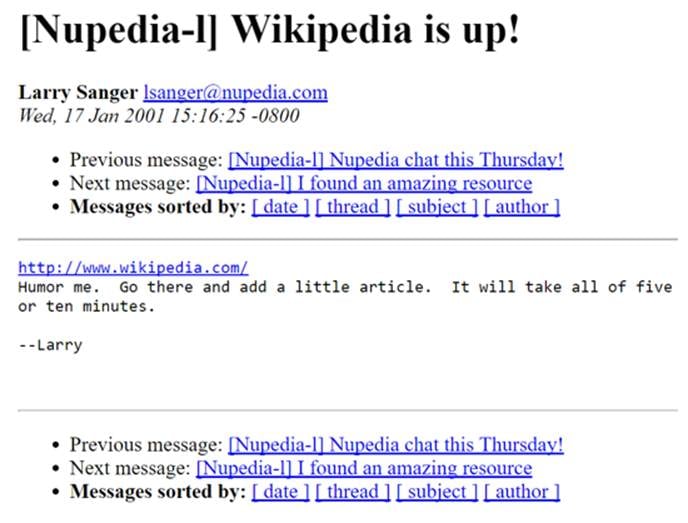
But let’s take a step back. How exactly did Wikipedia come about?
Wikipedia stemmed from a sense of optimism about the potential of online encyclopaedias. It was originally conceived as a backend area for an online encyclopaedia called Nupedia.
Unfortunately, a year on from its inception, entries for Nupedia were being added at a snail’s pace, with only about 20 articles online. So Jimmy Wales and Larry Sanger decided to speed up the article creation process using the wiki system, and immediately realised that this approach had enormous potential!
Nupedia was soon outshone by its ‘backroom’, which became a new encyclopaedia in its own right: Wikipedia! In just a few weeks, the entries started piling up, and the first versions of Wikipedia in other languages began to appear: first German, followed swiftly by Catalan and Japanese!
Interestingly, if you hunt for long enough, you can still stumble across the first ever Wikipedia page!
How the planet is celebrating Wikipedia’s 25th birthday
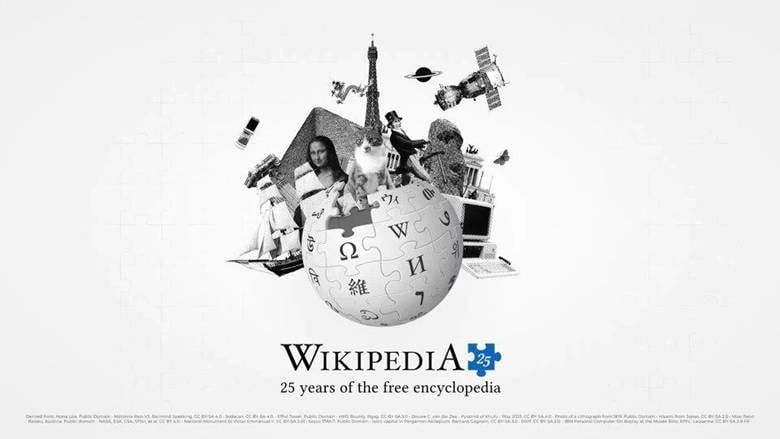
Isn’t Wikipedia’s story incredible? It is full of optimism regarding the relationship between humanity and technology, driven by the goal of making the internet a better place… one edit at a time.
And because the world is so fond of its free encyclopaedia, it wanted to come up with a fitting celebration to mark its major milestone. The festivities began with a major digital event organised by the Wikimedia Foundation.
Given Wikipedia’s fundamentally human character, it is only right that hundreds of in-person events are also planned around the world. You can find a constantly updated list here!
A fascinating nine-episode docuseries has been released paying tribute to the volunteer editors spread across the globe who are at the heart of the Wikipedia project, telling some of their stories.
For anyone wanting to celebrate Wikipedia’s 25th birthday in a more tangible way, the Wikipedia Store has put together a collection of official merchandise for sale: bags, caps, notebooks and other irresistible themed items!

And finally, don’t forget that you can still send your best wishes to the internet’s most famous encyclopaedia by signing a collective birthday card, which has gathered a huge number of signatures!
How about you? What do you think about Wikipedia and its history? Will it remain a stellar example of how humanity can harness technology for a long time to come? Or will it have to adapt to the new online landscape? And have you already marked the free encyclopaedia’s 25th birthday in some way?