

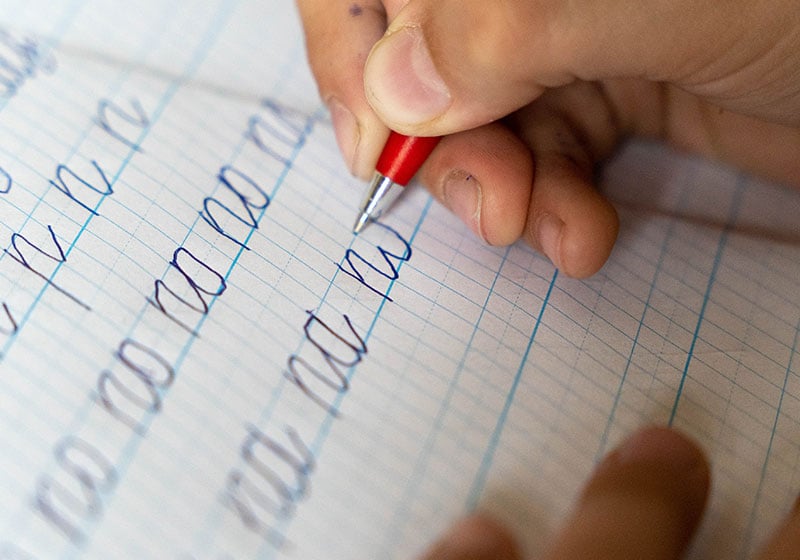
Do you still write with a pen? When was the last time you scribbled a page of notes or hand-wrote a letter (or even just a postcard)? And did you write in cursive (AKA joined-up writing) or block letters?
These aren’t trivial questions. They highlight how smartphones and other digital devices limit our opportunities to write with pen and paper. And that’s why, at the end of 2025, the Girolamo Moretti International Graphological Institute in Urbino, Italy, launched a petition to save joined-up writing from extinction by adding it to the UNESCO List of Intangible Cultural Heritage of Humanity.
But has digital technology really made the pen obsolete? And what’s so special about handwriting in general and joined-up writing in particular? We put these questions to Michela Vandelli, an expert on learning processes, a game trainer and primary school teacher. Michela is interested in penwork and teaching joined-up writing. In September 2019, she wrote La scrittura a mano: uno strumento d’inclusione (Handwriting: an inclusive practice) and Il primo corsivo con l’elefantino Valentino” (Erickson, 2023).
In her work, she explains the many benefits (some will surprise you!) that joined-up handwriting brings, including:
- 🧠 Brain plasticity
- 🎯 Concentration
- 💡 Construction of complex thoughts
- 📐 Spatial awareness
- 🎨 Creativity
Writing in cursive is also a powerful stress reliever and helps with learning and other skills like:
- 📖 Reading
- 🧩 Memory
- ➗ Maths
With invaluable advice on how not to lose your cursive skills, as well as explainers on the differences (for our brain) between typing on a keyboard and writing with pen and paper, Michela Vandelli makes a compelling case for the power of cursive writing.

Michela, for many of us, mastering cursive handwriting is one of the first big challenges we face as young school children. But it’s also one of the first basic skills that we acquire. Why is joined-up writing so important?
Learning and practising cursive writing helps ‘shape’ the mind. It’s a sort of bridge between thinking and the act of writing.
Essentially, writing in cursive is a movement, a physical act, a form of work and psychomotor training: it means picking up a pen and paper and performing a physical action that takes great concentration and activates many different parts of the brain.
This type of movement is very important because our mind doesn’t work like a piece of software isolated inside a computer. In fact, thoughts develop through interactions between our body, nervous system and physical environment.
Going way back, Maria Montessori fully understood the importance of the physical act of writing in shaping the mind. Today there’s a wealth of research to support these claims. And as a teacher myself, I see this every day in the classroom.
What benefits does writing in cursive have for the mind?
The fluid, continuous movement of joined-up writing stimulates neuroplasticity. It activates different areas of the brain like the prefrontal cortex and posterior parietal cortex, which control hand-eye movement and fine motor skills.
Writing in cursive aids concentration, too, because it’s an activity that demands great focus and motor control: it’s a continuous and controlled flow of motor movements that teaches children self-control and self-regulation.
As already mentioned, joined-up writing also promotes cognitive development, understood as the construction of complex thought. A child’s first thought might be spontaneous and superficial, but writing by hand in cursive allows them to control the thoughts they’re putting down on paper, coordinating them through the movement of the pen.
What’s more, this ability helps children with spatial awareness – they need to orient themselves on the page amid squares, lines and words – which is important for other subjects like mathematics. Good cursive writing skills also aid other areas of learning, like memory and reading. And cursive writing shapes graphomotor skills – the ability to control fine hand movements for drawing and writing – which are extremely important for learning. In fact, it has been shown that good graphomotor skills predict future academic success.
Is cursive writing in some way connected to our personality and its development? For example, some say it improves self-esteem. Is this really true, or just a misconception?
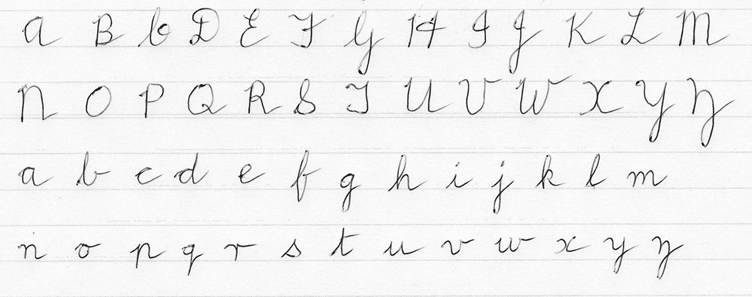
It’s not a misconception. Cursive is a skill acquired in childhood that we then make our own. So it undoubtedly expresses an individual’s personal identity and improves self-esteem, because it allows us to explore and discover our handwriting, our ability to express ourselves graphically, much like we do with our signature.
In this sense, writing in cursive differs from writing in block letters. We use block letters when we need to standardise handwriting. And while we’re on the subject of block letters, I’d like to bust a myth: writing in cursive is not harder to learn than writing in block letters. Joined-up writing actually comes more naturally to children.
There’s tons of research, including this Italian study, showing that the many benefits of cursive I listed earlier do not apply to block letters, especially when it comes to reading and spelling skills.
Does joined-up writing bring positive effects for adults, too?
Adults benefit from writing in cursive, too, of course. For example, it improves concentration and promotes cognitive immersion. It works sort of like active meditation, because the mind is focused on a single concept and making the movement to mark it on the page. And there’s more.
Lots of studies show that adults who take notes in cursive process the information better, which is to say in a deeper way than those who use a keyboard. People who type tend to transcribe literally, whereas those who write by hand have to summarise, reformulate and reconceptualise, thereby absorbing ideas differently.
For adults, cursive also helps long-term memory as well as creativity: the fluid movement of joined-up writing stimulates divergent thinking. And it also regulates emotions and reduces stress by lowering cortisol levels.
Are there any little exercises that you’d recommend for people who want to start handwriting again?
I’d recommend keeping a daily diary, which can also help organise chaotic thoughts by improving self-awareness. To loosen up the fingers and wrist, you can practise by copying out a page from a book that you like or a poem, focusing on the formation of the letters, on the movement, on the slant of the characters. Take your time and don’t rush.
A creative option is lettering exercises, sessions where you practise drawing letters free hand. But you can also use cursive writing for little things in everyday life, such as writing a shopping list or a to-do list on paper rather than a phone. This can also help us take a break from our phones and other devices.
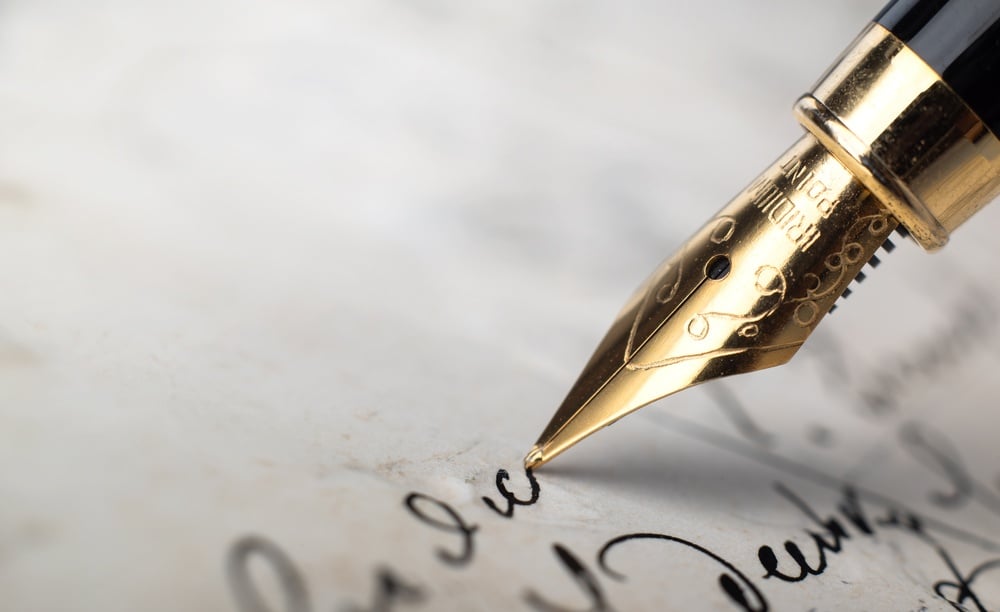
Which brings us to the digital tools that have undoubtedly negatively impacted the use of cursive writing. Do you believe that digital devices and cursive writing are sworn enemies, or can they live together? And if so, how?
Digital technology has impacted the role of cursive writing, but more generally, it has transformed the ways adults and children interact with the written word. It has also reduced opportunities to physically manipulate objects.
Writing with a keyboard activates far fewer areas of the brain than writing in cursive. The physical act of cursive writing involves continuity, joining letters, concentration, focus on the thing we’re doing. Digital writing, however, is fundamentally abstract and strips away some of the components that help us form our thoughts.
Obviously, technology is here to stay and we can’t ignore it. But I believe, and this is backed up by numerous studies, that there’s an age for everything. In the learning phase, writing in cursive helps with brain development, as we’ve already talked about, and most importantly, aids other learning, including the use of technology. For children, prioritising joined-up writing over digital writing is only a benefit.
There’s an international campaign to put cursive writing on the UNESCO List of Intangible Cultural Heritage of Humanity in an attempt to stop it from disappearing. Do you really think there’s a risk of losing this skill completely? And if so, how best can we highlight its value?
I’m well aware of this campaign and I’ve also signed the petition.
When it comes to the risk of cursive writing disappearing, a tipping point came about a decade ago, when the United States removed joined-up writing from their school curricula and replaced it with typing and digital skills. Finland did the same. This sparked a debate in which the studies I’ve cited were much discussed. From then onwards, the trend began to go the other way: in both countries, cursive writing was re-introduced and in Sweden, the government backed away from its hyper-digitalised approach to education.
So at this moment in time, I don’t see a risk of cursive being lost completely. But there’s no doubt that joined-up writing is a skill that’s been hit hard in recent decades and undervalued.
School is where we need to rehabilitate it. For example, in classrooms there persists the misconception that cursive writing is too hard or even impossible for children with learning disabilities. Yet studies show the exact opposite: joined-up writing can help weak students. It all depends on how it’s taught. But the university courses that train tomorrow’s teachers are seriously lacking when it comes to handwriting teaching methodology.
Many thanks to Michela Vandelli for kindly taking the time to speak to us.