


Table of Contents
Most people picture American independence as a public reading: a large crowd, a voice announcing liberty. But what actually carried the news across the thirteen colonies wasn’t a speech. It was a print run.
On the night of July 4, 1776, while Philadelphia slept, one man was bent over a press, setting type by candlelight, racing to turn the words of the Declaration into something that could travel fast, relay-style: inked paper. Two hundred and fifty years later, that printing remains the most overlooked part of the story. This article follows exactly that thread: how printing, in the service of politics, carried American independence from a room in Philadelphia to every corner of a brand-new nation.
The Night of July 4: John Dunlap and the First Printed Declaration
On the afternoon of July 4, 1776, the Second Continental Congress formally approved the text of the Declaration of Independence. That same evening, the approved manuscript was carried a few blocks away to the shop of John Dunlap, an Irish immigrant who held the official printing contract for Congress.
Dunlap worked through the night and into the early hours of July 5, setting the Declaration in type and printing it on single sheets known as broadsides: announcements printed on one side only, designed to be posted publicly, not read in private. The exact number of copies that came off that press isn’t documented. Scholarly estimates range between 200 and 500.
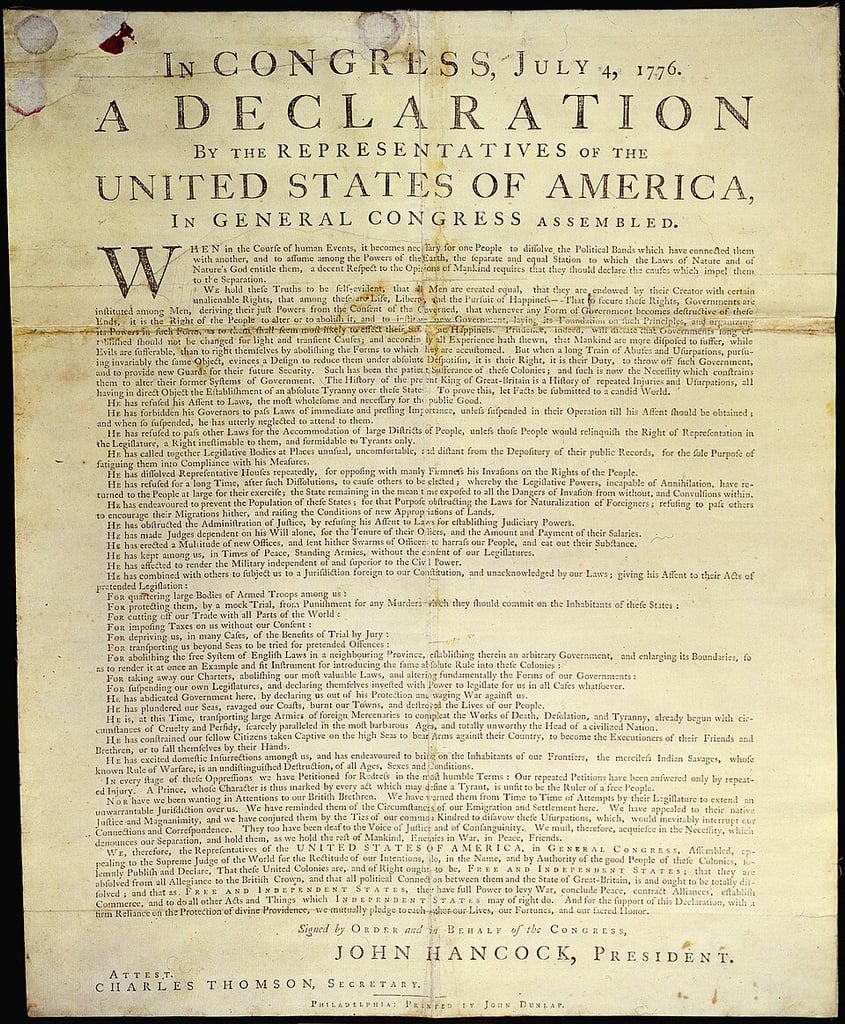
Public domain, National Archives (NAID 301682) via Wikimedia Commons.
These sheets, known today as the Dunlap broadsides, were literally the first physical copies of American independence ever to exist. Of that print run, 26 copies were recorded as surviving in the standard historical census, held across the National Archives, the Library of Congress, university libraries, and private collections.
That count rose to 27 in 2009, when a previously unknown copy was identified in the British national archives at Kew, most likely sent to London by a colonial official in the summer of 1776.
Every subsequent announcement of independence, every newspaper reprint, every public reading in a town square, descends from that very first, very limited print run.
It’s Not the Document You’re Picturing: The Famous Signed Copy Came Later
Here’s the detail that fools almost everyone: the elegant parchment, with its stately calligraphy and prominent signatures, the one that always appears whenever the “Declaration of Independence” comes up, is not what reached the public in 1776.
That version is known as the engrossed copy: a document transcribed by hand on parchment in formal script, intended for preservation and signature, not for distribution. It carries the July 4 date at the top, but Congress didn’t order it to be engrossed until July 19, 1776, and most delegates signed it beginning on August 2, nearly a month after independence had already been declared and printed.
Some of the Founding Fathers, including Thomas Jefferson, John Adams, and Benjamin Franklin, later recalled signing on July 4. Historians are divided on how to reconcile those recollections with the official record: proof that not even eyewitnesses always agree on their own history.
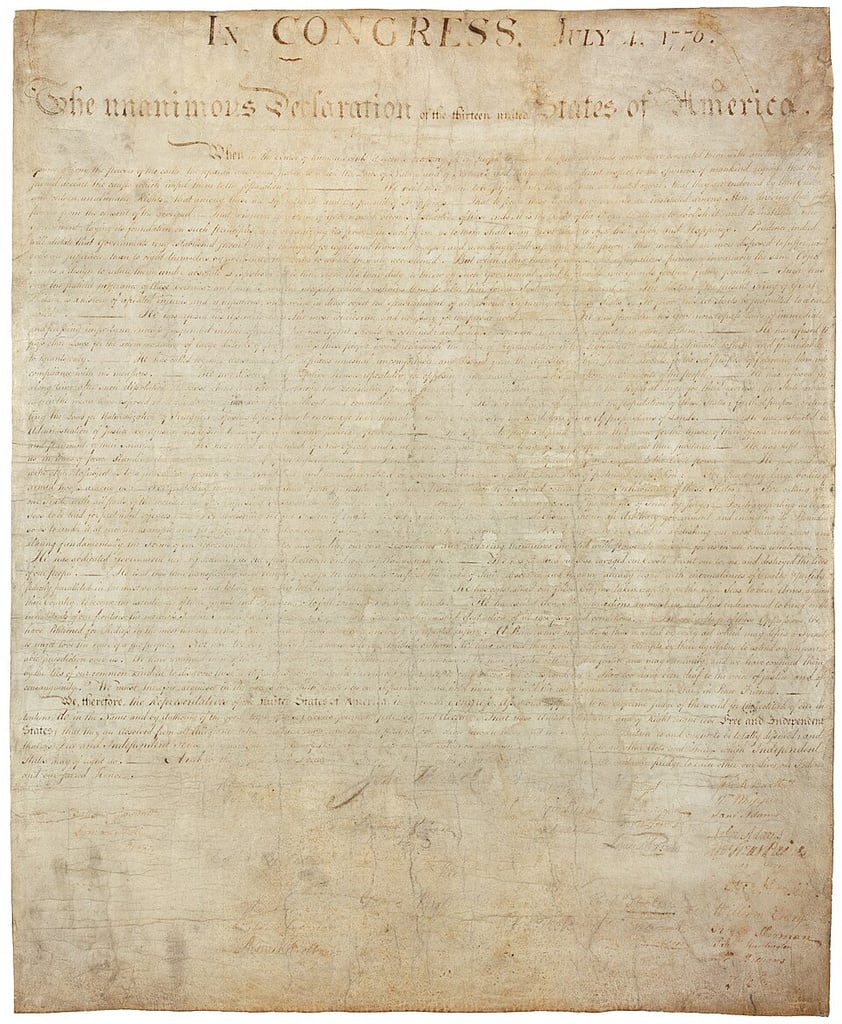
Public domain, National Archives via Wikimedia Commons.
In other words: the document everyone pictures is a later, commemorative artifact. The document that actually did the work of declaring independence to the public, the one that reached ordinary colonists, soldiers, and even enemies abroad, was the sheet printed by Dunlap, not the parchment hand-lettered by Timothy Matlack.
From the Press to the Public Square: How Independence Actually Reached People
Congress’s instructions were precise: copies were to be sent to the committees, the assemblies, and the commanders of the Continental Army, so that independence could be “proclaimed” – read aloud and posted publicly (Library of Congress).
That’s exactly what happened. The broadsides travelled by courier throughout the colonies over the following days and weeks, to be read from courthouse steps, on town greens, and in military camps. In New York, on July 9, a reading before Washington’s troops was followed by the toppling of the equestrian statue of George III at Bowling Green.
One particularly vivid account involves James Forten, born in Philadelphia on September 2, 1766, and destined to become one of the most important African American entrepreneurs and abolitionists of his era. According to the account recorded by his nineteenth-century biographer, Forten, then not quite ten years old, witnessed the public reading of the Declaration in the yard of the Philadelphia State House on July 8, 1776. It’s exactly the kind of scene that overnight print run had been designed to make possible.
In the weeks that followed, the text was picked up by colonial newspapers and by other printers, who multiplied the copies with print runs of their own. By August it had crossed the Atlantic: the Declaration was published in the British press and read in London as a document of final rupture.
In an age without telegraph, radio, or any form of instant communication, print was the only technology capable of carrying the exact same words, unaltered, across an entire continent. We can therefore say that independence was not declared once, but many times over, in many different places across America, week after week, until it had spread throughout the entire territory.
The Flag Before the Flag: From the Grand Union to the Betsy Ross Legend
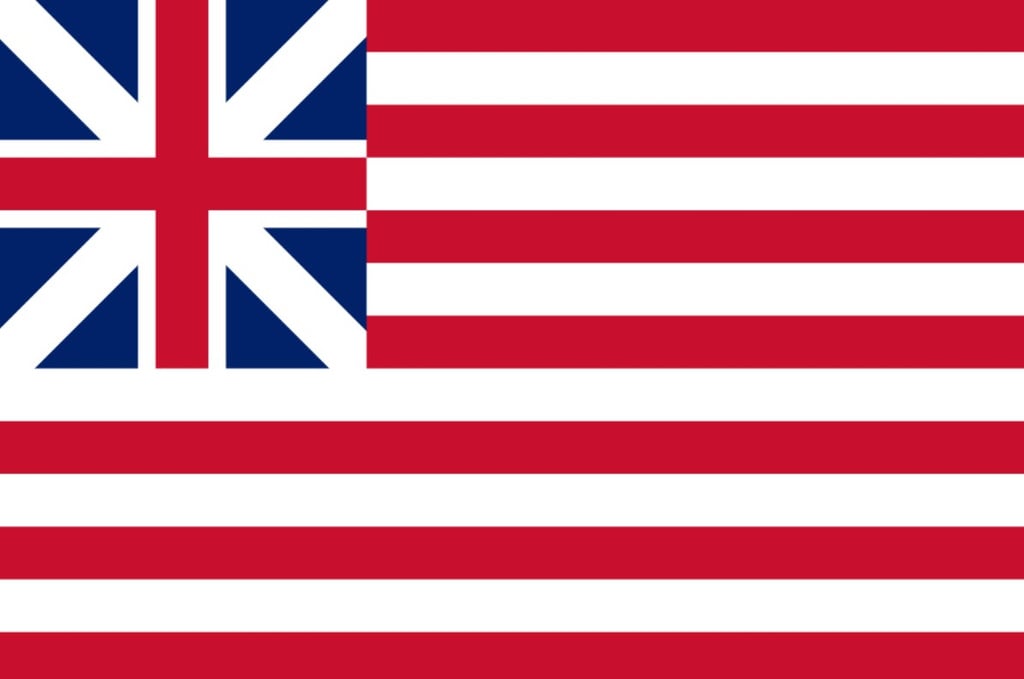
The flag Americans associate with 1776 didn’t exist yet either. The banner flown by Continental forces during that period was the Grand Union Flag (also called the Continental Colors): thirteen red and white stripes, but still bearing the British Union Jack in the canton. A strange hybrid, the perfect symbol of a country still deciding just how far it wanted to separate.
The stars-and-stripes design most people imagine as “the original flag”, thirteen stars arranged in a circle, is popularly credited to Philadelphia upholsterer Betsy Ross, who is said to have sewn it at George Washington’s request.
It’s a lovely story, and it’s almost entirely family tradition: there is no contemporary documentation from 1776 confirming Ross’s involvement. The account first emerged publicly in 1870, when her grandson William Canby presented it in a paper read before the Historical Society of Pennsylvania.
Many historians instead point to Francis Hopkinson, a signer of the Declaration, as the better-documented candidate. In 1780, he submitted a request to the Board of Admiralty for compensation for designing the flag and other public emblems. He was never paid.
🖼️“The Birth of Old Glory”, colour lithograph after a painting by Percy Moran, c. 1917. Public domain, Library of Congress via Wikimedia Commons. https://commons.wikimedia.org/wiki/File:RossBetsy.jpg
The image above deserves a note about what it actually is: not a historical document, but a piece of printed mythology. A popular early twentieth-century lithograph that did an enormous amount to cement the Betsy Ross story in the American imagination. A useful reminder that print doesn’t just record history – sometimes it helps create it.The flag design was made official by Congress with the Flag Resolution of June 14, 1777, a date now celebrated as Flag Day, and the Flag Act of 1818 later fixed the number of stripes permanently at thirteen, establishing the rule still in force today: the stripes stay fixed, the stars are added.
From 13 to 50 Stars: A Design Redrawn Again and Again
Every time a new state joined the Union, the flag’s canton had to be redesigned and reprinted, on fabric, government documents, public notices, and campaign material, making the flag one of the most frequently revised pieces of graphic design in American history.
Between 1777 and 1960 there were twenty-seven official versions.
The most famous of those redesigns has a genuinely charming origin story, though one that should be treated with some caution. In 1958, Ohio high school student Robert Heft created a 50-star design as a class project, anticipating the admission of Alaska and Hawaii to the Union.
According to the account Heft repeated for decades, his teacher awarded him a B-minus and challenged him to get the design adopted in Washington before reconsidering the grade. The anecdote has never been independently verified and survives largely through Heft’s own retelling.
What is certain is the outcome: the 50-star flag officially took effect on July 4, 1960, under Executive Order 10834, signed by President Dwight D. Eisenhower.
It remains the longest-serving flag design in United States history.
Quick Facts
- The number of Dunlap broadsides printed on the night of July 4-5, 1776, is not documented. Scholarly estimates range from 200 to 500 copies. Twenty-seven are known to survive, with the most recent identified in the British archives in 2009.
- The famous signed parchment most people associate with the Declaration of Independence was signed by the majority of delegates only from August 2, 1776 onwards, almost a month after Dunlap’s print run.
- The Betsy Ross flag story was not publicly recorded until 1870, nearly a century after the events it describes.
- The 50-star flag has remained in continuous use since July 4, 1960, longer than any other official flag design in U.S. history.
Frequently Asked Questions
Was the Declaration of Independence signed on July 4, 1776?
Not by most delegates.
The text was approved on July 4, 1776, but Congress ordered it to be engrossed on parchment on July 19. Most of the fifty-six delegates signed beginning on August 2, 1776.
The first version seen by the public was the broadside printed by John Dunlap, not the signed parchment now preserved by the National Archives.
How many copies of the original printing of the Declaration still exist?
The standard historical census counted twenty-six surviving copies.
In 2009, the total rose to twenty-seven following the identification of another copy in the British national archives at Kew.
Most surviving examples are held by public institutions, universities, and private collections.
Did Betsy Ross really design the American flag?
There is no contemporary evidence from 1776 confirming that she did.
The story derives from a family tradition first made public by her grandson William Canby in 1870.
Many historians regard Francis Hopkinson as the better-documented candidate, based on the compensation request he submitted to the Board of Admiralty in 1780.
Why does the flag still have only thirteen stripes?
The Flag Act of 1818 permanently fixed the number of stripes at thirteen in honour of the original colonies.The same legislation provided that each new state admitted to the Union would be represented by an additional star, leaving the number of stripes unchanged.
Sources
- National Archives (U.S.) — The Dunlap Broadside
https://www.archives.gov/dc/highlights/dunlap-broadside - National Archives (U.S.) — Declaration of Independence: A History
https://www.archives.gov/founding-docs/declaration-history - National Archives (U.S.) — Executive Order 10834 (Flag of the United States)
https://www.archives.gov/federal-register/codification/executive-order/10834.html - Library of Congress — Today in History: July 4
https://www.loc.gov/item/today-in-history/july-04/ - Library of Congress — The Declaration of Independence (Continental Congress Collection)
https://www.loc.gov/collections/continental-congress-and-constitutional-convention-from-1774-to-1789/articles-and-essays/declaration-of-independence/ - Library of Congress — Journals of the Continental Congress, resolution of July 19, 1776
https://memory.loc.gov/cgi-bin/ampage?collId=lljc&fileName=005/lljc005.db&recNum=528 - The National Archives (UK) — Rare Copy of the American Declaration of Independence Found at The National Archives
https://www.nationalarchives.gov.uk/about/news/rare-copy-of-the-american-declaration-of-independence-found-at-the-national-archives/ - British Library — Declaration of Independence
https://www.bl.uk/collection-items/declaration-of-independence - Smithsonian National Museum of American History — Grand Union Flag
https://americanhistory.si.edu/collections/object/nmah_435300 - Smithsonian National Museum of American History — The Star-Spangled Banner Collection
https://americanhistory.si.edu/collections/object-groups/the-star-spangled-banner - U.S. Senate — Francis Hopkinson and the American Flag
https://www.senate.gov/artandhistory/history/common/generic/Flag_FrancisHopkinson.htm - U.S. Senate — Flag Day
https://www.senate.gov/artandhistory/history/minute/Flag_Day.htm - U.S. Senate — The Stars and Stripes
https://www.senate.gov/artandhistory/history/minute/The_Stars_and_Stripes.htm - National Park Service — James Forten
https://www.nps.gov/people/james-forten.htm - Historical Society of Pennsylvania — Betsy Ross and the American Flag
https://hsp.org/history-online/exhibits/pennsylvania-tapestry/betsy-ross-and-the-american-flag - Museum of the American Revolution — Betsy Ross and the Making of America
https://www.americanrevolutionmuseum.org/read-the-revolution/review/betsy-ross-and-the-making-of-america/