


Table of Contents
When it comes to packaging, most of the attention tends to focus on design, graphics and materials. However, there’s another aspect that’s just as important: box assembly. A correctly assembled box protects the product, reduces the risk of damage during transport and makes packing operations more efficient.
Whether you’re preparing e-commerce orders, retail packaging or logistics shipments, choosing the right box and understanding its assembly system can have a direct impact on time, costs and the customer experience. In recent years, increasingly practical and time-saving solutions have emerged, such as self-locking boxes, designed to simplify packing without compromising on strength or reliability.
But what are the main types of cardboard boxes? How do you assemble a cardboard box correctly? And which solutions help save time without compromising the protection of the contents?
In this guide, we’ll explore the main box types, the most common assembly techniques and the key factors to consider when choosing the right solution for your needs.
What is box assembly and why is it important?
Box assembly is the process of transforming a flat die-cut blank into a three-dimensional package ready to hold a product. Although it may seem like a straightforward task, it directly affects the strength of the packaging, the speed of packing operations and the overall customer experience.
A correctly assembled box maintains its structural rigidity, distributes the weight of its contents more evenly and reduces the risk of accidental opening or deformation during handling and transport.
By contrast, poor assembly can compromise the stability of the packaging, increase the likelihood of product damage and slow down order fulfilment.
Protecting the contents
The primary purpose of any box is to protect its contents.
A properly assembled structure absorbs impacts more effectively, keeps the product securely in place during transport and helps minimise the risk of knocks, crushing or accidental opening.
This becomes particularly important in e-commerce, where every parcel passes through multiple handling and distribution stages before reaching the customer.
Operational efficiency
Box assembly also has a direct impact on productivity.
If assembling a single box takes just a few extra seconds, the difference may seem negligible. However, when you’re packing hundreds or even thousands of orders each day, those seconds quickly add up to hours of additional work.
That’s why many businesses choose packaging solutions specifically designed to speed up packing operations while reducing the likelihood of errors.
Customer experience
Packaging represents the first physical interaction between the customer and the product.
A well-assembled box conveys care, professionalism and attention to detail, while a damaged or poorly closed package can create a negative impression of the brand before the product has even been used.
For this reason, box assembly is an integral part of the unboxing experience, helping to enhance both the product and the brand itself.
How a box is made: from die-cut blank to finished packaging
To fully understand how a box is assembled, it’s useful to know how it’s manufactured.
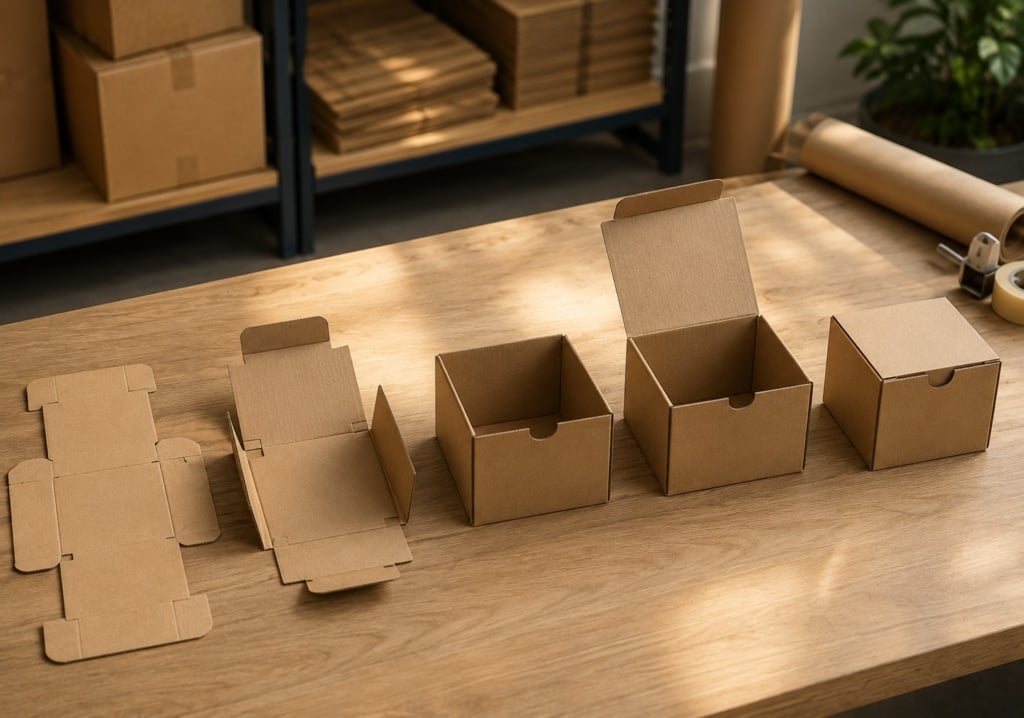
Most cardboard boxes are produced from a die-cut blank—a flat sheet containing all the cut lines and crease lines needed to create the finished package.
When it leaves the production line, the box is completely flat. This allows it to be transported and stored efficiently, optimising warehouse space and reducing shipping volumes.
The box only takes its final shape when it’s folded along the pre-scored crease lines during assembly.
Crease lines guide the folding of the cardboard without damaging its structure, while tabs, flaps and locking systems enable the box to be assembled accurately and securely.
Before exploring the different types of boxes available, it’s useful to understand the main elements that make up a die-cut blank.
| Element | Function |
| Cut line | Defines the shape of the box. |
| Crease line | Guides the cardboard fold without damaging the material. |
| Tab | Allows different sections of the box to lock or close together. |
| Closing flap | Seals the top or bottom of the box. |
| Base | Supports the weight of the contents. |
| Lid | Protects the product and completes the packaging. |
The assembly process simply involves following these predefined folds to transform the flat blank into a sturdy three-dimensional structure.
The complexity of assembly depends on the type of box. Some designs require only a few folds and a simple locking mechanism, while others involve additional steps or the use of packing tape.
Understanding these differences is the first step towards choosing the right packaging solution, particularly when packing speed and operational efficiency are key priorities.
The main types of boxes and their assembly systems
Not all boxes are designed in the same way. Depending on their intended use, they can differ in structure, closing system, level of protection and, of course, assembly complexity.
Choosing the right model means finding the best balance between practicality, strength, cost and user experience. That’s why it’s important to understand the main types of boxes available and the situations they’re best suited to.
The table below provides an overview of their key characteristics.
| Box type | Ease of assembly | Packing tape required | Typical use |
| Regular Slotted Container (RSC) | Medium | Yes | Shipping, logistics and e-commerce |
| Self-locking box | Very high | Generally no | E-commerce, retail and customised packaging |
| Briefcase-style box | High | No | Promotional kits, catalogues and sample packs |
| Drawer box | Medium | No | Cosmetics, luxury products and premium packaging |
| Two-piece box (base and lid) | High | No | Gift boxes and premium products |
| Locking tab box | High | No | Retail and customised packaging |
Let’s take a closer look at each type.
Regular Slotted Container (RSC): the industry standard for shipping
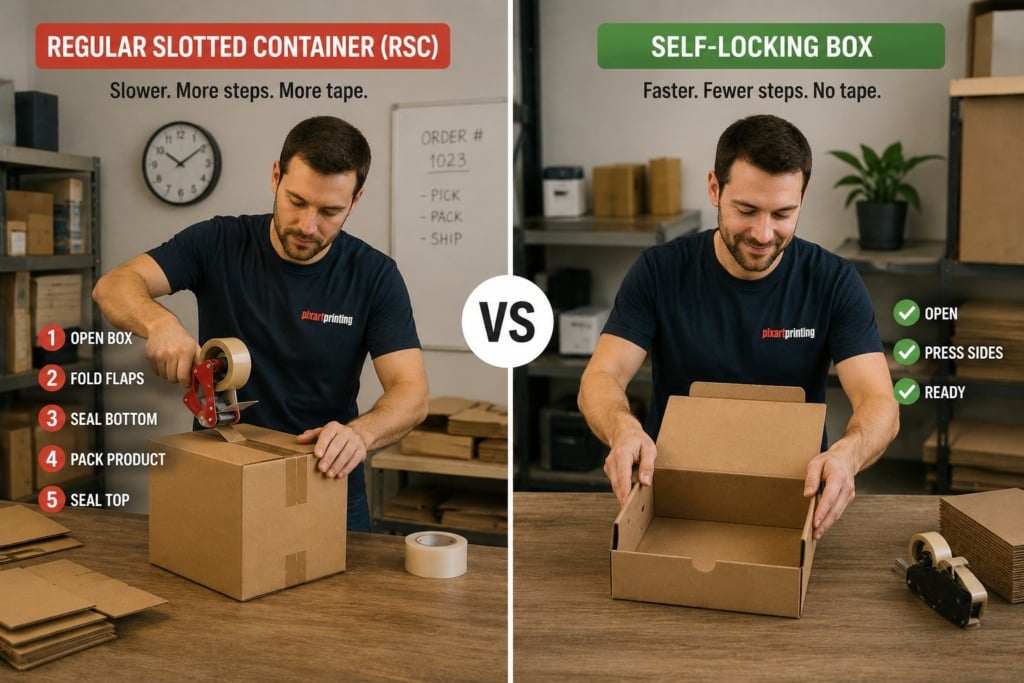
The Regular Slotted Container (RSC)—commonly known as the standard shipping box—is the most widely used cardboard box worldwide. It features four side panels and top and bottom flaps that are sealed with packing tape.
Its popularity comes from its versatility: it’s available in a wide range of sizes, provides excellent protection and is suitable for almost any type of shipment.
How to assemble an RSC box
Assembly is straightforward:
- open the flat-packed box;
- fold up the side panels;
- close the bottom flaps;
- seal the base with packing tape;
- place the product inside;
- close and seal the top flaps.
Although it’s a highly reliable solution, it requires several manual steps, which can affect packing times when handling large volumes of orders.
Two-piece boxes
These boxes consist of two separate components: a base and a lid that fits neatly over it.
They’re commonly used for premium products, gift packaging, luxury goods and any application where presentation plays an important role.
Assembly is generally simple, although working with two separate pieces makes the packing process slightly slower than with single-piece designs.
Briefcase-style boxes
Briefcase-style boxes feature a front-opening design with an integrated closing system, making them practical and easy to use.
They’re widely used for:
- corporate kits;
- catalogues;
- sample packs;
- welcome packs;
- promotional products.
They usually assemble using tabs and locking mechanisms, eliminating the need for packing tape.
Drawer boxes
Drawer boxes consist of an outer sleeve and an inner sliding tray.
This design creates a premium unboxing experience and is particularly popular for cosmetics, jewellery and luxury packaging.
Although the structure is more sophisticated, modern die-cutting techniques make assembly relatively straightforward.
Locking tab boxes
Locking tab boxes use specially designed tabs and slots that allow the structure to lock together without glue or packing tape.
Their main advantages include:
- faster assembly;
- reduced use of additional materials;
- improved recyclability;
- a cleaner, more professional finish.
For these reasons, they’re becoming increasingly popular in retail and customised packaging.
Self-locking boxes: the fastest assembly solution
In recent years, self-locking boxes have become one of the most popular packaging solutions.
Their success comes down to one key advantage: minimising the number of steps needed to transform a flat die-cut blank into a fully assembled box.
The base is designed to lock automatically as the box is opened. A simple push on the side panels activates the locking mechanism, removing the need to fold and secure each bottom flap manually.
This significantly speeds up the packing process while maintaining a strong and reliable structure.
Why choose a self-locking box?
Self-locking boxes are particularly beneficial when large numbers of parcels need to be packed quickly.
Their main advantages include:
- fast, intuitive assembly;
- fewer assembly errors;
- little or no packing tape required;
- more consistent packaging;
- improved productivity.
That’s why they’re increasingly used by e-commerce businesses, manufacturers, online retailers and companies handling high shipping volumes.
How much time can they save?
The difference becomes clear when comparing assembly times across different box designs.
| Box type | Average assembly time |
| Self-locking box | 3–5 seconds |
| Locking tab box | 10–15 seconds |
| Regular Slotted Container (RSC) | 20–40 seconds |
| Complex premium box | 30–90 seconds |
Actual assembly times vary depending on the box size and the operator’s experience, but the comparison clearly shows how a design optimised for fast assembly can improve overall packing efficiency.
For businesses looking to combine speed, practicality and customisation, Pixartprinting’s custom self-locking boxes offer an excellent solution. Thanks to their integrated locking systems and extensive customisation options, they help streamline packing operations while reinforcing brand identity.
RSC or self-locking box?
When choosing a packaging solution, this is one of the most common comparisons.
Both options offer excellent protection, but they’re designed for different needs.
| Feature | Regular Slotted Container (RSC) | Self-locking box |
| Assembly time | Medium | Very fast |
| Packing tape required | Yes | Generally no |
| Ease of assembly | Good | Excellent |
| Productivity | Good | Excellent |
| Best suited for | General shipping | E-commerce and high-volume packing |
| Customisation | High | High |
The Regular Slotted Container (RSC) remains one of the most versatile solutions, particularly when shipping products in a wide variety of sizes. Self-locking boxes, on the other hand, provide a clear advantage whenever speed, consistency and packing efficiency are priorities.
Now that we’ve explored the main types of cardboard boxes, it’s time to look at the practical side of the process: how to assemble a cardboard box correctly, avoid common mistakes and create secure, professional-looking packaging.
How to assemble a cardboard box: step-by-step guide
Although every box type has its own characteristics, there are a number of best practices that apply in most situations. Following them will help you assemble boxes more quickly, reduce mistakes and create sturdier, more reliable packaging.
1. Check the die-cut blank before you start
Before folding the cardboard, take a few moments to examine the die-cut blank.
Identifying the crease lines, tabs and locking systems will help you understand the correct assembly sequence and prevent you from forcing the material in the wrong direction.
In most cases, the fold lines are specifically designed to guide the assembly process while preserving the strength of the cardboard.
2. Pre-fold the crease lines
One simple step can make assembly much easier: gently pre-fold all the crease lines before putting the box together.
This helps to:
- make folding easier;
- create cleaner, more accurate corners;
- reduce the risk of deformation;
- speed up the remaining assembly stages.
It’s often overlooked, but it’s particularly useful when assembling large numbers of boxes.
3. Form the box structure
Once the folds have been prepared, raise the side panels until the box takes on its three-dimensional shape.
At this stage, check that all the corners are properly aligned and that the cardboard isn’t under unnecessary tension.
A well-formed structure is essential for creating strong and stable packaging.
4. Assemble the base
The assembly method depends on the type of box.
- Regular Slotted Containers (RSCs): fold the bottom flaps and seal them with packing tape.
- Locking tab boxes: insert the tabs into the corresponding slots until they’re fully secured.
- Self-locking boxes: the base locks into place automatically as the box is opened and only requires a quick final check.
Whatever the system, make sure the base is fully secure before placing the product inside.
5. Pack the product
Once the box has been assembled, you can place the product inside.
For fragile items, it’s advisable to use protective materials such as packing paper, honeycomb cardboard or cushioning fillers to minimise movement during transport.
Choosing the right box size and combining it with suitable internal protection helps reduce the risk of damage.
6. Close the box
The final stage is sealing the package.
Depending on the design, the box may feature:
- locking tabs;
- self-locking flaps;
- adhesive closures;
- magnetic closures;
- packing tape.
Before dispatch, it’s good practice to check that the box is fully closed and that it maintains its shape without distortion.
The most common box assembly mistakes
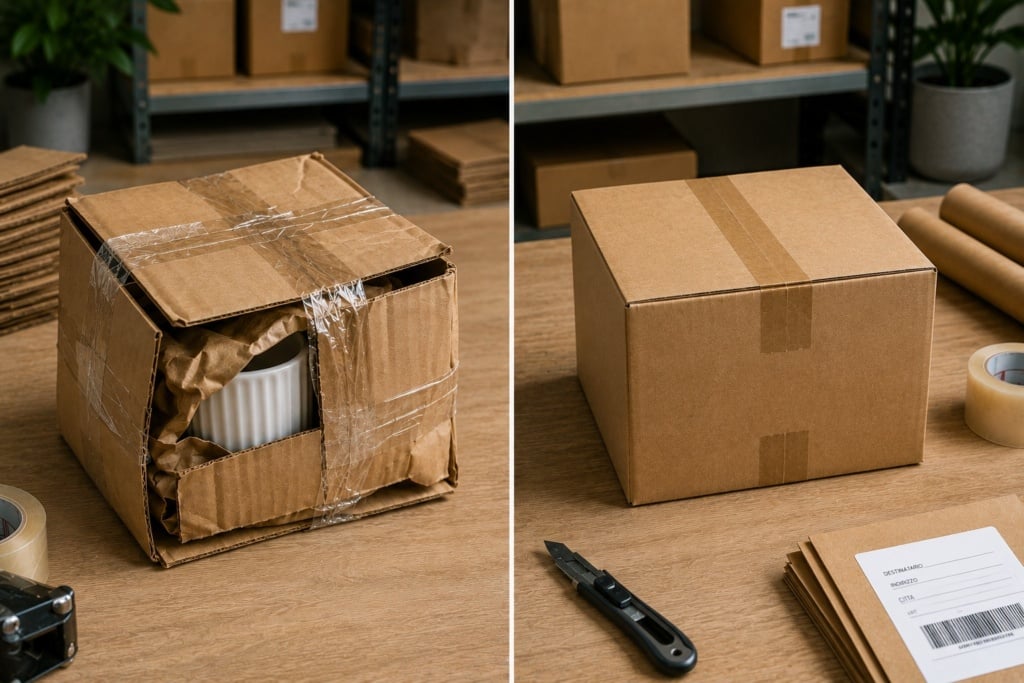
Even a high-quality box can fail to perform properly if it’s assembled incorrectly. The most common mistakes are easy to avoid, but they can compromise product protection and slow down packing operations.
Folding the cardboard in the wrong direction
Crease lines are designed to fold in a specific direction. Folding the cardboard the wrong way can cause cracking, deformation or a reduction in structural strength.
Failing to secure the locking tabs
With locking tab boxes, it’s essential to ensure that every tab is fully engaged.
If the locking system isn’t properly secured, the box may open accidentally during handling or transport.
Choosing a box that’s too large
Using an oversized box usually means more protective material is needed and allows the product to move around inside the package.
Where possible, choose a box that’s appropriately sized for the item being shipped.
Overloading the box
Every box is designed to support a specific weight. Exceeding that limit can cause the base to collapse or the structure to deform, reducing the level of protection.
Skipping the final inspection
Before shipping, it’s worth checking that:
- the base is securely closed;
- all locking tabs are fully engaged;
- the box maintains a regular shape;
- the product is stable inside the package.
These checks only take a few seconds but can prevent many problems during transit.
The table below summarises the most common assembly mistakes and their possible consequences.
| Mistake | Possible consequence |
| Folding in the wrong direction | Structural deformation |
| Locking tabs not fully engaged | Box opening during transit |
| Oversized box | Increased product movement |
| Overloading the box | Base collapse |
| Poorly sealed closure | Reduced protection during transport |
Why are some boxes easier to assemble than others?
Ease of assembly doesn’t depend solely on the experience of the person packing the product—it also depends on the design of the box itself.
Behind every well-designed package is careful engineering of the die-cut blank, crease lines and locking systems. The goal is to minimise the number of assembly steps without compromising structural strength.
Self-locking boxes are one of the clearest examples of this approach. Thanks to their automatically locking base and reduced number of manual operations, they allow products to be packed much more quickly than traditional box designs.
Of course, ease of assembly shouldn’t be the only factor when choosing a box. It’s also important to consider the type of product, the level of protection required, shipping frequency and the customer experience you want to deliver.
In the next section, we’ll look at how to choose the right box for different applications and explore the solutions that can make your packing process even more efficient.
Choosing the right box for your application
There’s no single box that’s suitable for every purpose. The right choice depends on several factors, including the type of product, its weight, how fragile it is, how frequently it’s shipped and the experience you want to create for your customers.
Considering these factors before selecting your packaging helps improve packing efficiency, reduce waste and provide better protection for your products.
Boxes for e-commerce
In e-commerce, speed is everything.
When you’re preparing dozens or even hundreds of orders every day, using boxes that are quick and easy to assemble can significantly reduce packing times and help standardise your packing process.
Self-locking boxes are an excellent choice because they simplify assembly, minimise the need for additional packing materials and create neat, professional-looking parcels.
Boxes for fragile products
Glassware, electronics, ceramics and collectables all require extra care.
In these cases, it’s essential to choose a box that’s strong enough for the job and combine it with suitable protective materials, such as packing paper, honeycomb cardboard or void fill, to prevent the contents from moving during transport.
Correct box assembly also plays an important role in ensuring the package remains stable throughout its journey.
Boxes for retail and premium packaging
In retail, packaging does much more than simply protect the product.
A well-designed box helps strengthen brand identity while enhancing the customer’s purchasing experience.
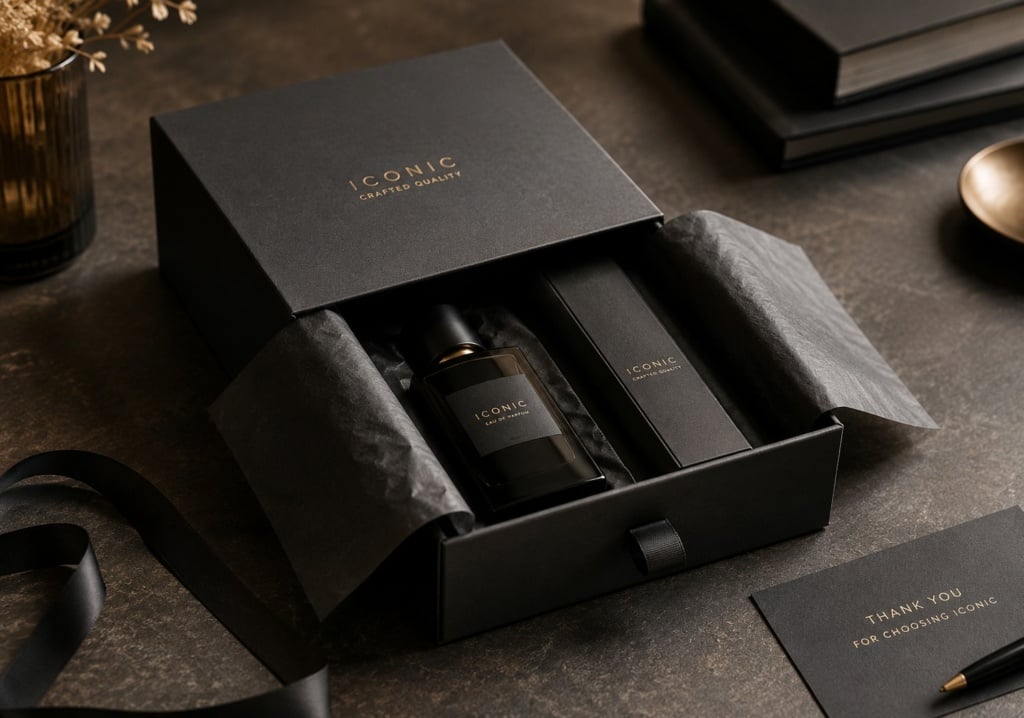
That’s why businesses often choose drawer boxes, two-piece boxes, briefcase-style boxes or other premium packaging solutions featuring refined opening systems and high-quality finishes.
Although these designs may require a little more time to assemble, they create a stronger visual impact and add value to the product inside.
Boxes for events, exhibitions and promotional kits
Sample packs, press kits, welcome packs and promotional materials often need to be prepared in large quantities within tight deadlines.
For these applications, locking tab boxes and self-locking boxes are particularly practical because they allow large numbers of packages to be assembled quickly while maintaining a professional appearance.
In summary, different applications call for different types of packaging.
| Application | Recommended box type |
| E-commerce | Self-locking box |
| Fragile products | Reinforced RSC or self-locking box with protective inserts |
| Cosmetics and luxury goods | Drawer box |
| Clothing and fashion accessories | Self-locking or briefcase-style box |
| Corporate kits and sample packs | Briefcase-style box |
| Gift packaging | Two-piece box (base and lid) |
How to speed up box assembly
As packing volumes increase, even small improvements can lead to significant time savings.
There are several simple ways to make your packing process more efficient without changing your overall workflow.
Standardise box sizes
Working with a limited number of box sizes simplifies warehouse operations and speeds up packing.
It also reduces the likelihood of choosing the wrong box for a particular order.
Organise your packing station
A well-organised packing area helps operators work more efficiently.
Boxes, protective materials, labels and sealing supplies should always be within easy reach to avoid unnecessary interruptions during order preparation.
Choose boxes designed for fast assembly
The design of a box has a direct impact on assembly time.
For example, Pixartprinting’s custom self-locking boxes are designed to minimise the number of assembly steps required while offering complete freedom to customise the packaging with your own graphics.
Establish clear packing procedures
When several people are involved in packing orders, consistent procedures help improve quality and reduce mistakes.
Even a short training session on correct assembly techniques can have a positive impact on productivity.
Box assembly and sustainability
The sustainability of packaging depends not only on the materials used, but also on how the box is designed and assembled.
Choosing the right box size helps reduce the amount of protective material required, optimise transport space and minimise waste.
Similarly, selecting designs that require less packing tape or fewer additional materials contributes to a more efficient packing process.
The future of box assembly
The packaging industry continues to evolve in response to changing business needs and customer expectations.
Today’s packaging needs to be easy to assemble, durable, sustainable and capable of enhancing the product itself. At the same time, it must integrate seamlessly into increasingly fast and automated logistics processes.
Self-locking boxes are one of the clearest examples of this evolution. They simplify packing, improve operational efficiency and help deliver a more refined unboxing experience.
As new materials, smarter locking systems and increasingly efficient packaging solutions continue to emerge, box assembly is likely to become even faster, simpler and more efficient in the years ahead.
Frequently asked questions about box assembly
How long does it take to assemble a box?
It depends on the type of box. A self-locking box can be assembled in just a few seconds, whereas a Regular Slotted Container (RSC) usually takes longer because the bottom flaps need to be folded and sealed with packing tape. Boxes with more sophisticated closing systems may require a few additional assembly steps.
Which type of box is the easiest to assemble?
In general, self-locking boxes are the quickest and easiest to assemble. Their base locks automatically into place as the box is opened, reducing the number of manual operations and speeding up the packing process.
Do you always need packing tape?
No. Many modern box designs feature locking systems or automatic bases that eliminate the need for packing tape during assembly. Traditional RSC boxes, however, generally require tape to secure both the bottom and top flaps.
Are self-locking boxes strong enough for shipping?
Yes. When manufactured from suitable materials and assembled correctly, self-locking boxes provide a level of protection comparable to many traditional shipping boxes. Their strength depends primarily on the quality of the cardboard, the structural design and the weight of the product being packed.
How do you choose the right box?
The right choice depends on four main factors:
- the size of the product;
- its weight;
- the level of protection required;
- how frequently it will be shipped.
If you’re packing large numbers of orders every day, choosing a box that’s quick and easy to assemble can significantly improve efficiency.
Does a larger box provide better protection?
Not necessarily. An oversized box allows the product to move around more during transit and usually requires additional protective materials. Whenever possible, it’s best to choose a box that’s appropriately sized for the item being shipped.
What are the most common box assembly mistakes?
The most common mistakes include:
- folding the cardboard in the wrong direction;
- failing to secure the locking tabs properly;
- choosing a box that’s too large;
- overloading the box;
- skipping the final inspection before dispatch.
Although these may seem like minor oversights, they can compromise the stability of the packaging and increase the risk of damage during transport.
Are custom boxes more difficult to assemble?
No. Custom printing has no impact on how easy a box is to assemble. A custom box can incorporate exactly the same locking and assembly systems as a standard box while offering the added benefit of fully personalised graphics.
Conclusions: the right box for every product… properly assembled
Box assembly is a fundamental part of effective packaging. It affects product protection, operational efficiency and the way customers perceive your brand. A correctly assembled box helps reduce the risk of damage while making packing operations faster and more reliable.
Choosing the right box design makes all the difference. Traditional Regular Slotted Containers remain a versatile and dependable solution, while modern locking systems and self-locking boxes allow businesses to assemble packaging much more quickly.
For companies that ship products regularly or want to streamline their packing process, solutions such as Pixartprinting’s custom self-locking boxes offer an excellent balance of speed, practicality and customisation.
As logistics, sustainability and customer experience become increasingly important, choosing the right box means investing in packaging that’s more efficient, professional and fit for today’s business needs.