


Table of Contents
Dr. Strangelove is one of those films that everyone has heard of. Stanley Kubrick’s celebrated black comedy about the Cold War undoubtedly produced some of the most iconic images in cinema, like the eccentric German scientist with a ‘nostalgic’ arm, played by Peter Sellers, and the unforgettable pilot who rides an atomic bomb like a Texan cowboy!
However, when you look at the film’s renowned poster – which the author of this article has to admit is still on the wall of his old teenage room – through modern eyes, you can’t help but notice another detail. The film has a subtitle: ‘or: how i learned to stop worrying and love the bomb‘.
This outlandish sentence, printed on the poster with each word on a new line, seems like a perfect description of the modern world – proof of the cinematic genius of Stanley Kubrick, who observed what was happening around him, understood the human psyche and predicted what would happen in the future. And the film’s power was also amplified by this highly original poster that is now considered one of the top satirical images of the Cold War.
As you can see, we’ve got plenty of material to be going on with… so without further ado, while we try to ‘stop worrying and love the bomb’, let’s unpack the story behind the poster for Stanley Kubrick’s Dr. Strangelove!
Dr. Strangelove: a milestone in black comedy
Dr. Strangelove was Stanley Kubrick’s seventh film. It was released in 1964 – in the midst of the Cold War and only two years after the Cuban Missile Crisis, one of the moments when the world came closest to nuclear war – following the success of the American director’s only other comedy, Lolita.
And it is certainly a comedy, albeit a rather bitter and dark one! The plot of Dr. Strangelove narrates a US nuclear strike on the Soviet Union provoked by the madness of an American general – an early example of a conspiracy theorist – and describes a chain of absurd yet plausible events in a world dominated by the rules of war.
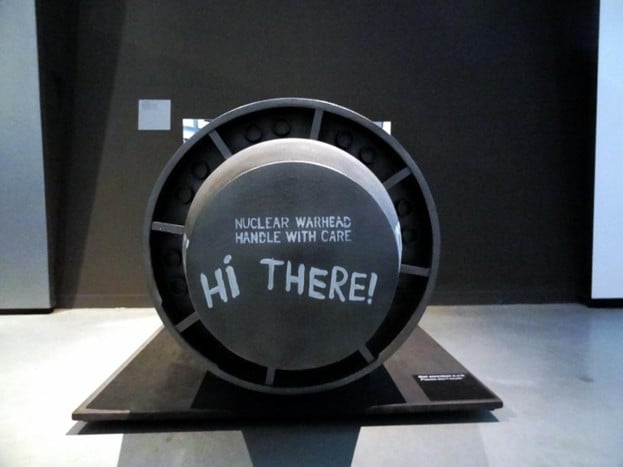
It’s so realistic, all you can do is laugh: indeed, Dr. Strangelove is considered one of the best comedies ever produced for the big screen. A satirical, bordering on farcical, comedy that was brave enough to poke fun at something that was terrorising society at the time, and indeed continues to do so: the possibility of the global superpowers engaging in nuclear war.
Kubrick therefore called on a specialist in political and social satire, Tomi Ungerer, to create the film poster, with legendary results.
Tomi Ungerer’s poster for Dr. Strangelove
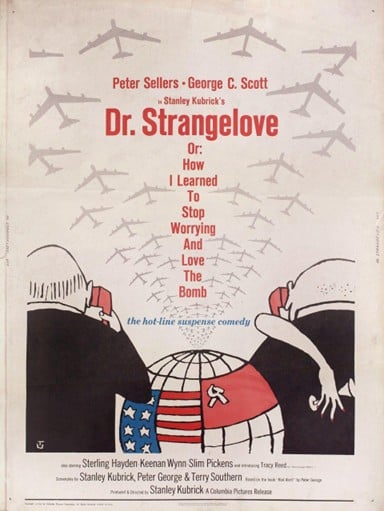
The official poster for Dr. Strangelove matches the film’s satirical intent. It shows the leaders of the USA and the USSR from behind while on the phone, attempting to avert the ongoing nuclear disaster.
You can also glimpse a woman’s arms around one of the two heads of state’s necks. And this is no minor detail: sex and a male chauvinist mentality are presented as going hand in hand with power throughout the film, including in the incredible finale where – in a world destined for nuclear apocalypse– the leaders of the two warring countries, knowing they themselves will be safe, imagine a polygamous future as a way to repopulate the Earth.
War planes fly in the poster’s background, one of which, piloted by the Texan Major Kong, stars in one of the most hilarious yet troubling scenes in the whole film!
Now let’s take a closer look at the poster’s designer: Tomi Ungerer, the French master illustrator, graphic designer and children’s book author.
Tomi Ungerer: the pacifist illustrator born under Nazism in Alsace
An interview with Ungerer offers a hint of what the relationship was like between the meticulous Stanley Kubrick and the multitalented artist. Ungerer describes how he was put in charge of both the poster and all the promotional materials for Dr. Strangelove: ‘[Kubrick was] a fine man – and modest too. A good person. He always had a book and would write down everything you said – the same way I do. Very meticulous’.
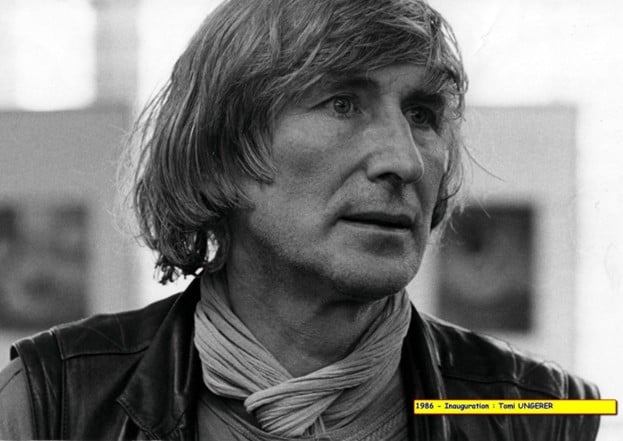
Kubrick tended to put a lot of thought into choosing his poster designers, and his choice for Dr. Strangelove was incredibly apt. Tomi Ungerer had moved to New York, Kubrick’s hometown, in 1956. Here, in the 1960s, he took advantage of the boom in illustrated magazines, which did particularly well in the USA’s cultural capital. But Kubrick’s decision to hire the French illustrator was certainly not just based on his geographical proximity.
It is well known that the American director was particularly interested in the themes of violence, institutionalised violence and power (they were also the focus of other films of his, including A Clockwork Orange and Full Metal Jacket). And Ungerer was very sensitive to these topics too, in part due to his life story.
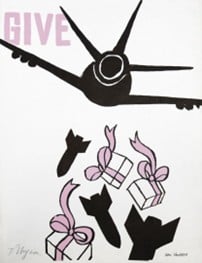
Born in Alsace in 1931 [you can visit a museum dedicated to him in Strasbourg, as we described here], at the age of eight the young Tomi experienced first-hand the Nazi occupation of his homeland, Hitler’s propaganda, and the spiral of violence that led to the war.
All these things left a deep impression on him that lasted for the rest of his life, and which can be seen in some of the darker elements of his drawings – in everything from his children’s illustrations to his political satire. Tomi Ungerer was almost unmatched in his versatility: as well as a top illustrator, he also drew cartoons, designed powerful posters against the war in Vietnam and even produced books of erotica.
Other Dr. Strangelove posters
In addition to Tomi Ungerer’s iconic design, there are some interesting alternative Dr. Strangelove posters that give us an opportunity to talk a bit more about this incredible film.
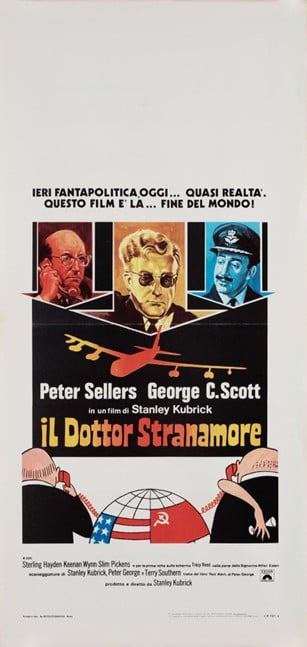
One of these is the Italian poster, which as well as Ungerer’s illustration also includes three characters from the film (known as il Dottor Stranamore in Italian)… all played by the same actor! In Kubrick’s masterpiece, the British actor Peter Sellers – famous among other things for playing Inspector Clouseau in The Pink Panther – put his role-switching abilities to the test by portraying three very different characters: the Royal Air Force general Lionel Mandrake, the president of the United States Merkin Muffley and, of course, the iconic Dr. Strangelove himself.
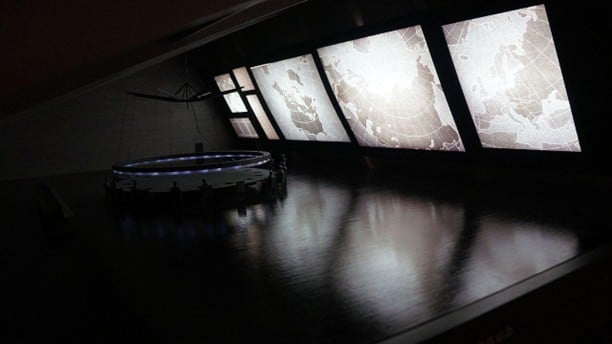
Another interesting poster focuses on the now legendary War Room, the operations centre where a substantial amount of the film is set, and where Peter Sellers improvised part of his performance!
The War Room is so engrained in the public imagination that apparently when Ronald Reagan was elected president in the 1980s, he asked White House staff to show him the famous operations centre… only to discover that it was invented for the film!
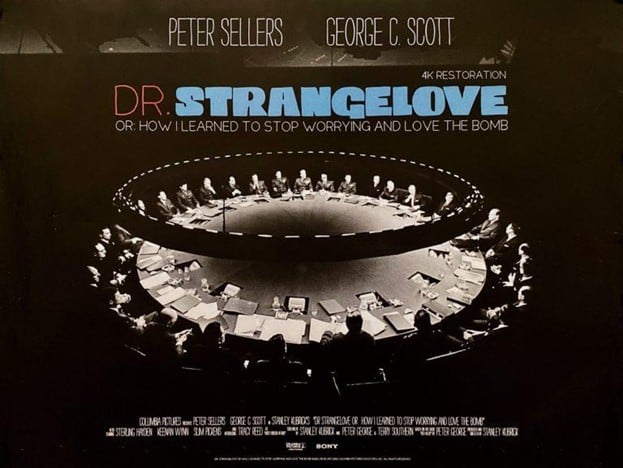
Putting this room together was no easy task for the film’s set designer, Ken Adam. After his first idea was scrapped, Adam took inspiration from expressionist films for his design, with a huge oval light suspended above a table, which Kubrick wanted to be green to look like a poker table, where the most powerful people on Earth gambled with the fate of humanity!
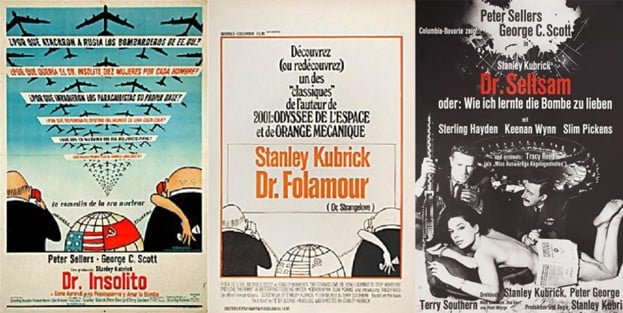
Finally, we’d like to show you these three posters from Argentina, France and Germany, so you can appreciate the variety of ways the name of the famous Dr. Strangelove has been translated.
Peter Sellers’s grotesque character – an eccentric Nazi scientist now employed by the United States – is translated as Dr. Insolito in Spanish, Dr. Folamour in French and Dr. Seltsam in German!
What do you think of the cult poster for Stanley Kubrick’s Dr. Strangelove? Did you know the story of the illustrator who created it? And have you ever come up with an alternative poster for this film that acerbically pokes fun at war? Let us know!