


Table of Contents
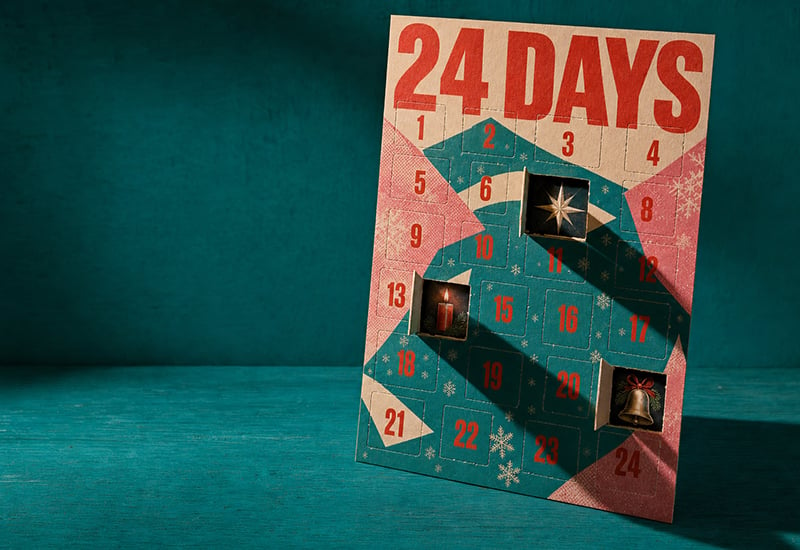
Every year, on the first of December, millions of people around the world open a small paper window. It’s a tiny gesture, repeated for twenty-four days, yet behind it lies over a century of printing history, commerce, and the way we experience anticipation. The advent calendar, in fact, wasn’t born as we know it today: it’s the result of a slow evolution, made up of chalk marks on walls, candles, printed cards and, much later, chocolate. Tracing this story from the beginning helps explain why such a simple object became one of the longest-running and most widespread printed rituals of the season.

Before the advent calendar: the many shapes of waiting
Before an advent calendar as such existed, the need that gave rise to it already did: counting down the days to Christmas. In Lutheran Germany in the 19th century, families had developed very simple ways of doing this. Some drew twenty-four chalk lines on a wall, rubbing one out each day. Others hung small hand-cut religious pictures on their windows every day, building a kind of homemade calendar day by day.
One episode in particular is often cited as a direct precursor: in 1839, the Protestant pastor Johann Hinrich Wichern, director of an orphanage in Hamburg, built a large wooden wheel fitted with twenty-four candles — twenty small ones for weekdays, four larger ones for the Sundays of Advent (source: Wikipedia). Every evening, together with the children at the orphanage, he lit one of them, accompanied by songs and prayers. It wasn’t yet a calendar in the sense we use the word today, but the underlying logic was already the one we recognise: marking out the wait visually, one day at a time.
The birth of the calendar as we know it: Gerhard Lang and the first printed card with little doors
The decisive step forward came in the early 20th century, and it has a name: Gerhard Lang, a German publisher and former printer from Maulbronn. Sources don’t fully agree on the exact date — some point to 1903, others to 1908 (source: Sellmer Verlag, a historic German manufacturer) — but the substance of the story remains the same: as a child, Lang had received a homemade calendar from his mother, with twenty-four small biscuits to nibble, one a day, until Christmas. As an adult, he decided to turn that personal memory into a mass-produced printed product.
The result was a card with twenty-four little doors, each one hiding a small Christmas picture to discover day by day. It was, in effect, the first commercial advent calendar in history: a paper object, designed to be printed in bulk and sold — no longer a homemade family item, but a proper publishing product.
The idea was an almost immediate success. Other publishers and printers began offering their own versions, in cardboard, in fabric, with increasingly elaborate illustrations. The advent calendar, in short, was born as a printed object before it ever became a Christmas consumer product.
From paper to chocolate: growth through the twentieth century
For the first few decades, the advent calendar remained essentially a paper object: behind the little doors were pictures, Bible verses, small religious illustrations or Christmas scenes. It was a product that spread mainly across German-speaking countries, where it had its deepest cultural roots.
The turning point came towards the end of the 1950s, when the first versions appeared with a chocolate behind every door — twenty-four chocolates, one a day. It’s a small change on paper, but a huge one in substance: the advent calendar stopped being purely a contemplative object and also became a small, indulgent ritual, capable of winning over adults and children alike. The leap to industrial-scale production, however, came a little later: it was in 1971 that Cadbury — the historic British chocolate brand founded in 1824 in Birmingham (source: Wikipedia) — launched its first version, helping to establish the chocolate advent calendar as one of the most recognisable seasonal products of the Christmas period (continuous production, it’s worth noting, wouldn’t actually begin until two decades later, in 1993) (source: NPR).
Crossing the Atlantic: how the advent calendar reached America
The spread of the advent calendar beyond Europe followed a less straightforward path than one might imagine, and is linked — curiously — to the Second World War. During the conflict, American soldiers stationed in Germany came into direct contact with this local tradition and, on returning home, brought it with them. One of the earliest photographic records of its adoption in the United States has gone down in history: an image published in the press in 1953 showed President Dwight Eisenhower’s grandchildren posing beside an advent calendar made by the historic German printing house Sellmer Verlag, of Stuttgart (source: NPR).
Alongside the classic twenty-four-day version, a shorter variant also spread over time, lasting twelve days, inspired by the well-known *Twelve Days of Christmas* (source: Jolly Festive) — not an exclusively American quirk, but a format that still coexists with the canonical one across several markets today.

Where it became an institution: the geography of the advent calendar
Although its reach is global today, the advent calendar doesn’t carry the same cultural weight everywhere. In Germany, Austria and other German-speaking countries, it remains a genuine institution: it’s part of the Christmas ritual as naturally as the tree or the nativity scene, and it’s present in practically every household with children.
In the Nordic countries, the tradition has taken a particularly original shape: for decades, public broadcasters have aired proper televised advent calendars — a mini-series or an episodic programme, one instalment a day, from 1 to 24 December (source: Wikipedia). Some of these have also become tied to charitable fundraising, turning into a small collective ritual that goes well beyond the physical object.
Italy has its own, highly visual take: every year, in Bolzano, the twenty-four windows of the historic Palazzo Max Valier are transformed into a building-sized advent calendar, with a different illustration revealed each day (source: Südtirol.com) — probably the largest advent calendar in the country, and an example of how a tradition born on paper can extend even into urban architecture.
Closer to home, the UK can genuinely claim to be the birthplace of one of the format’s biggest modern reinventions: the luxury beauty advent calendar. Selfridges launched the first one in 2011, selling out almost instantly, and Liberty followed with its own version in 2013 — which remains, to this day, the fastest-selling product in the department store’s nearly 150-year history (source: Retail Gazette). Since then, dozens of UK retailers have followed suit, turning the advent calendar into a genuine retail category in its own right, well beyond chocolate.
In the United States, by contrast, the tradition remains more recent and less widespread than in Europe: research from the analytics firm CivicScience put the share of American adults willing to follow an advent calendar at around 20–22% in recent years (source: CivicScience) — a useful reminder that, however universal the custom may seem today, its spread is far from uniform around the world.
The explosion of modern variants
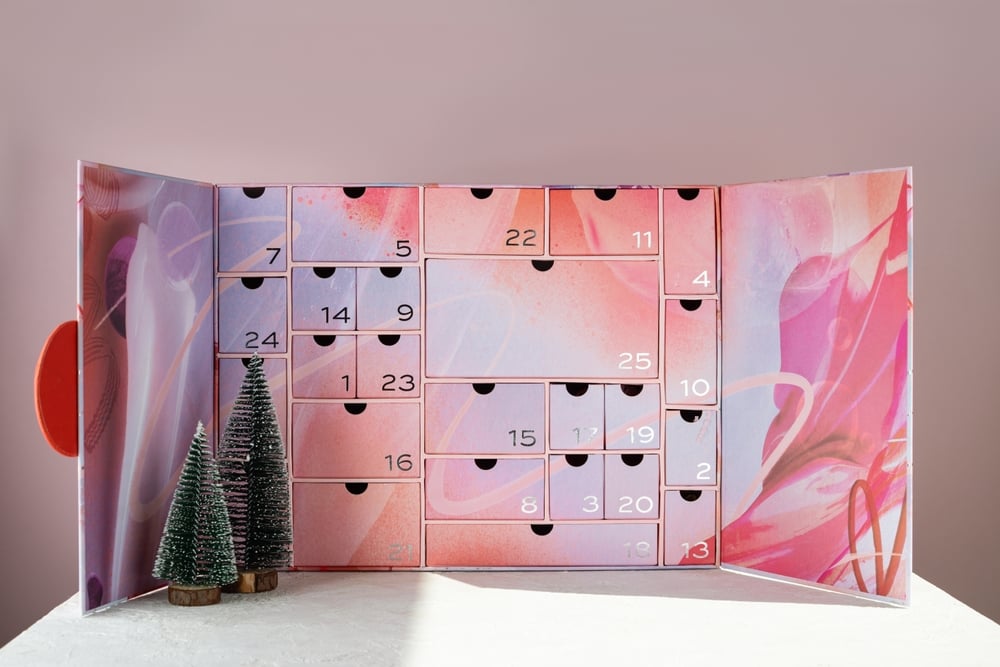
Over the past twenty years, the advent calendar has undergone a second transformation, perhaps even more radical than the first: from an object almost exclusively tied to confectionery to a universal format, applicable to virtually any product category. Today there are advent calendars dedicated to tea, craft beer, capsule coffee, cosmetics and skincare, wine, and even to pet products, with small treats or toys for dogs and cats (source: NPR).
At the opposite end of the spectrum sit the luxury editions produced by major jewellery and fashion houses, which each year offer calendars with a small piece of jewellery or an accessory behind every door. The cost of these calendars isn’t easy to pin down, but they’re undoubtedly out of reach for most.
What stays constant, regardless of the contents, is the structure: twenty-four days, twenty-four small reveals, a format that has proven capable of adapting to almost any product without losing its original identity as an object tied to anticipation.

Frequently asked questions
Who invented the advent calendar?
There’s no single, definitive answer. The earliest forms of “counting down” to Christmas — chalk marks on walls, candles lit one a day — date back to the 19th century. However, the first printed calendar with little doors, as we know it today, is generally attributed to Gerhard Lang, a German publisher, between 1903 and 1908 (source: Sellmer Verlag).
Why is it called an “advent calendar” rather than a “Christmas calendar”?
Because it follows the liturgical season of Advent, the period of waiting and preparation that precedes Christmas in the Christian tradition. Hence the name, even in the entirely secular, non-religious versions found on shelves today.
Since when have chocolate advent calendars existed?
The first versions with chocolates in place of religious pictures date back to the late 1950s; Cadbury, the best-known name in the category, didn’t enter the market until 1971 (source: NPR). From then on, they became the most widespread and recognisable variant, particularly among younger audiences.
Is the advent calendar an equally widespread tradition everywhere in the world?
No. It remains especially deep-rooted in German-speaking countries and, in different forms, across the Nordic countries. In other regions, such as the United States, its spread is more recent and less widespread than its current popularity on shelves and online might suggest.
A calendar worth printing, beyond Christmas
If this history of the advent calendar has left you wanting to print something personalised, whether before or after the Christmas period, take a look at Pixartprinting’s range of personalised calendars. A calendar always makes a great gift: a useful object that whoever receives it will consult and look at all year round. So, well beyond advent, it’s always a good time to print a personalised calendar.