



Table of Contents
Let’s face it: it’s all getting a bit boring. Whether you’re browsing LinkedIn, flicking through a magazine or sifting through blogs written for any audience, there’s only one topic under discussion: artificial intelligence, its applications in the world of business – communication, marketing, operations, etc. – and the promise of a technological revolution.
The topic is ubiquitous: it’s the subject on everyone’s lips, and has received such massive global investment it has even been studied in depth by the European Central Bank‘s financial analysts.
One statistic reported by the Guardian stands out in particular: Jim Bianco, president and macro-strategist at the US-based Bianco Research, found that 41 AI-related stocks now account for almost half of the value of the S&P 500, the USA’s most important stock index.
We’ve also discussed AI extensively in this blog – for example, investigating the opportunities it presents for the world of publishing, outlining its main applications when planning advertising campaigns, and trying to figure out how generative AI could help you to optimise marketing content.
But for businesses, achieving a return on investment for an AI project is still very much a work in progress…
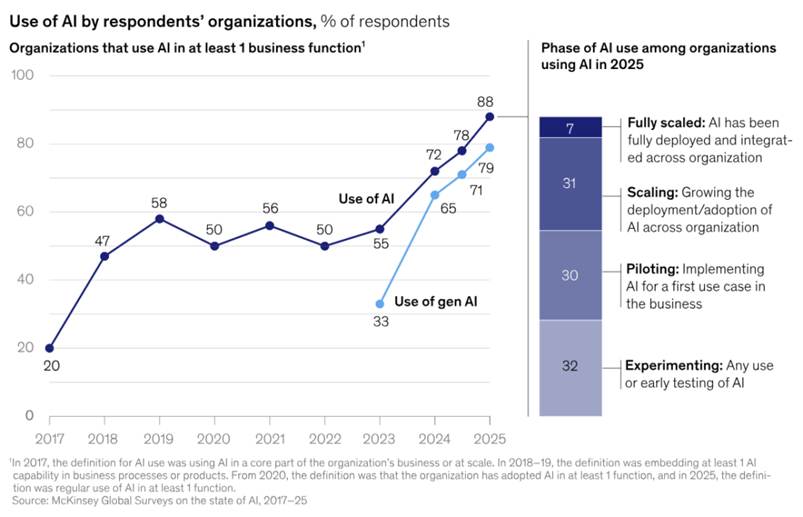
AI technology has been growing incessantly recently, particularly in terms of its adoption at companies and in the world of business, and it now feels like it is everywhere. The global report The State of AI in 2025: Agents, Innovation, and Transformation produced by the consulting firm McKinsey provides an excellent snapshot of how it has evolved over the years.
However, this report also shows that AI is still in an ‘experimental’ (32% of respondents) or ‘pilot’ (30%) phase: businesses, entrepreneurs and managers perhaps haven’t yet fully understood its potential, leading to sometimes sub-optimal returns on investment.
One much-discussed example of how AI is being used intensively but inefficiently in businesses’ marketing and internal and external communication is AI slop – the mass of substandard, useless and/or fake content (like deformed images, meaningless text or pointless videos) generated by AI and produced solely to obtain clicks and visibility online. This wave of low-quality or worthless content led sociologist Cory Doctorow to coin the term enshittification to describe the degradation of digital environments.
Marketing expert David Armano offered an excellent definition of AI slop:
‘[AI slop…] is the digital residue of generative abundance; content that’s algorithmically spawned, barely curated, and pushed into the world at scale. It’s the blog post written in seconds but devoid of insight. The marketing email that sounds like it came from 10,000 other brands. The image that’s technically perfect but emotionally vacant. It’s what happens when generative tools become default instead of intentional.’
The AI slop phenomenon is so pervasive, it has gradually entered the office, too, where it is known as workslop. Presentations that are well made but identical to all the rest; emails between colleagues that are theoretically correct but lacking in substance; and so on. This can have major effects on the relationships within organisations. Writing in the Harvard Business Review, a working group of business school researchers and business consultants recently described their insights from a very interesting study involving 1,150 full-time employees from American businesses:
- 40% of the employees had received at least one piece of workslop in the month before the survey;
- over 15% of the content received was classed as workslop – it was particularly common in peer-to-peer interactions (40%), but also (surprisingly) seen in interactions with managers and direct reports;
- the services and technology sectors produced the most internal workslop.
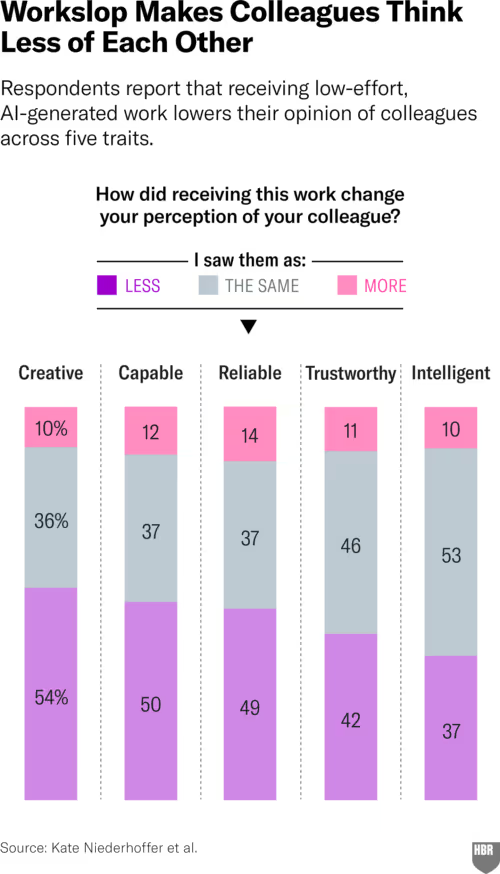
This makes you wonder what the legacy of all this AI-produced content will be. Harvard Business Review research highlighted that people who receive workslop tend to see the person who produced and shared it as less creative, able, reliable, trustworthy and intelligent, which therefore seriously undermines the collaboration between colleagues.
Another issue: the cost of AI tools
In the previous section we discussed the struggle to make a return on investment in projects and initiatives based on AI technology, and examined the (worrying) rise of AI slop. But while we are still yet to see and experience AI’s true potential, we are also a long way from understanding the costs – both from the corporate supply side and in terms of business and consumer demand. But let’s take one thing at a time.
Organisations are spending money, but AI’s effectiveness, and particularly its efficiency, are still anything but proven. As The Guardian notes:
‘The inherent promise in AI use is that the money a company spends on using these tools is more than paid back in improved productivity – a measure of economic efficiency, where improved productivity means you get more output from each worker. If this trade-off isn’t happening, then the assumptions underpinning AI valuations – and policies – [are] undermined.’
‘“The costs are getting completely out of control,” says Liam Betsworth, founder of the British AI startup Pendra. Software developers in his circle are using agents to code, he said, starting with the cheapest subscription, and very quickly moving on to the most expensive package. They aren’t alone – news site Axios recently reported on an unnamed company that spent $500m in a month on licences for Claude Code.’
Ah, costs… always a dilemma in purchasing decision-making processes! Marketing theory has long stated that consumers are flexible on price, and that even very cheap initial pricing quickly becomes a standard that no longer produces any enthusiasm or ‘wow’ effect. Take Amazon, for example: how many people are still excited about its prices, how quickly you can receive your order, or the free delivery? Not many, I would wager, despite the great value it offers.
I can see you asking: what exactly does this have to do with the hot topic we’re discussing in this article?
Everything, that’s what!
Because as well as businesses starting to tire of investing massively in AI for uncertain returns, people are also starting to take a step backwards. Every day, a new technology based on AI is released that promises to work better and (above all) at a lower cost than the alternatives had done before. Take the battle between ChatGPT and Claude, with the former gradually losing market share to the latter. And it surely won’t be long until another competitor comes along, not necessarily from the USA…
Then there’s the fact that the AI companies haven’t yet found a business model that turns a profit. In general, building an AI ecosystem is very expensive, as the USA – the world’s leading economy – knows well: its national debt now exceeds $40 trillion, in part due to these costs. Not to mention a plethora of public opinion and health claims, with dozens of protests across the world organised by people and communities that don’t want large, polluting data centres near their homes.
Seattle – the symbolic city home to Amazon and Microsoft – has approved an emergency moratorium on the building of new large data centres. From the Netherlands to other US administrations, a growing number of regions are asking decision-makers to pause and reflect on the effects of the race to adopt AI on their electrical grids, land and resources.
Indeed, people are even starting to consider orbital data centres in space as an alternative!
Basically, the risk – including from a value proposition point of view – is that we end up with a dangerous stalemate, with growing production costs leading to pricing strategies that customers are not necessarily willing to accept, but which are difficult to escape from.
AI: a bubble or the future? It’s all about value
Let’s return to the question we’ve been answering throughout the article: is AI a genuine revolution, or just speculation that is slowly turning into a large bubble, ready to burst?
I’d like to return to a mantra that I always keep in mind when thinking about whether or not a trend or technology will prove successful: it is people and consumers who provide the market litmus test – whether we’re talking about B2B or B2C.
- If these technologies manage to position themselves as ‘essential’ to the lives of businesses and individuals, their cost will lose its perceived importance in the eyes of users compared to their function.
- However, if people do not really understand their differentiating value, there will be no reason to consider them.
In other words, the answer lies in AI technology’s value proposition and ‘stickiness’ – its ability to become integral to our everyday habits.
Time will tell… but one thing’s for sure, there’ll be plenty more twists and turns along the way.