

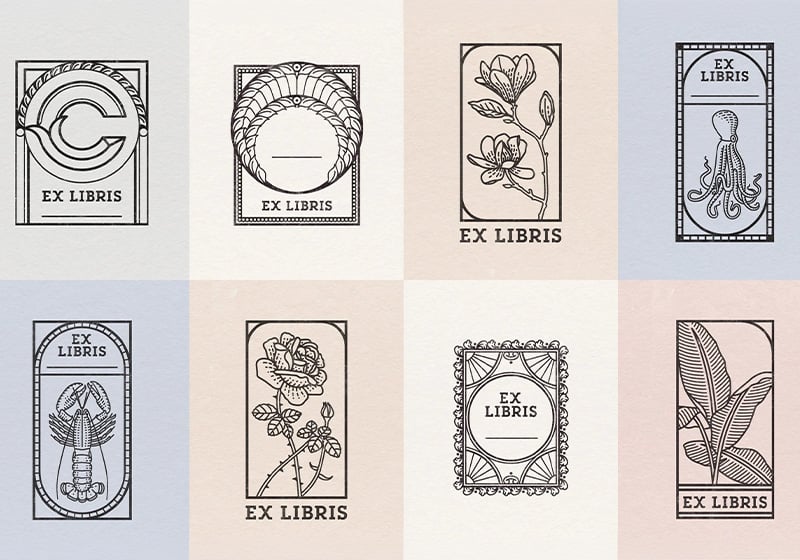
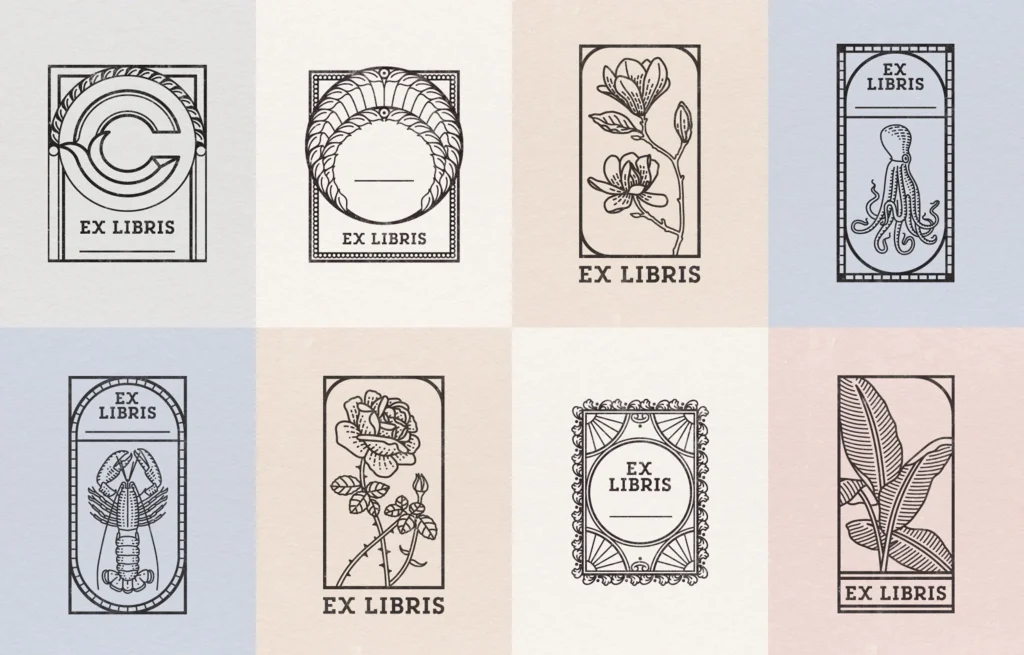
Have you lost count of books lent to friends and family, but never returned? With her Ex Libris Room project, Milan-based graphic designer and illustrator Clara De Lorenzi has an elegant solution to the problem. Her collection of bookplates (ownership stamps inked onto the title pages of books) deftly blends modern details with nostalgic nods to the past.
In the shop on Clara’s website, you can choose from eight themed collections, spanning botany to zoology, letters of the alphabet to signs of the zodiac. You can also order a semi-custom stamp based on existing designs, or have one made from scratch. You’re spoilt for choice, because each and every one of Clara’s bookplates is a masterpiece of graphic design to keep and cherish, or gift to the book lovers in your life.
We asked Clara to tell us more about her work as a book illustrator and graphic designer.
Clara, where did you get the idea to create custom bookplates?
I began by designing bookplates to give to people I’m fond of, then decided to offer them to the public, too. I liked the challenge of working in a confined space: I thought it was a great test of creativity! So I created my first themed collections and posted them on my Instagram for everyone to see. Soon I started getting requests for custom bookplates, and thanks to word-of-mouth, I’ve been making about 400 a year for the past 6–7 years.
How do you make your bookplates?
For personalised insignia, I put together three proposals based on the client’s request. Usually, I pick three alternative layouts into which I insert different illustrations of the same thing. Then, once a design has been chosen, I laser engrave the rubber stamp. I decided to create a stamp instead of a more traditional label, because it should last a lifetime: all you have to do is change the ink-pad when it runs dry.
Is your figurative style influenced by old bookplates?
Yes, I am inspired by my favourite 20th-century artistic movements, particularly art deco, futurism and Bauhaus. But I have to keep in mind the technical limitations of the medium: with laser engraving, you can’t use designs with lines that are very thin or very close together.
Which collection or individual bookplates are you most proud of?
There isn’t one in particular, but I do love creating bookplates for children. It’s exciting to think that these labels will accompany them through a lifetime of reading…or at least I hope they will!
Bookplates for children designed by Clara De Lorenzi.
More generally, in your work as an illustrator and graphic designer, where do you find everyday inspiration?
I usually look to the past rather than the present, because I don’t want to be overly influenced by what’s out there at the moment. I search online and in antique markets, hunting for engravings, old records, advertising posters and book covers.
Which books would you recommend to someone seeking inspiration for their graphic design projects?
Definitely Type: A Visual History of Typefaces and Graphic Styles, because it offers full overview of type design. Also, the masterpiece that is Codex Seraphinianus, which is packed with magnificent illustrations of an imaginary world. Then there’s Scripts: Elegant Lettering from Design’s Golden Age, a comprehensive compilation of calligraphy characters, and Russian Criminal Tattoo Encyclopaedia Volume II, which is great for exploring different visual languages.
You’ve recently worked on a number of brand identity projects. What’s your creative process for these?
I always begin with a digital mood board put together from research in books and online. Then I start drawing my initial ideas with pen and paper. I prefer hand drawing, because those eureka moments often arrive as I’m doing my first sketches.
How has your career developed over the years?
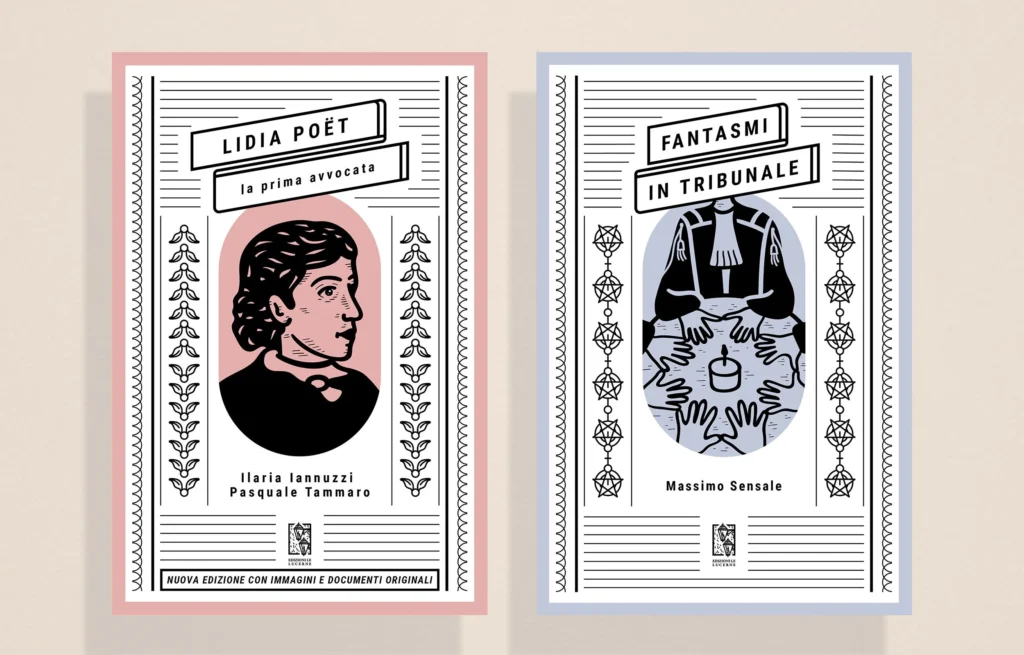
After graduating, I worked for four years as a graphic designer at an advertising agency in Berlin. Then I went freelance, first in Berlin, and later in Milan, doing mostly brand identity projects. I started Ex Libris Room 10 years ago as a side project, and it gradually grew into one of my main lines of work. More recently, I began doing book illustrations and I’ve been working with publishers Le Lucerne for some time now. In 2022, I did the cover designs and illustrations for their series Massime dal Passato (Past precedents), and for the last few years I’ve been designing the covers for all the new titles released. It’s a fascinating project that gives me great satisfaction!
In an age when digital tools are ubiquitous and generative AI is revolutionising the creative process, is it tough to establish yourself as a book illustrator and graphic designer? What advice would you give someone looking to follow this career path?
The advent of AI worries me for two main reasons: copyright is being infringed, and data centres have an enormous environmental impact. There’s also the risk of a general creative flattening, because images created using AI without expert human input all tend to look the same. So for anyone who wants to become a book illustrator or graphic designer, I have one piece of advice: find your style. It’s the only way to protect yourself from the relentless rise of AI.
Clara’s bookplates can be bought from her web shop, and come in both custom and ready-to-use formats. They’re beautiful yet useful items designed to accompany the most avid bibliophiles in their reading.
Want to dive deeper into the intriguing world of bookplates? In “The history of bookplates: from property marks to collector’s items”, (add link) we explore the styles, themes and printing techniques used to make bookplates over the centuries.
Clara’s Ex Libris shop: https://www.claradelorenzi.com/shop
Clara de Lorenzi’s Instagram: https://www.instagram.com/ex_libris_room/