



Table of Contents
Since the dawn of time, humans have dreamed of living in a large global village, where everyone can speak to and understand one another regardless of their geography, location or native language.
And this dream is shared by entrepreneurs and business managers, and particularly those in the communication, marketing and sales sector, who deal on an almost daily basis with international and global markets and clients without necessarily speaking their language or understanding their cultural sensitivities.
Previously, bridging this divide required large budgets (for example recruiting managers with broad experience and a long track record, or strengthening a team’s language skills through tailored training courses). But today it can be done with the click of a mouse, thanks to some innovative generative AI tools.

This is a vital topic, especially for small or medium-sized organisations. In this article, we’ll investigate it in depth and help you decide which tools are right for you!
How generative AI can help your team achieve its international potential (and which tools to use)
‘Generative artificial intelligence (generative AI) is a branch of AI that uses advanced models based on enormous quantities of existing data to create new and original content (including text, images, music, code and videos).’
This definition of generative AI should give you a good idea of where I’m coming from. Generative AI and language AI tools can transform content created in a certain language (text, audio, video and other formats) into multilingual communications perfectly suited for advertising campaigns, sales demos, customer webinars and other marketing and sales management materials.
And that’s not all! They can also produce:
- headlines, calls to action (CTAs), landing pages, emails, advertisements and product data sheets;
- social media posts, articles, FAQs, videos and captions;
- dubbing and subtitles for creative output in multiple languages – without needing to organise multiple shoots.
This is just an initial – and by no means exhaustive – list of content that generative AI tools can produce and reimagine. But, I hear you ask… which tools?
The list of software out there, as you’re no doubt well aware, is growing all the time. I’ve therefore tried to group the tools together based on the results they produce… or rather optimise. And for obvious reasons, I’ve left out the already ubiquitous ChatGPT…
Text
- DeepL: powered by Linguee’s knowledge base, this tool calls itself the world’s most accurate translator. So it seems logical to try it, if only to prove this assertion wrong! It was launched several years ago as a challenger to Google, and is now one of the key multilingual communication tools used by both individuals and businesses. And talking of businesses, I recommend taking a look at their customer story section to understand the potential benefits of this type of solution.
- Microsoft Translator: for users of Microsoft’s suite of products, and as of last year also available for iOS devices, this tool includes conversation modes and useful options for business contexts and company training, for example translating slides between dissimilar languages.
Meetings
This section contains a list of solutions that add extra functionality to the leading video conferencing solutions available on the market.
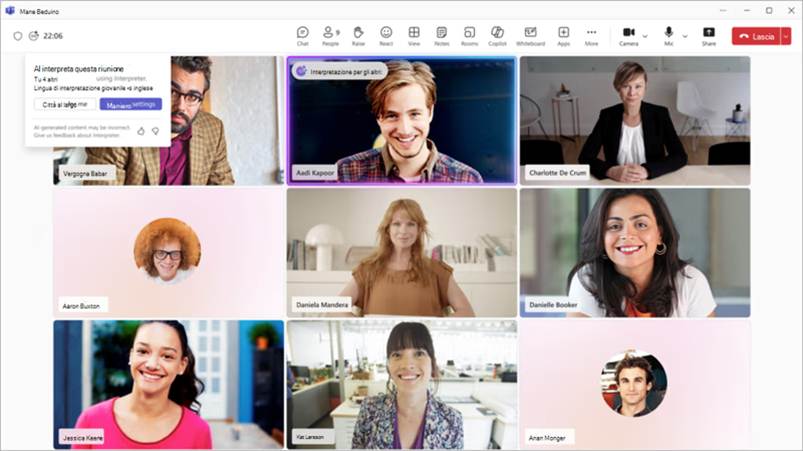
- Microsoft Teams Interpreter: this tool allows up to 1,000 meeting attendees with multiple native languages to speak and listen in their preferred language with real-time speech-to-speech interpreting, aiming to remove language barriers and support inclusivity. It currently supports English, Spanish, Portuguese, Japanese, simplified Chinese (Mandarin), Italian, German, French and Korean, but other languages are also in the pipeline. To allay privacy concerns, voice data is processed in real time, with no storage of voice samples or biometric data.
- Google Meet (translated captions and speech translation): for some Workspace types, Google Meet offers AI-translated captions – real-time translation of spoken text. And it has also recently introduced speech translation using a cloned voice, seeking to reduce or possibly even eliminate language barriers.
- Zoom (translated captions): Zoom enjoyed enormous success during the pandemic, but in recent years its use by businesses and individuals has declined. However, certain plans and account types can access a function that provides AI-powered captions in multiple languages, allowing participants to see spoken content translated into their preferred language. For example, if one meeting attendee is speaking English, the other participants can view captions in German, Italian, Japanese and myriad other languages. Unfortunately, it is not yet possible to translate between dialects of the same language, such as between the French spoken in France and Canadian French.
Audio and video
In the introduction to this list of tools, I mentioned that I wouldn’t be discussing ChatGPT, for obvious reasons: it is already very popular, and has so many different uses. Now I’d like to add another tool to the ‘ignore’ list, for the exact same reasons: YouTube. YouTube has always adapted to the latest market trends and the ways users access media, and this field is no exception: it is currently developing automatic dubbing features, which have been rolled out to many ‘eligible’ creators (their words 😶🌫️) and partner channels. Anyway, back to our round-up…
- HeyGen: a very interesting solution – launched by a company of the same name – that has been getting a lot of (positive!) air time for a while. The company develops generative AI tools that create photorealistic avatars based on photos and videos uploaded by users and a library of predefined avatars and voices. These digital avatars can then deliver instructions in multiple languages, using lip syncing (matching a person’s lip movements to prerecorded audio). The potential benefits of applying this technology to video marketing or sales management (how-to guides, product explanations/demos, etc.) are huge. Their website also has a very interesting use case section that is well worth a read!
- Synthesia AI: this tool has features similar to HeyGen, and allows users to develop increasingly expressive and realistic full-body AI avatars, drawing on a library of over 240 ready-to-use models.
- ElevenLabs: with the ElevenLabs AI Voice Generator you can create high-quality synthetic audio for any output or content, including videos, audiobooks and podcasts: indeed, the company claims it is the most realistic voice AI platform in the world! 🤯
Using GenAI to internationalise your communication: where should you start?
This list of tools is a useful starting point for assessing whether generative AI can help you take your sales, communication and marketing global.
Even better, they are almost all freemium solutions, meaning you can try them free of charge and then move to a paid plan once you’re convinced they’re right for you.
So, ready to go?
Don’t rush into a free trial too quickly. To start off on the right foot, it’s worth having a checklist of points to follow… like this one 👇 I’ve created for this precise purpose!
- Brand kit: also known as a brandbook, brand guidelines… the name isn’t important. What matters is the substance: it’s a centralised starting point to feed into large language models (LLMs) describing your company and/or brand. What keywords does your brand use? What tone of voice should it apply? And are there any phrases you actively encourage… or want to avoid?
- Governance: not all content is created equal, and the amount of attention you need to dedicate to it varies as a result. If it’s a post to publish on the company’s social media, for instance, a quick proofread will usually be enough; the same cannot be said, however, of multilingual video marketing content or interpreting the CEO’s speech… It is therefore crucial that you remain vigilant regarding legal, compliance and reputational aspects; it may be worth classifying all your content by risk level.
- Policies and privacy: before settling on a particular tool, always read its policies and terms and conditions, particularly in the business sphere, and especially if the tool originates from the USA or China, where policies and privacy regulations differ from those in Europe. It is also worth establishing which of your organisation’s documents (e.g. price lists, strategy decks, etc.) should not be uploaded onto LLMs to ensure they remain closely guarded secrets.
- Prompt design: finally, as I’m sure you’re aware, prompt design is a crucial art – particularly in the area of communication, internationalisation and localisation. Work hard on your prompting, and dedicate plenty of time to it. Everyone agrees that ‘Translate this text into English’ is no good, and that something like ‘Rewrite this text for a UK-based B2B decision-maker, with a professional, ROI-oriented tone, avoiding slang and keeping these technical terms…’ is much better… right?
With these points taken care of, the only limit to how you use this innovative technology is your imagination. While it should be handled with care, it really is incredibly powerful!