


Table of Contents
Heat transfer printing on fabric is one of the most widely used techniques for customising garments, accessories and textile materials with logos, text and high-impact graphic elements.
It is highly valued because it combines precision, versatility and visual quality, especially when you want to achieve effects such as metallic finishes, glossy surfaces or sharply defined details.
However, people searching for information about this technique are not just looking for a definition.
They want to understand:
• when it really makes sense to use it
• which fabrics it works best on
• how much it costs
• what alternatives are available
• which technique to choose for their specific project
This guide is designed to answer all these questions, with a practical, decision-oriented approach.
What is heat transfer printing on fabric
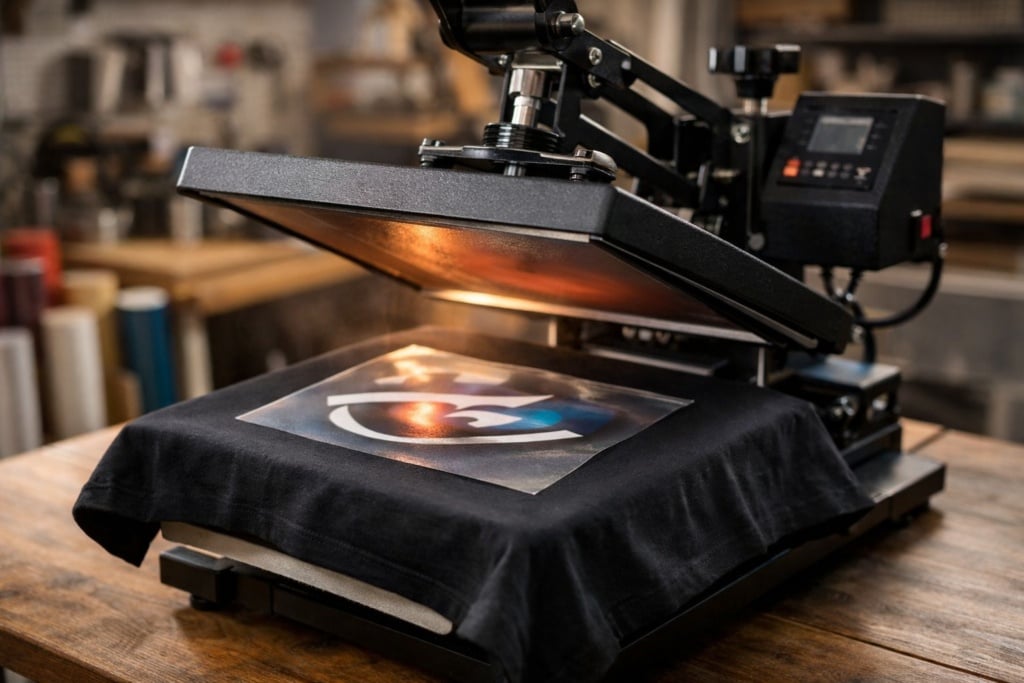
Heat transfer printing on fabric is a thermal transfer technique: the design is not printed directly onto the garment, but applied using heat and pressure through an intermediate support.
The process is based on three key elements:
• heat
• pressure
• transfer support (film, sheet or heat-adhesive material)
Unlike direct digital printing or screen printing, the design is prepared separately and then transferred onto the fabric.
This approach allows for highly precise and controlled results, making heat transfer printing particularly suitable for:
• corporate logos
• text and lettering
• clean graphic elements
• decorative effects
It is not a “one-size-fits-all” solution, but when used in the right context, it can deliver excellent results.
How heat transfer printing on fabric works
The process is relatively straightforward, but requires accuracy in production parameters.
It consists of four main stages:
1. Design preparation
At this stage, the design is adapted to work effectively with heat transfer printing.
Simple graphics with clean edges and no complex gradients are recommended, as this technique performs best with sharp elements such as logos, text and solid shapes.
2. Creating the transfer support
The design is prepared on an intermediate support, such as a heat-adhesive film or transfer sheet, which acts as a bridge between the design and the fabric.
3. Heat pressing
The support is placed onto the fabric and pressed at a high temperature for a specific amount of time.
4. Cooling and bonding
Once cooled, the material adheres firmly to the textile fibres.
Today, one of the most interesting evolutions of this process is DTF technology.
A practical example is DTF heat transfer sheets for fabrics by Pixartprinting, which allow you to apply even complex graphics while maintaining the heat transfer approach.
Types of heat transfer printing on fabric
There is no single “heat transfer printing” method — there are several variations, each with specific characteristics.
Heat transfer vinyl (HTV)
This is the most common type of heat transfer printing on fabric. It uses coloured heat-adhesive vinyl that is cut according to the design and then applied to the garment using a heat press.
Once pressed, the vinyl adheres to the fabric, creating a durable and well-defined print.
👉 Particularly suitable for:
• corporate logos
• names and text
• sports numbering
It is a simple, precise and widely used solution, especially for clean designs without gradients.
Hot foil printing
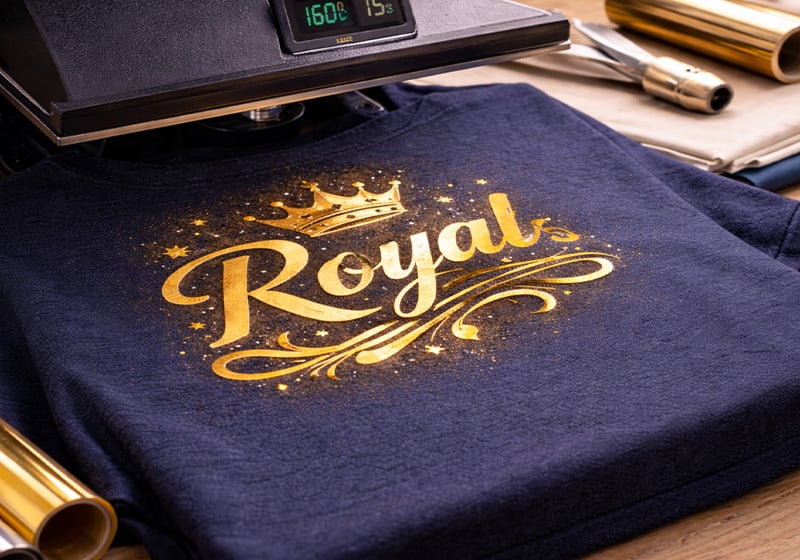
This variation uses a very thin film with a metallic or glossy finish, applied to the fabric using heat and pressure.
During the process, the foil adheres only to the selected areas of the design, creating bright, reflective effects.
👉 Particularly suitable for:
• decorative details
• premium logos
• fashion items or high-end merchandise
The result is an elegant and distinctive print, ideal for more refined visual outcomes.
Special materials
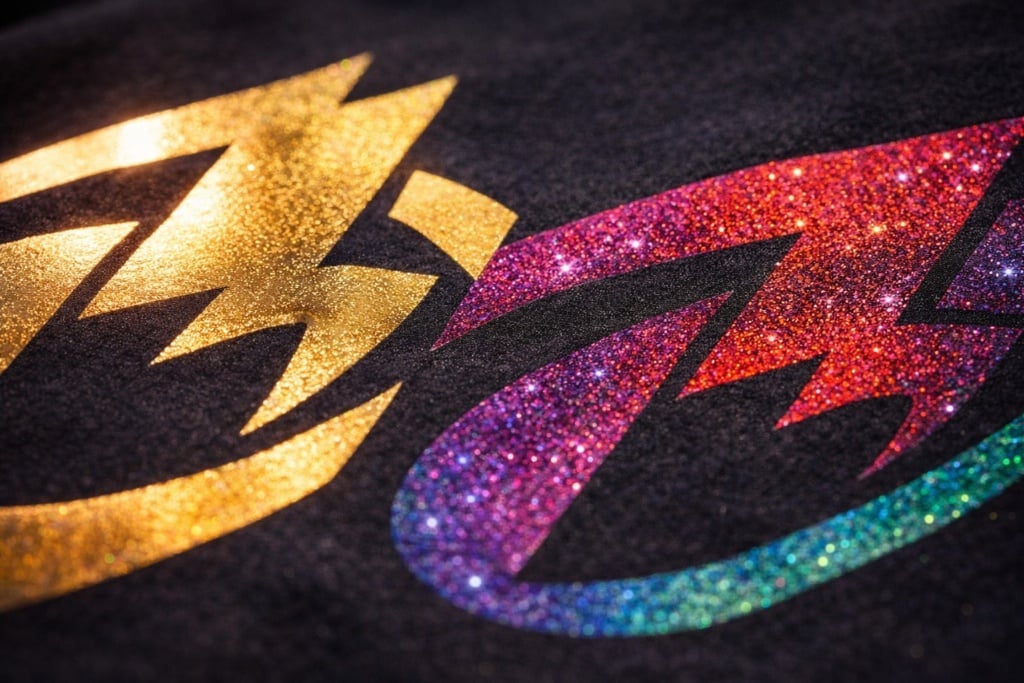
This category includes heat transfer films with unique finishes designed to create distinctive visual effects. These may include glitter, fluorescent, reflective or textured materials.
They are applied using the same heat transfer process but add strong visual impact and, in some cases, functional benefits such as visibility in low-light conditions.
👉 Ideal for:
• sport → high-visibility details
• safety → reflective workwear
• creative branding → bold, distinctive designs
Their strength lies in turning a simple print into something more dynamic and eye-catching.
Which fabrics can be used
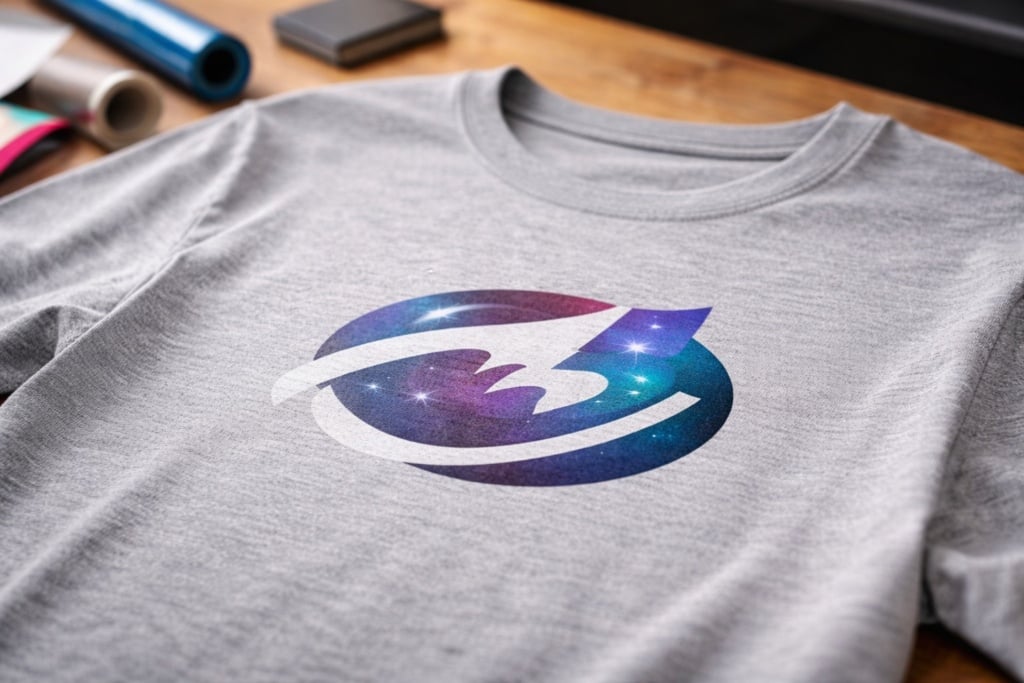
One of the key advantages of heat transfer printing is its versatility.
It works well on:
• cotton
• polyester
• blended fabrics
• technical textiles
This makes it suitable for a wide range of applications, from promotional clothing to professional uniforms.
However, not all fabrics behave the same way.
Factors such as elasticity, texture and heat resistance can affect the final result.
👉 Rule of thumb: the more stable the fabric, the more predictable the outcome.
Advantages of heat transfer printing on fabric
Heat transfer printing on fabric is widely appreciated for several reasons.
The main advantages include:
• high precision in details
• excellent results for logos and text
• ability to create special effects
• good durability over time
• flexibility for small production runs
Another major advantage is the ability to apply designs to finished garments without altering the production process.
Limitations to consider
To make an informed decision, it’s important to understand the limitations as well.
The main ones are:
• complex graphics → photographic images are better suited to other techniques
• tactile feel → the print may feel more noticeable on the fabric
• process dependency → incorrect temperature or pressure can affect results
These are not flaws, but indications of when the technique is most appropriate.
How much does heat transfer printing on fabric cost
The cost varies depending on several factors.
Key elements include:
• quantity
• size
• material
• type of fabric
• level of customisation
Practical examples
To give a clearer idea:
• 1–10 items → higher unit cost
• 50–100 items → more cost-effective
• complex personalisation → higher price
When it is cost-effective
Heat transfer printing is generally a good option when:
• quantities are limited
• the design is simple
• precision is required
When it really makes sense to choose heat transfer printing
To simplify:
✔ Choose it if:
• you have logos or text
• you want special visual effects
• you are working with small quantities
• you need to customise technical garments
❌ Avoid it if:
• you have photographic images
• you want an ultra-soft finish
• you are producing large standard runs
Practical examples: when to use it
To better understand, here are some real-world scenarios.
Events and promotions
Staff T-shirts or event apparel: clear and visible logos.
Merchandising
Ideal for emerging brands with strong visual identity.
Sports
Names and numbers on jerseys: precision is essential.
Workwear
Professional uniforms with logos.
👉 In all these cases, the key factor is the same:
control and precision of the final result
Heat transfer vs digital, DTF and screen printing: comparison
| Technique | Best for | Limitations |
| Heat transfer printing | logos, effects | not suitable for gradients |
| Digital printing | complex images | less durable in some cases |
| Screen printing | large runs | less flexible |
| DTF | versatility | slight thickness |
DTF, in particular, represents one of the most interesting developments.
You can see a practical example in DTF heat transfer sheets for fabrics by Pixartprinting, which allow more complex designs while maintaining the heat transfer process.
Alternatives for creating customised clothing
If you want to create customised garments, it’s important to have multiple options.
With Pixartprinting you can:
• choose from different garments
• use various printing techniques
• work even with small quantities
In this context, solutions like DTF heat transfer sheets allow you to combine quality and flexibility.
How to prepare a heat transfer design correctly
To achieve a good result:
✔ Use clean, simple graphics
✔ Avoid very fine details
✔ Use high-quality files
✔ Adapt the design to the fabric
✔ Always test when possible
How to choose the right technique
Before deciding, ask yourself:
• what type of design you have
• which fabric you will use
• what the purpose of the garment is
👉 The right technique always depends on these answers.
FAQ: Frequently asked questions about heat transfer printing on fabric
Does heat transfer printing last over time?
Yes, if applied correctly it offers good resistance to washing and wear.
Durability depends on material quality and correct application settings.
Is heat transfer suitable for all fabrics?
It works with many materials, but not all behave the same. Some fabrics require specific adjustments.
Is it better than digital printing?
It depends on the project. Heat transfer is better for logos and effects, digital for complex images.
Is it affordable?
Costs vary depending on quantity and complexity. It is often cost-effective for small runs.
How should a heat transfer garment be washed?
Wash inside out at low temperatures and avoid aggressive drying.
Can heat transfer prints peel or deteriorate?
If applied correctly they are durable, but improper care can reduce lifespan.
Conclusion
Heat transfer printing on fabric is a highly effective technique when used in the right context.
In summary:
• perfect for logos and text
• ideal for visual effects
• not suitable for all types of graphics
The best choice is never the “best technique overall”, but the one that best fits your specific goal.
And when you need flexibility, quality and a wide range of options, tools like DTF and online printing platforms such as Pixartprinting can help you find the right balance between creativity and production.