


Table of Contents
This year, people all over the world are celebrating an important centenary – 1 June 2026 would have been Marilyn Monroe’s 100th birthday. Universally recognised as an showbusiness icon and gossip-column fixture, the actress and model who had a troubled life and a brief yet dazzling career is permanently etched in the collective memory.
Marilyn Monroe was fragile, dreamy, and beautiful enough to enchant entire generations. Witty, candid and seductive. A trained actress, a highly cultured woman, and the first great sex symbol of the modern age. A multifaceted global cultural phenomenon, complex and nigh-on impossible to put into words.
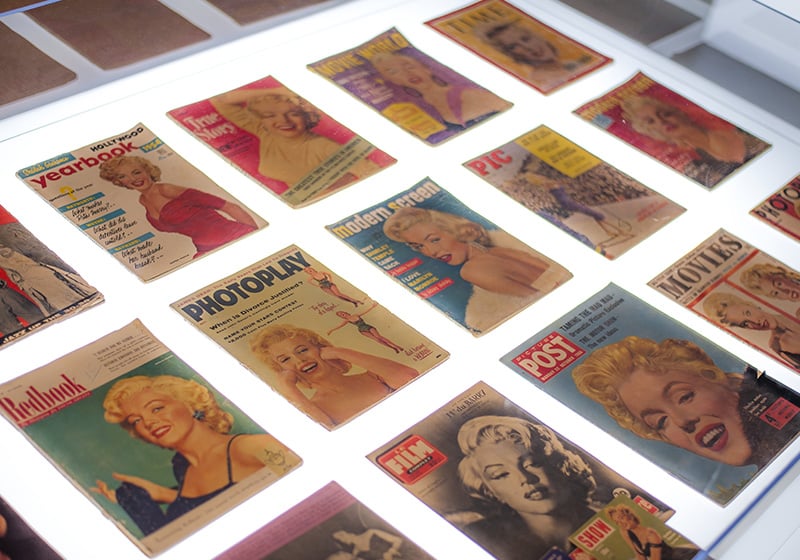
Today we’d like to pay tribute to Marilyn from our own perspective: while cinema may have made her famous, her legendary status was definitely amplified by her appearances in print.
From her famous, controversial calendar through to her iconic Life covers, and from Andy Warhol’s silkscreen prints that made her a star of pop art to the first edition of Playboy, today we’ll celebrate the memory of the legendary Marilyn Monroe by exploring her most popular magazine covers and printed images!
Marilyn’s covers for Life magazine
Life, the long-standing American photojournalism magazine, was one of the first publications to recognize the power of Marilyn Monroe’s image, and it accompanied her throughout her career, right through to the tragic events of 5 August 1962, when the actress was found dead in her Los Angeles home at the age of 36.
In Life’s golden age from the 1940s to the 1960s, it opened a window onto current affairs for its American and global readers.
Marilyn Monroe appeared on the cover of Life six times during her lifetime over the course of around 10 years, alongside photos of the twentieth century’s most important events: the Vietnam War, the Apollo missions, 2001: A Space Odyssey, Elvis Presley and countless other era-defining moments.
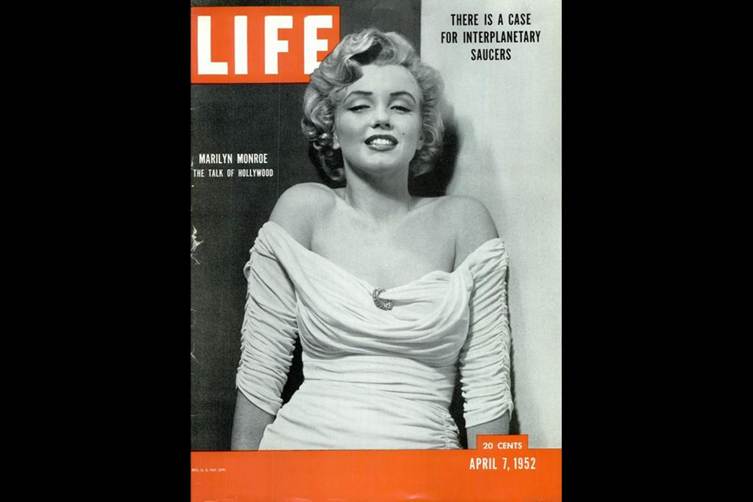
The first photo of Marilyn Monroe to appear on the cover of Life, on 7 April 1952, was taken by Philippe Halsman. The films that would make Monroe a cult heroine had not yet been released: Gentlemen Prefer Blondes and How to Marry a Millionaire appeared in cinemas the following year, while Billy Wilder’s masterpieces The Seven Year Itch and Some Like It Hot came even later. Yet the Marilyn pictured is already the legendary, iconic figure we know so well.
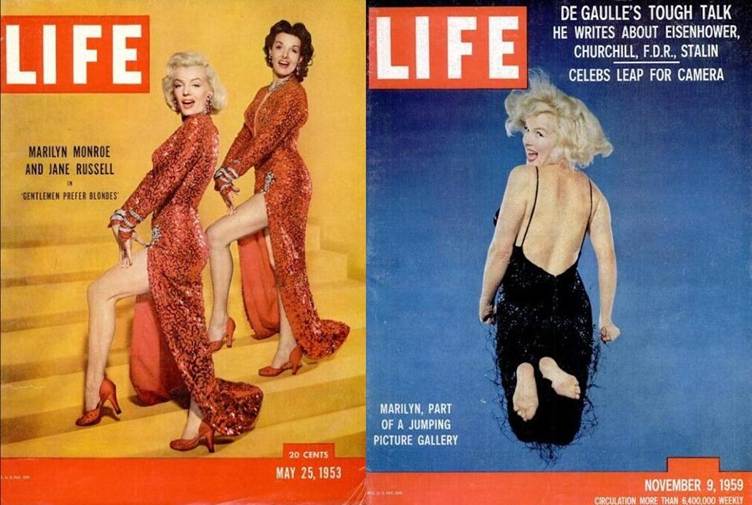
10 years later, the actress died. On 3 August 1962, Life published what became known as Marilyn Monroe’s final interview, two days before her death. One phrase in particular that the actress uttered to Richard Meryman, the Life journalist interviewing her, revealed her fragility and humanity: ‘Please don’t make me a joke’.
Marilyn Monroe’s infamous calendars
In 1949, Marilyn Monroe posed nude for photographer Tom Kelley in what became known as the Red Velvet session. Marilyn was 22 and was struggling financially. She was paid $50 for the photo shoot, and two of the photographs ended up featuring years later in the infamous calendars A New Wrinkle and Golden Dreams. These images, which caused a scandal at the time, were reproduced millions of times all over the world.
Then Marilyn got famous. In a series of interviews that could have ended her career, the actress admitted candidly that she was the star of the photos, and explained why she had posed for Kelley. In short, she never disowned the calendars. ‘I appeared in the calendar because I don’t want to be a woman for the few. I want to be for the many, because I was once one among many too’, Marilyn is reported to have said.
Far from destroying her fledgling career, the images therefore helped to create her myth. And the story of the Red Velvet session did not end there. Some of those shots led to the founding of a new magazine, which would also acquire legendary status…
Marilyn Monroe and the first issue of Playboy
In December 1953 the stories of two icons converged. Marilyn Monroe on the one hand, and the first issue of a magazine that would become legendary – Playboy, the world’s most famous erotic magazine – on the other.
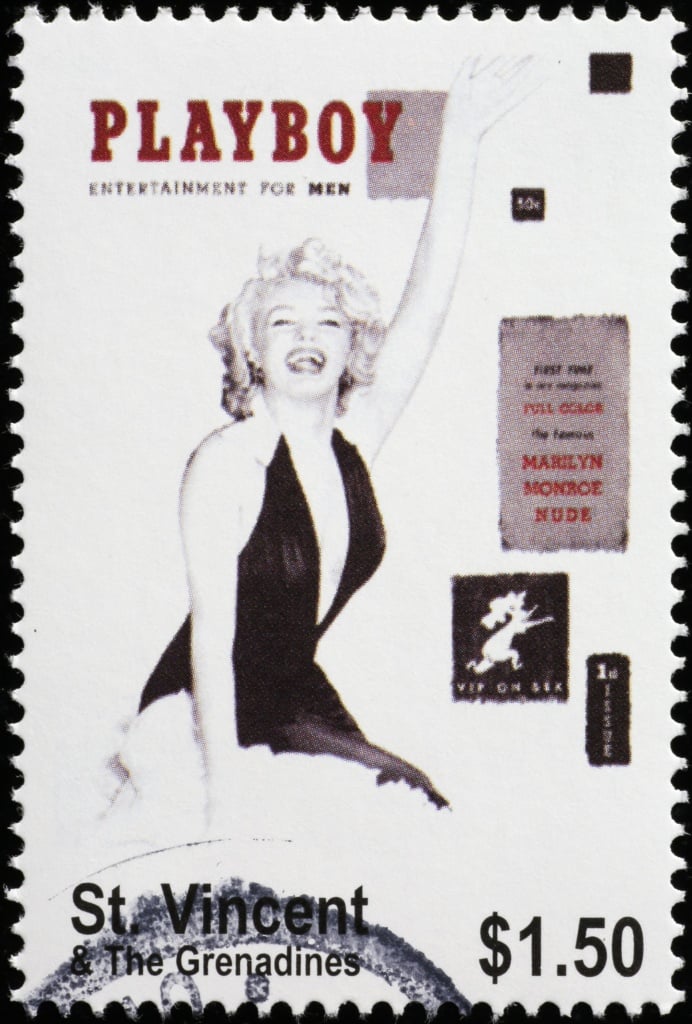
The magazine’s founder, journalist Hugh Hefner, used one of Tom Kelley’s photos from the famous and controversial 1949 photoshoot for the cover. Over the years, Playboy became an important part of American and global pop culture. Marilyn paved the way for many other stars who appeared on the magazine’s front page to promote rather than hinder their careers, including Bo Derek, Madonna, Pamela Anderson, Drew Barrymore and Kate Moss!
Marilyn Monroe: a pop art legend
As well as a pop icon, Marilyn Monroe was also a star of the art world. Did you know that numerous artists painted her portrait, including the surrealist Salvador Dalí, the expressionist Willem de Kooning and the American painter James Gill?
But one name in particular brought together Marilyn’s popular and artistic sides, turning her definitively into a pop cultural icon. Who? Andy Warhol, of course, the master of pop art.
A few weeks after Marilyn’s death in August 1962, the New York-based artist dedicated the Marilyn Diptych to her: a promotional photograph from the film Niagara repeated 50 times.
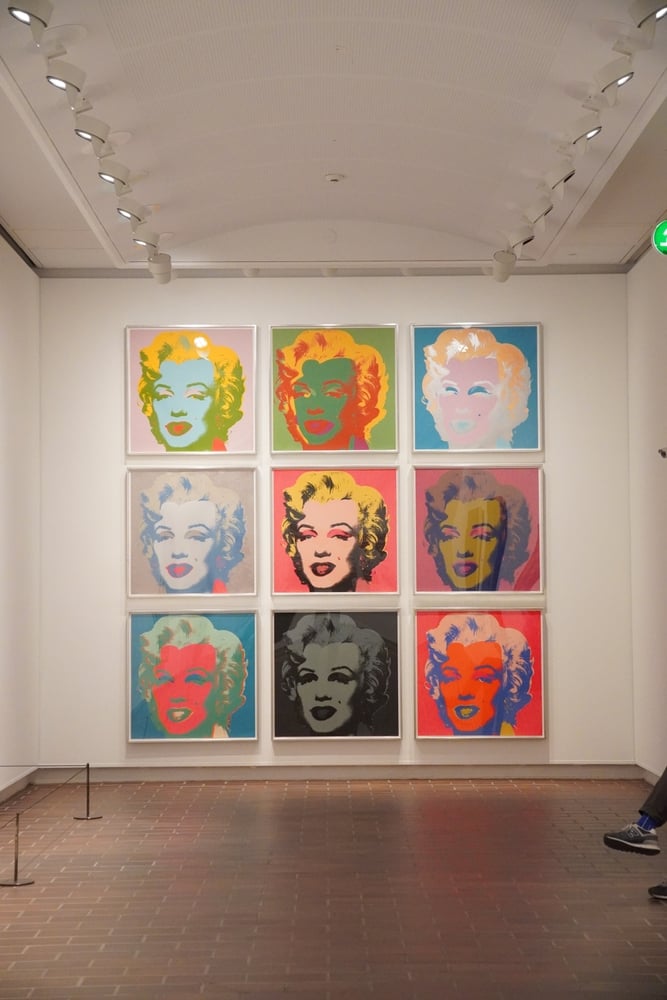
Marilyn embodied two of Andy Warhol’s artistic obsessions: the cult of celebrity and death. He used her image in many subsequent silkscreen paintings, including Marilyn Monroe in 1967 and the 1964 work Shot Sage Blue Marilyn, which became the twentieth century’s most expensive artwork when it sold at auction for $195 million.
The famous dress over the subway grate: the classic poster image of Marilyn
Let’s conclude our round-up with perhaps the most iconic image of Marilyn Monroe, one of the most frequently printed on posters and all types of media, and one of the twentieth century’s most famous photographs.
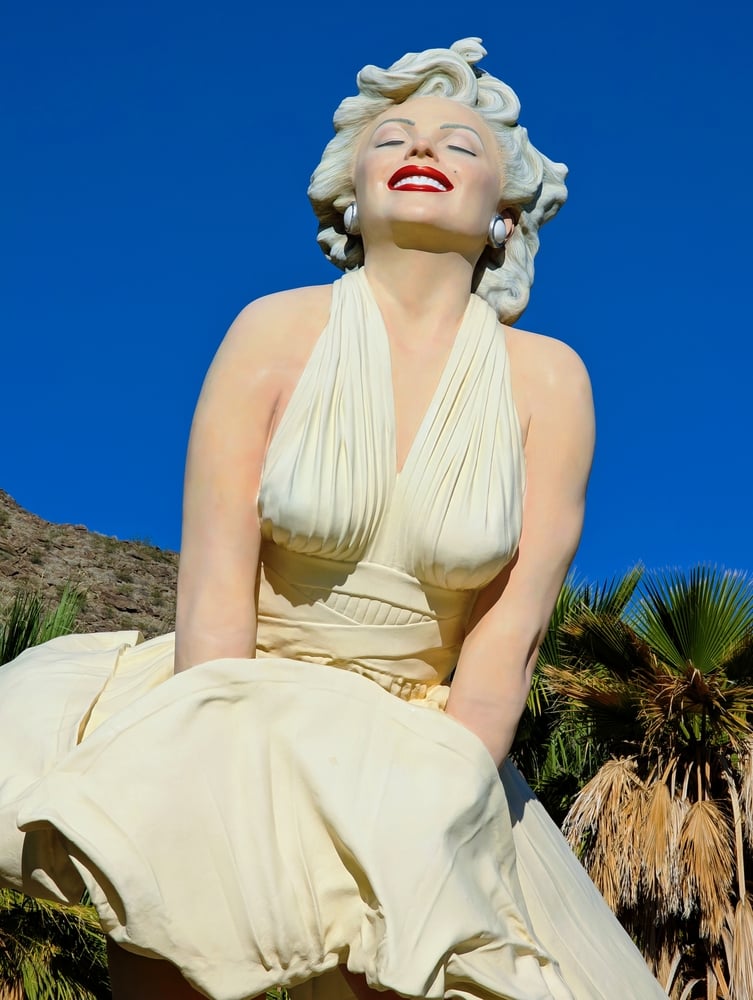
The story went like this. It was 1954, and Marilyn Monroe was filming a scene from The Seven Year Itch, a movie directed by Billy Wilder. In one particular scene she was wearing a white dress (which would become a legend in its own right) that was blown up in the breeze coming from a subway grate.
Marilyn was already a star and, as a way of promoting the film, the exact street in New York where the scene was being shot had been made public. Despite being late in the evening, a crowd of fans, journalists and photographers hurried there, and Marilyn rewarded them by posing for them above the famous grate.
And so the iconic image came to be. But once again, the story did not end there. Indeed, two people were left feeling rather disgruntled. One was the film’s director, Billy Wilder, who tried to shoot the scene several times amidst the hustle and bustle before having to give up – the scene that appears in the film was reshot at the (much less hectic) studios in California.
The other person unhappy at the turn of events was Joe DiMaggio, a famous baseball player and, most importantly, Marilyn’s husband at the time. He was also at the famous subway photoshoot, and was not at all pleased at what he saw. The argument that ensued ultimately led to the couple’s separation.
Have you got any other favourite photos of the iconic Marilyn Monroe? What do you think about the stories behind her images? And how do you see the timeless Marilyn in your own imagination? Let us know!
Editor’s note
The images included in this article are used for informational purposes and in accordance with the freedom of criticism, discussion and expression. The images are not in high definition. All rights belong to their respective owners.