


Table of Contents
This article was written in collaboration with Gaia Magurno, Senior Brand Storytelling & Strategic Writer at GreatPixel
Feeling nostalgia for an era you never lived through might, on the face of it, appear paradoxical. Yet Generation Z – young people born between 1997 and 2012 – are increasingly yearning for an imaginary analogue past, despite having only experienced the digital present.
You could be forgiven for writing this off as the latest generational fad.
But that would be a superficial interpretation. And superficial interpretations, whether in marketing or psychology, rarely teach us anything useful…
In a recent post, we explored how brands are using music to trigger nostalgia in consumers.
This time, we’ll dig further into the relationship between nostalgia and marketing today, and try to give you some guidance for engaging younger consumers by tapping into this feeling.
Nostalgia and marketing: ever closer bedfellows?
Is the nostalgia we’re talking about today a projection onto the present of an emotion associated with the past? Or is it an authentic feeling in its own right?
Nostalgia – or, more precisely, newstalgia – is now one of the most recognisable themes in contemporary culture. But what’s surprising is that those interpreting nostalgia and transforming it into consumer behaviour are often Gen Z: people who in most cases have never directly lived through the eras they’re harking back to.
The question, then, is not just how authentic this feeling is. What we need to understand is whether it’s about imitation, identification or, more likely, a response to a perception that the present day is overwhelming.
The past as a response to a hyper-exposed present
Gen Z is the first generation to experience a social life that’s constantly on display.
In this fishbowl existence, almost any moment can be documented and any expression of identity viewed, judged and commented upon.
While digital technology has enormously expanded the possibilities for personal expression, it has also made it feel like a full-time job. You have to show up, answer, react, have an opinion. You have to build a recognisable simulacrum of yourself, one that’s plausibly authentic, but not too vulnerable, original, but legible, spontaneous, but polished enough to deserve attention.
It’s this contradiction that gives the analogue – with its strong sense of nostalgia – such allure. A photo shot on film can’t be endlessly edited. A vinyl record invites you listen to tracks you might otherwise have skipped. A dumb phone with no apps and no internet means you’re no longer constantly connected.
They’re objects, sure, but they’re also symbols of limits.
For a generation who grew up with the idea that everything should be available immediately and infinitely, a limit can actually seem reassuring.
The implications of newstalgia stretch beyond the field of sociology. And for marketers and brand experts, it poses questions:
- Is nostalgia something spontaneously felt by consumers, or a desire driven by social media platforms?
- Which companies have the credibility to use it?
- How can it be translated into a branding strategy without being reduced to a retro filter applied to an unchanged product?
The constant dialogue between form and content is nothing new. It’s a breadcrumb trail, a recurring marker that allows us to find our bearings within the phenomenon.
Marketing familiarity: the snapshot effect
A faded photo from someone else’s past has become one of the most effective shortcuts for making a timeless product feel new.
Familiar enough to be recognised by those who lived through that period, but distant enough to seem novel to those encountering it for the first time.
Before we go any further, we should define some terms.
In common usage, nostalgia is generally associated with an autobiographical experience. We remember something that’s no longer available to us, and that makes us miss it.
But this definition doesn’t explain why someone born in 2003 might look back longingly at a lifestyle aesthetic from 1993.

Vicarious nostalgia: borrowing memories
We talk about vicarious or borrowed nostalgia when the thing yearned for isn’t part of our personal memory, but a past experienced through family stories, films, music, photographs, archives, historical artefacts and cultural works.
We do not directly remember a period. We re-evoke – or, more accurately, interiorise – its representation.
It’s an important distinction. In autobiographical nostalgia, the past is connected to an individual experience. In vicarious nostalgia, it becomes a symbolic archive from which we pick and choose objects to build an identity in the present.
A study recently presented by Vevo, Then is Now, described this phenomenon as borrowed nostalgia. In a sample of about 2000 Gen Z, Millennial and Gen X consumers in the United States, United Kingdom and Australia, 65% of Gen Z respondents said they felt nostalgic for cultural moments that happened before they were born or that they were too young to remember. One in three young people also claimed that they felt ‘born in the wrong generation’. Across the entire sample, 60% recognised a form of shared nostalgia constructed from reboots and common cultural content rather than individual experience.
Though these findings only apply to three Anglophone markets, they reflect a wider international trend. According to the Ipsos Global Trends 2024 report based on over 49,000 interviews conducted in 50 markets, the past is increasingly used as symbolic benchmark against which the present is measured.
In an in-depth study into the Asia-Pacific region, Ipsos found that, overall, 57% of Gen Z would have preferred to have grown up in the period when their parents were children. That compares to 51% of Gen Z globally.
This doesn’t necessarily mean that that over half of young people today want to give up the rights, opportunities and technologies they enjoy now. Rather, it means that the past is being used as point of comparison: a screen on which they project what’s missing from the present.
The image they desire is not the past as it was. It’s the past as it appears once the rough edges of its contradictions have been knocked off.
Authentic nostalgia or induced nostalgia?
It’s an interesting question, but it’s not the one we should be asking.
Nostalgia can be entirely induced and yet have entirely real effects. A throwback hit heard on TikTok, a classic series discovered on Netflix or an old photo encountered on Pinterest can elicit authentic nostalgic feelings even in the absence of any autobiographical reference.
Then again, personal memory is hardly an objective record.
It selects, omits and reshapes. Autobiographical memory is a reconstructive process, influenced by the present and the meaning assigned to events at the moment they are recalled. The media, social platforms and brands don’t manufacture nostalgia out of thin air. They put together the raw materials for its production: they decide which songs make a comeback, which items become icons, which versions of a decade are thrust into the foreground and which remain in the background.
Algorithms don’t directly generate the feeling, but repeatedly expose users to the elements that foster it.
This difference matters for marketers. Asking whether nostalgia is genuine misses the point. The real question is: what present need does it satisfy?
Almost never is the answer actually a desire to wind back the clock. More often, it’s a wish to:
- Reduce complexity
- Regain a sense of control
- Make an experience more real
- Escape the digital world, at least symbolically
- Adopt recognisable identity markers
- Connect with a different community or an older generation
Nostalgia is not just a form of memory. It’s also a language used to express needs, shortcomings and tensions of the present.
The Ipsos study Is Life Getting Better? 1975 vs 2025, conducted with over 23,000 people in 30 countries, backs this up. When asked if they would rather have been born in 1975 or 2025, 44% of interviewees chose the past and only 24% the present. What’s more, 55% believed that in their country people were happier 50 years ago.
Many of people’s ideas about 1975 were not, however, borne out by the facts. For example, respondents tended to overestimate life expectancy in the past and underestimate that in the present. Yet Gen Z was the only generation that showed a slight preference for the present: 38% would have chosen to be born in 2025, versus 34% who chose 1975. Their attraction to the past is therefore selective, not unconditional.
So more than a nostalgic pull towards the past, younger generations feel a desire to restore some of its aspects today.
Familiarity reduces distance
For brands, the value of nostalgia lies in its ability to narrow cognitive distance. A familiar object requires less time to be interpreted – an archival logo, a recognisable shape or a shared cultural reference offer an immediate way in. Before consumers have even evaluated a product, they already have an emotional predisposition towards it. In an environment flooded with stimuli and choices, familiarity can reduce the perception of distance: something can seem familiar even when never owned or relatable even when rooted in another generation’s memories.
Yet familiarity does not automatically translate to loyalty.
The Brand Connection – The Age of Meaningful Brands study conducted by Deloitte in 2025 among 7000 consumers in Italy, France, the United Kingdom, the United States, China, Japan and the United Arab Emirates, revealed that for 60.5% of those interviewed the best-loved brands were those that evoked fond memories. Meanwhile, 45.7% said that they didn’t feel a connection with any brand. This shows that memory can help begin a relationship, but isn’t enough to maintain it.
The Vevo study mentioned above also offers important takeaways for marketers about nostalgic content:
- 72% of interviewees said it makes a brand more relatable and recognisable
- 71% associate it with a positive emotion
- 67% say it makes them more likely to pay attention to the brand
Compared to new content, nostalgic content is more effective at building emotional connection, re-engaging audiences and strengthening relationships with long-standing customers.
The point is not that nostalgia automatically lifts sales. It’s that it can lower the emotional cost of that first interaction.

Who can use nostalgia credibly?
Nostalgia does not work for everyone. Many brands try to use it, but few manage to pull it off without looking fake.
Instead of asking who should harness the nostalgia effect, it makes more sense to ask which brands possess the attributes to deploy it credibly.
Reviving a typeface from the nineties is easy. Demonstrating that this heritage still has something meaningful to say to your audience is much harder.
The best-positioned brands are those with a recognisable legacy: iconic products, logos, characters, campaigns, packaging, sounds and rituals that are rooted in collective memory.
But a long history isn’t enough. A firm can be 100 years old without having any distinctive attributes that are still relevant. Another can be 30 years old and have already won a cherished place in the minds of generations.
The real competitive advantage is mnemonic capital: all the symbols, experiences and associations that the public immediately associates with the brand.
This means there are at least four types of brand that can work with nostalgia:
- Historic brands that own distinctive assets that are still recognisable.
- Brands associated with rituals transformed or reshaped by technology, like taking photos, listening to music, making phone calls, playing games or collecting things.
- Brands that have archive products that match contemporary tastes.
- Younger firms, platforms and retailers that can access other brands’ heritage through collaborations, licensing and experiences.
The key isn’t having a long history behind a brand, but having a credible reason for looking backwards.
The most instructive cases show how nostalgia can be employed at different levels of a brand strategy. Let’s take a look at some examples.
Pepsi revisited designs from its past to bolster distinctiveness and recognisability, rolling out the new visual system in over 120 markets.
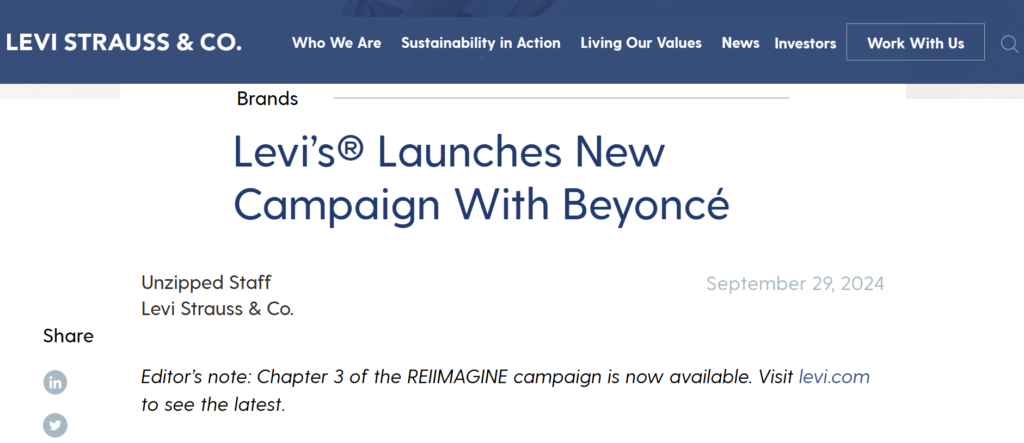
Levi’s, through its REIIMAGINE collaboration with Beyoncé, reinterpreted its legendary Launderette campaign from 1985, recasting the narrative and giving it renewed cultural relevance.
Puma relaunched Speedcat, bringing back a silhouette from its motorsport archive to capitalise on the low-profile trainer revival.
Airbnb teamed up with Mattel to turn the Polly Pocket universe into a physical, immersive experience, using its own platform to promote another brand’s cultural heritage.

In all these instances, the past was not just replicated: it was re-worked as a strategic lever to bring new meaning to identities, products, stories and experiences.
How do you turn the nostalgia effect into a branding strategy?
The examples above show that there’s no one way to do nostalgia marketing. Pepsi focuses on identity, Levi’s on storytelling, Puma on product and Airbnb on experience. The choice of lever depends on the brand’s strengths and the outcome it’s trying to achieve. Here’s a five-step mini guide to help you decide on the right approach to take.
1. Start with a memory inventory
The first step is to identify what the public already associates with your brand.
Which products are sought after on the second-hand market? Which ads are still quoted? Which packaging is kept? Which logos can be sketched from memory? Which characters, sounds, slogans or usage occasions are still embedded in popular culture?
A company archive contains everything a business has produced, whereas a strategic archive contains only what people remember.
It’s on the latter that you should focus.
2. Connect memory with a current need
The second step is to identify which current need can be expressed through a past need. Without this tension, referring to the past is simply a superficial exercise.
The strategic question is: why is it important to revisit this now?
3. Decide on the right level of transformation
Not all assets require the same treatment. Some can be re-used pretty much as they are, especially when they have a strong formal quality. Some will need their function, language or representation updating. And others will work better when given to an artist, creator or partner who can re-contextualise them successfully.
The better known the reference, the greater the skill needed to re-interpret it.
4. Creating for two different memories
A ‘nostalgic’ strategy aimed at Gen Z should keep in mind at least two audiences.
- The first has an autobiographical memory: they have worn that item, seen that ad or used that technology.
- The second has a vicarious memory: they have discovered that same item through social media, family stories, films or visual culture.
The campaign must work for both audiences, but in different ways. For the first, it should lead to recognition; for the second, discovery. For the first, it should re-open a chapter in their own story. For the second, it should offer a way into a new story.
It’s this dual coding that makes nostalgia relevant for Gen Z, too: it creates common ground between demographics who don’t share the same memories, but do recognise the same symbols.
5. Measuring what’s left after the conversation
Just tracking impressions, mentions and media coverage is not enough.
A successful nostalgia branding strategy should strengthen at least one of the key performance indicators (KPIs) of the brand and business: recognition, consideration, ability to attract younger audiences, re-engagement of previous customers, product sales, cultural relevance or association with a specific behaviour.
Virality signals that the public recognised the reference. But it doesn’t necessarily mean that they recognised the brand. Nostalgia truly works when what’s longed for is not just the era evoked, but the brand that made it meaningful again.
The takeaway is this: referencing the past is not enough – you have to give it new meaning.