

Table of Contents
When preparing an exhibition stand, fitting out a showroom or promoting a product in a retail environment, one of the first display solutions that usually comes to mind is the roll up banner. Easy to transport, quick to assemble and relatively affordable, it has become a staple of trade shows, conferences, retail spaces and corporate receptions.
However, anyone approaching this product for the first time is often faced with a simple but important question:
What size roll up banner should I choose?
The answer is not as straightforward as it may seem. The dimensions of a roll up banner influence the visibility of the message, the readability of the content, the overall visual impact of the display and, ultimately, the effectiveness of the communication itself.
In this guide, you’ll discover the most common roll up banner sizes, learn how to choose the right format for your needs, understand the mistakes to avoid during the design process and find out how to create a display that genuinely captures attention.
At a glance: what are the standard roll up banner sizes?
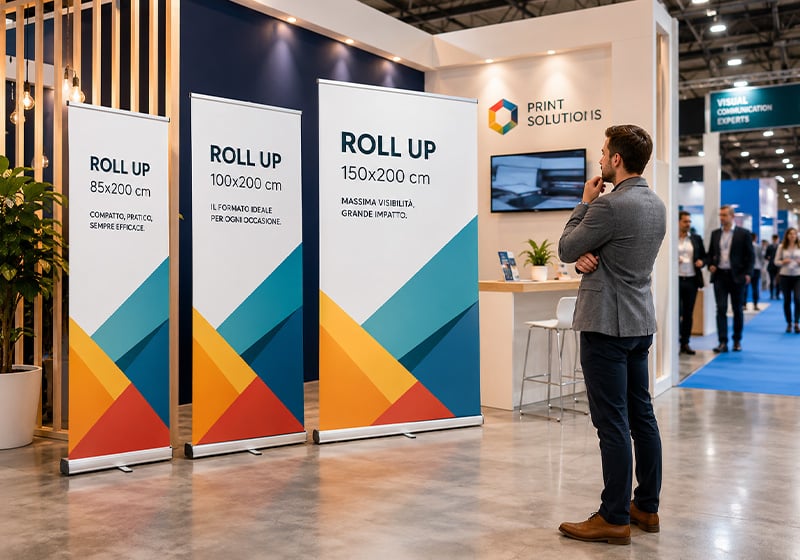
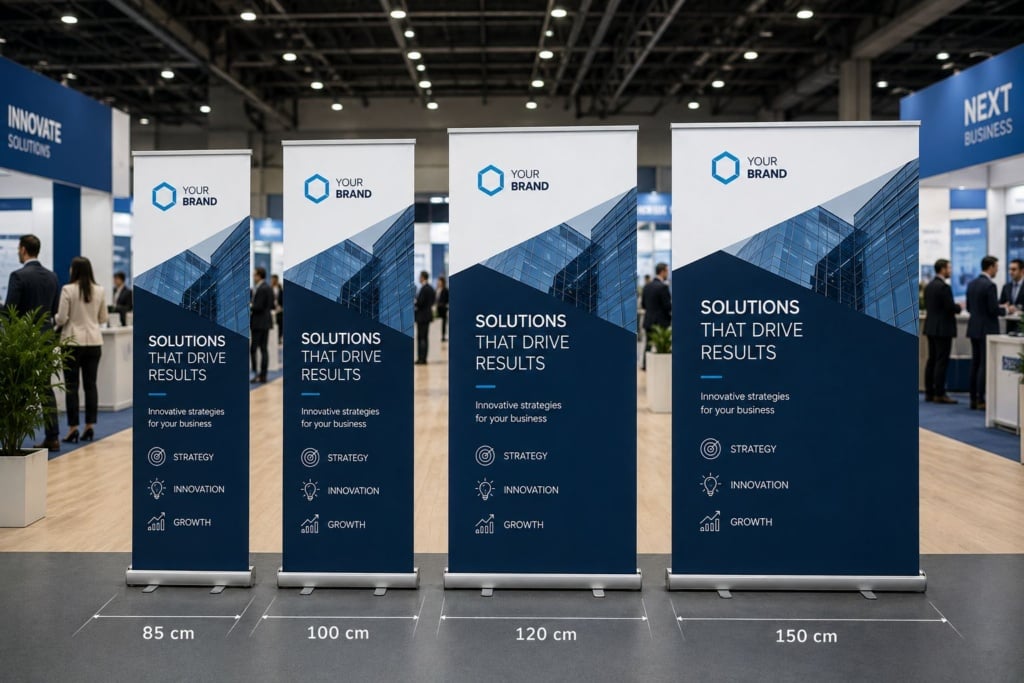
The most common roll up banner dimensions are 850 x 2000 mm, 1000 x 2000 mm, 1200 x 2000 mm, 1500 x 2000 mm and 2000 x 2000 mm. The 850 x 2000 mm format is the most widely used in shops, receptions and commercial spaces, while the 1000 x 2000 mm version is often the preferred choice for exhibitions, conferences and events thanks to its excellent balance between visibility and practicality.
What is a roll up banner and why do dimensions matter?
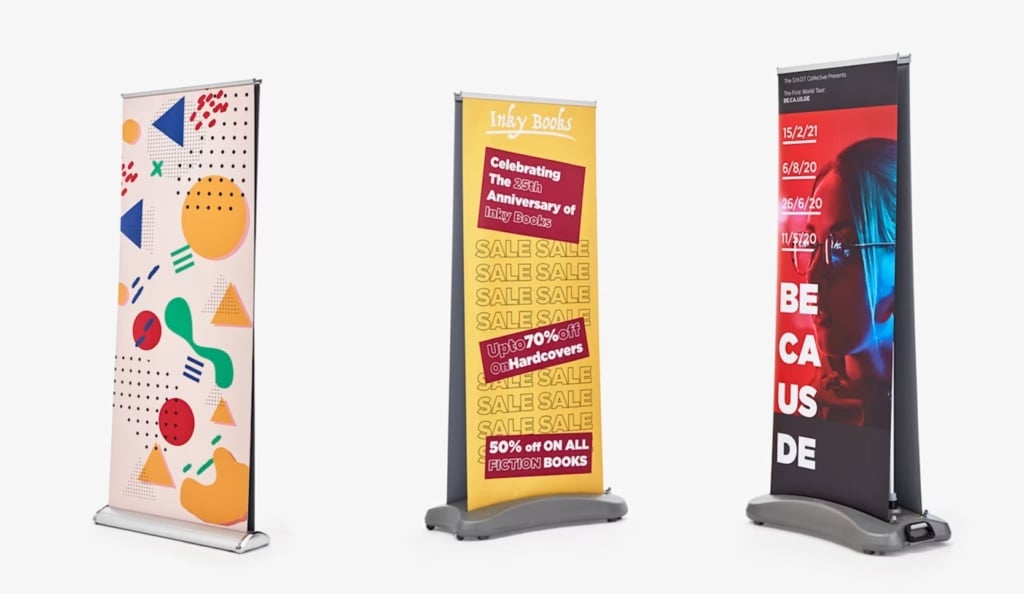
A roll up banner is a self-standing display system consisting of a printed graphic that retracts into a compact aluminium base. When in use, the graphic is pulled up and secured to a support pole, creating a professional vertical display surface for promotional, informational or branding messages.
Its popularity stems from four key advantages:
- easy transportation;
- quick assembly;
- compact storage;
- excellent cost-to-visibility ratio.
Because roll up banners are so versatile, choosing the right size is an important decision.
A small banner positioned in a shop entrance serves a very different purpose from a large display used in a busy exhibition hall. Selecting the wrong format can reduce visibility, compromise readability and ultimately limit the effectiveness of your investment.
What are the standard roll up banner sizes?
Which roll up banner size is the most popular?
If there is one format that could be considered the industry standard, it is undoubtedly the 850 x 2000 mm roll up banner.
Its popularity comes from its versatility. It offers a generous display area while remaining easy to transport, store and position in a wide variety of environments.
For businesses that regularly attend trade shows and exhibitions, however, the 1000 x 2000 mm format is often regarded as an even more effective option, thanks to its stronger visual presence and greater flexibility for graphic design.
Although custom solutions are available, the market is largely built around a handful of standard sizes capable of meeting most display requirements.
| Size | Typical Use | Recommended Viewing Distance | Visual Impact |
| 850 x 2000 mm | Retail stores, receptions, promotional areas | 1–3 metres | Medium |
| 1000 x 2000 mm | Exhibitions, conferences, showrooms | 2–5 metres | High |
| 1200 x 2000 mm | Medium-sized exhibition stands | 3–6 metres | High |
| 1500 x 2000 mm | Events, product launches, branded backdrops | 4–8 metres | Very High |
| 2000 x 2000 mm | Large exhibition spaces | Over 8 metres | Maximum |
Let’s take a closer look at the strengths and limitations of each format.
850 x 2000 mm Roll Up Banner
This is by far the most widely used size and is often the first choice for businesses investing in roll up banners.
Its relatively compact width makes it suitable for almost any environment without becoming intrusive.
Best suited for
- retail stores;
- corporate receptions;
- professional offices;
- pharmacies;
- promotional corners;
- local events.
Advantages
- cost-effective;
- easy to transport;
- compact footprint;
- highly versatile.
Limitations
In very large venues it may not attract as much attention as wider formats.
1000 x 2000 mm Roll Up Banner
Many professionals consider this size the ideal balance between practicality and visibility.
While the increase in width compared with the 850 mm format may appear modest on paper, the difference is immediately noticeable in real-world applications.
Best suited for
- trade shows;
- conferences;
- business events;
- showrooms;
- corporate presentations.
Advantages
- increased visibility;
- more design flexibility;
- additional space for images and messaging.
Limitations
Slightly bulkier during transport and storage.
1200 x 2000 mm Roll Up Banner
This format begins to take on a much stronger exhibition role.
It is particularly suitable when the banner is intended to become a central element of the display.
Ideal for
- exhibition stands;
- industry events;
- product launches;
- larger retail environments.
Advantages
- stronger visual impact;
- more space for branding and imagery;
- excellent long-distance readability.
Limitations
- larger footprint;
- less convenient to transport;
- higher cost than standard formats.
1500 x 2000 mm Roll Up Banner
With its larger display area, this format approaches the concept of a compact exhibition wall.
It is ideal for showcasing impactful imagery, product photography and high-profile branding campaigns.
Ideal for
- photo backdrops;
- corporate events;
- conferences;
- presentations.
Advantages
- strong visual presence;
- excellent image reproduction;
- highly visible in busy environments.
Limitations
- requires more space;
- less portable than smaller formats;
- higher investment.
2000 x 2000 mm Roll Up Banner
This format is designed for businesses seeking maximum visibility.
In large venues and busy exhibition halls, it can attract attention from considerable distances.
Advantages
- maximum visibility;
- exceptional graphic impact;
- ideal for large-scale events and exhibition spaces.
Limitations
- increased logistical requirements;
- requires significant floor space;
- higher overall cost.
How to Choose the Right Roll Up Banner Size
Many people search for standard roll up banner dimensions, but the real question is usually:
Which size is right for my specific needs?
In many cases, the difference between an effective roll up banner and one that goes unnoticed has little to do with print quality or graphic design. Instead, it comes down to selecting a format that suits the environment in which it will be used.
A banner that is too small may struggle to attract attention, while one that is too large can appear disproportionate to the available space.
Before making a decision, it is worth considering four key factors.
Available Space
The first consideration is where the banner will be displayed.
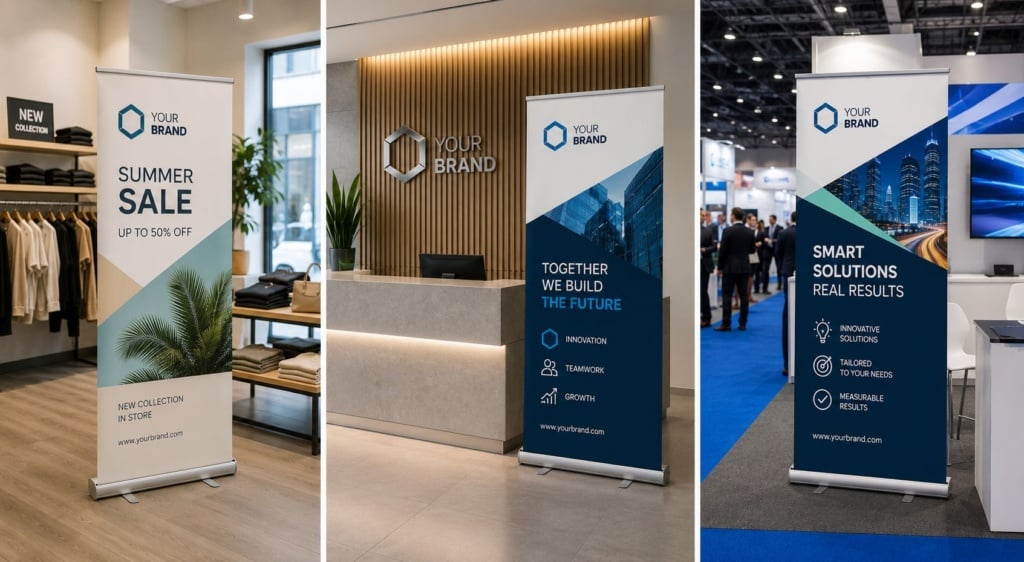
A small retail shop, a reception area or a narrow corridor presents very different requirements compared to an exhibition stand or conference venue.
If space is limited, an 850 x 2000 mm roll up banner often provides the ideal balance between visibility and practicality. Conversely, in larger venues, a smaller banner may fail to stand out.
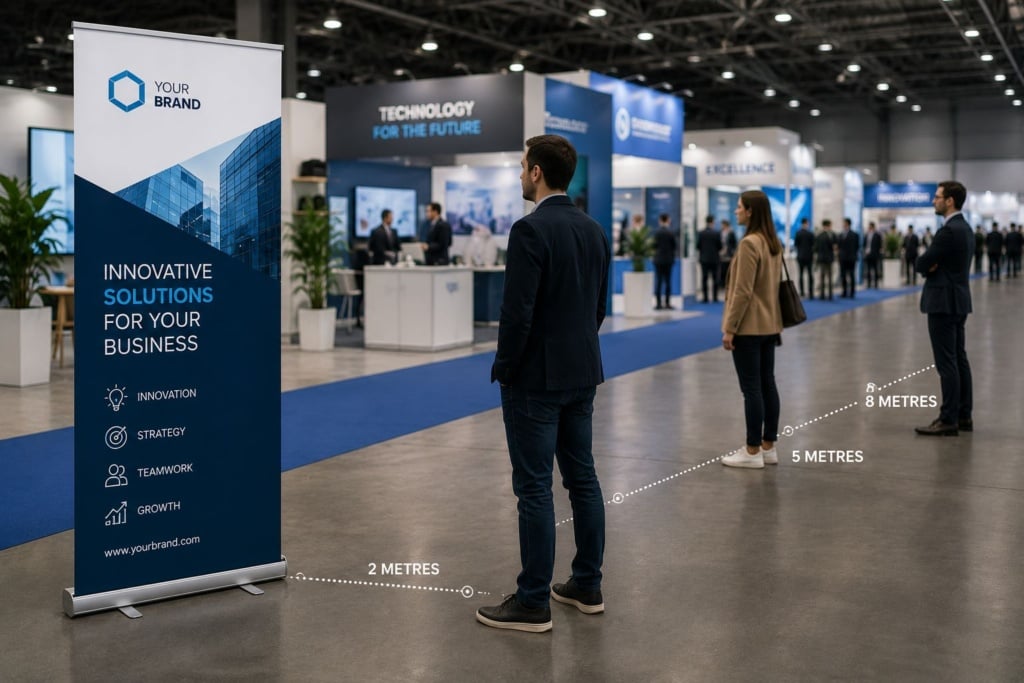
Viewing Distance
Another frequently overlooked factor is the distance from which visitors will see the display.
There is a significant difference between someone standing one metre away and a visitor spotting your stand from the other side of an exhibition hall.
As a general guideline:
- up to 2 metres → 850 x 2000 mm;
- between 2 and 5 metres → 1000 x 2000 mm;
- over 5 metres → 1200 mm wide or larger.
Naturally, readability will also depend on the size of the text and the quality of the design.
Amount of Content
A roll up banner should never become a vertical brochure.
If the message is simple and direct, a standard-size banner will often be sufficient.
However, if you need to display:
- multiple products;
- several photographs;
- infographics;
- technical information;
a larger format may help maintain clarity and visual balance.
Communication Goals
Roll up banners can serve a variety of purposes.
They may be used to:
- increase brand awareness;
- promote a product;
- advertise a special offer;
- direct visitors;
- attract traffic to a stand.
Understanding the primary objective will help determine the most suitable format.
Quick Guide to Choosing the Right Format
If you’re looking for a simple recommendation, the following table provides a useful starting point.
| If you need to… | Recommended Format |
| Equip a reception area | 850 x 2000 mm |
| Promote a business in-store | 850 x 2000 mm |
| Attend a trade show | 1000 x 2000 mm |
| Furnish a showroom | 1000 x 2000 mm or 1200 x 2000 mm |
| Launch a new product | 1200 x 2000 mm or 1500 x 2000 mm |
| Create a promotional backdrop | 1500 x 2000 mm |
| Communicate in large spaces | 2000 x 2000 mm |
Which Banner Size Works Best in Different Situations?
One of the most common questions is not about dimensions themselves, but how they perform in real-world environments.
Let’s look at the most suitable formats for common applications.
Roll Up Banners for Trade Shows and Exhibitions
Trade shows are probably the environment where roll up banners are used most frequently.
In these situations, the goal is usually to attract attention quickly and encourage visitors to approach the stand.
For this reason, the 1000 x 2000 mm format is often considered the most balanced option.
It provides strong visibility without becoming difficult to transport and offers plenty of space for branding, imagery and key messages.
For larger stands or major product launches, businesses may also consider 1200 mm or 1500 mm wide formats.
Roll Up Banners for Retail Stores
In retail environments, roll up banners are often used to highlight:
- promotions;
- new products;
- services;
- seasonal campaigns.
In most cases, an 850 x 2000 mm banner is more than sufficient.
It attracts attention without overwhelming the available space.
Roll Up Banners for Corporate Receptions
Reception areas serve a slightly different purpose.
Rather than selling a product, the banner is often used to reinforce corporate identity, communicate values and strengthen brand perception.
For this reason, the standard 850 mm format is usually an excellent choice.
Roll Up Banners for Showrooms
Showrooms place a strong emphasis on visual presentation.
Product photography and brand imagery often play a central role in the visitor experience.
As a result, many businesses choose 1000 x 2000 mm or 1200 x 2000 mm formats to maximise visual impact.
Roll Up Banners as Promotional Backdrops
When the banner forms part of the overall display or is intended to serve as a photographic backdrop, larger formats are generally preferable.
The 1500 x 2000 mm and 2000 x 2000 mm versions create a much stronger visual presence and are particularly effective for branded environments.
How Visible Is a Roll Up Banner in Practice?
This is one of the most interesting questions and one that is rarely addressed in articles about banner sizes.
Many people assume that choosing the largest format automatically guarantees better results.
In reality, size is only one element of the equation.
Visibility is also influenced by:
- font size;
- colour contrast;
- image quality;
- lighting conditions;
- banner placement.
A well-designed 850 mm banner can be far more effective than a poorly designed 1500 mm banner overloaded with information.
For this reason, banner dimensions should always be considered alongside graphic design. A larger format cannot compensate for a confusing layout, while a clear and focused design can perform exceptionally well even in smaller formats.
How Much Content Should a Roll Up Banner Include?
One of the most common mistakes is attempting to fill every available centimetre with information.
A roll up banner is not a brochure and should not be treated like a webpage.
Many designers follow what is often called the three-second rule.
According to this principle, a visitor should be able to understand the main message within approximately three seconds.
If it takes twenty or thirty seconds to work out what the banner is trying to communicate, the design is probably too complicated.
To maximise effectiveness, it is generally advisable to:
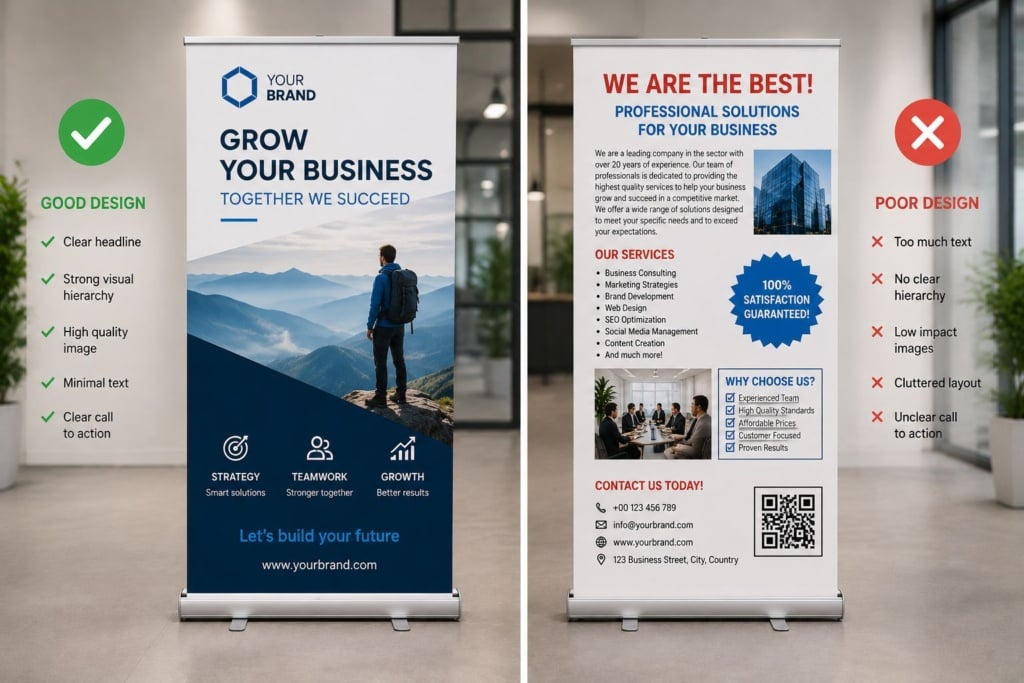
- use a strong headline;
- minimise text;
- prioritise high-quality images;
- maintain a clear visual hierarchy;
- focus on a single primary call to action.
The goal is not to explain everything, but to capture attention and encourage further engagement.
How to Design an Effective Roll Up Banner
Choosing the right size is only part of the process.
Even the best format can lose impact if it is paired with a weak or cluttered design.
One of the most widely used design principles is to structure the banner according to the natural path of the viewer’s gaze.
The logo and main message are usually positioned at the top, where they immediately attract attention.
The central area is generally reserved for:
- imagery;
- products;
- key benefits;
- strong visual elements.
The lower section is often used for:
- contact details;
- website addresses;
- QR codes;
- supporting information.
Top Section: The Main Message
This is the most important area of the banner.
It should typically contain:
- your logo;
- slogan;
- value proposition;
- key message.
Middle Section: The Core of the Communication
This is where most viewers focus their attention.
Product images, benefits and supporting visuals should generally appear here.
Bottom Section: Supporting Information
As this is the least-viewed area, it is usually best to avoid placing critical information here.
Instead, use it for contact details, QR codes and secondary calls to action.
Common Mistakes to Avoid
Choosing the right roll up banner size is important, but it is not the only factor that determines success. Even the most appropriate format can fail to deliver results if common mistakes are made during the planning and design stages.
Including Too Much Text
This is arguably the most common mistake.
Many businesses try to use every available centimetre of the banner to explain their products, services or competitive advantages.
However, a roll up banner is not designed to be read like a brochure or a webpage.
Visitors usually spend only a few seconds looking at a display. If the main message is hidden within large blocks of text, it is likely to be overlooked.
Using Low-Quality Images
Pixelated or low-resolution images immediately create an impression of poor quality and lack of professionalism.
Because roll up banners are printed at a large scale, it is essential to use high-resolution visuals that remain sharp and attractive when enlarged.
Ignoring Viewing Distance
A design that looks perfectly readable on a computer screen may be difficult to understand when viewed from several metres away.
For this reason, it is important to use:
- large, clear headlines;
- readable typography;
- strong colour contrast;
- concise messaging.
Choosing a Size Based Solely on Price
The cheapest option is not always the most cost-effective.
A banner that is too small for its environment may struggle to attract attention and reduce the overall return on investment.
Selecting the right size for the intended context often delivers better results with only a modest increase in cost.
Roll Up Banners, PVC Banners and Exhibition Walls: Which Should You Choose?
Many businesses preparing for an event, exhibition or promotional campaign face a common question:
Should I choose a roll up banner, a PVC banner or an exhibition wall?
The answer largely depends on the available space, budget and desired visual impact.
| Solution | Key Advantages | Best Used For |
| Roll Up Banner | Easy to transport and assemble | Trade shows, events, receptions |
| PVC Banner | Cost-effective and suitable for large surfaces | Temporary or permanent installations |
| Exhibition Wall | Maximum visual impact | Large stands and major events |
Roll Up Banners
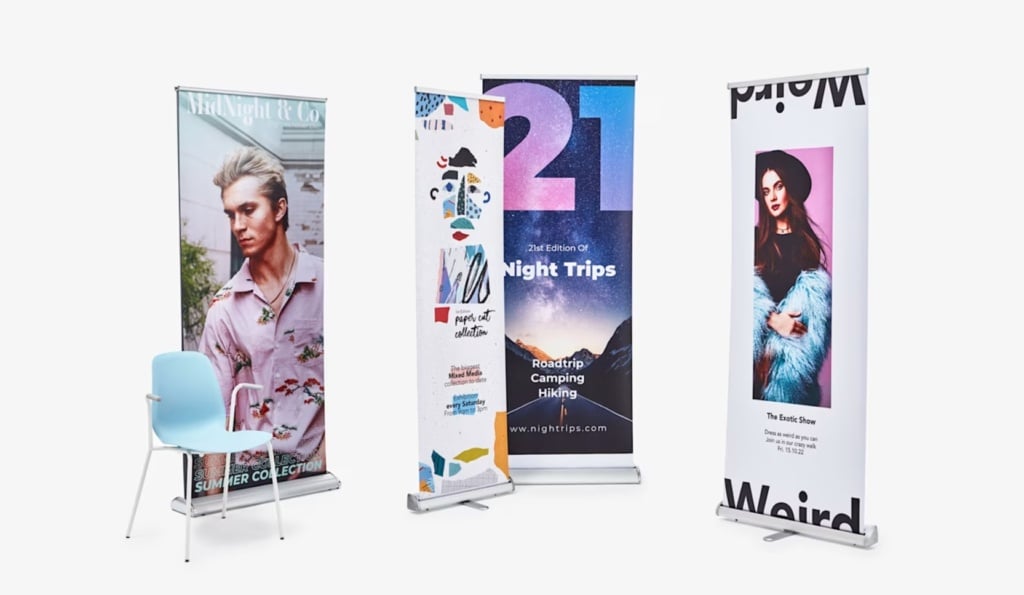
Roll up banners are among the most versatile display solutions available.
They are particularly suitable for:
- exhibitions;
- conferences;
- reception areas;
- showrooms;
- corporate events;
- short-term promotional campaigns.
Their main advantage is convenience. They can be transported, assembled and dismantled quickly, making them ideal for businesses that regularly attend events.
PVC Banners
Custom PVC banners are an economical solution for covering large areas.
They are especially useful when a structure is already available for installation, such as a wall, fence or frame.
However, unlike roll up banners, they require a dedicated mounting system and are less convenient to transport and set up.
L-Backdrop Banners
L-Backdrop Banners are a large-format display solution particularly well suited to trade shows, events and corporate presentations.
Unlike a roll up banner, which is typically used to communicate a specific message, an L-Backdrop Banner provides a larger graphic area and a stronger visual presence.
It allows you to create high-impact promotional backdrops while maintaining ease of transport and assembly.
When the goal is to increase brand visibility or attract attention in larger spaces, it may be worth considering custom L-Backdrop Banners.
How to Prepare Artwork for Printing
Once you have selected the most suitable banner size, the next step is preparing your artwork correctly.
A properly prepared file helps prevent errors that could affect the final printed result.
As a general rule, it is advisable to:
- use the correct template for the chosen format;
- work with high-resolution images;
- respect bleed and safety margins;
- check fonts and graphic elements;
- export the artwork as a print-ready PDF.
It is important to remember that each banner size usually has its own dedicated template.
Using the correct template ensures that logos, images and text remain within safe areas and reduces the risk of unwanted cropping during production.
To simplify the process, templates are available for the various custom roll up banner models offered by Pixartprinting.
How to Order a Custom Roll Up Banner from Pixartprinting
Once you have chosen the right format and prepared your artwork, ordering a roll up banner is straightforward.
At Pixartprinting, you can configure your Roll Up Banners online by selecting the dimensions, quantity and technical specifications that best suit your requirements.
The process typically involves:
- selecting the banner model;
- choosing the size;
- downloading the template;
- uploading the artwork;
- reviewing the print specifications;
- confirming the order.
With a wide range of customisable roll up banners available, it is possible to find a solution suitable for everything from local promotional events to major international exhibitions.
When Is a Roll Up Banner the Right Choice?
One of the greatest strengths of roll up banners is their versatility.
They can be used in a wide variety of situations, including:
- trade shows and exhibitions;
- showrooms;
- retail environments;
- corporate receptions;
- conferences;
- open days;
- product launches;
- business presentations;
- promotional campaigns.
Their combination of portability, ease of use and visual impact explains why they remain one of the most popular forms of offline marketing communication.
Frequently Asked Questions About Roll Up Banner Sizes
What is the standard roll up banner size?
The most common format is 850 x 2000 mm, although 1000 x 2000 mm, 1200 x 2000 mm, 1500 x 2000 mm and 2000 x 2000 mm formats are also widely available.
What size roll up banner is best for exhibitions?
For most exhibition stands, a 1000 x 2000 mm banner offers an excellent balance between visibility, practicality and ease of transport.
Is an 850 mm or 1000 mm roll up banner better?
It depends on the intended use. An 850 mm banner is more compact and suitable for smaller spaces, while a 1000 mm banner provides greater visual impact and more room for graphics and messaging.
What is the difference between an 850 mm and a 1000 mm roll up banner?
The primary difference is the available display area. A 1000 mm banner offers more space for images, branding and text, making it particularly effective for exhibitions and events.
Which banner size should I choose for a trade show?
For most trade show environments, a 1000 x 2000 mm banner is an excellent choice. Larger exhibition spaces may benefit from 1200 mm or 1500 mm formats.
Which size works best for a 3 x 3 metre exhibition stand?
In many cases, one or more 1000 x 2000 mm banners will provide sufficient visibility. For a stronger visual presence, larger formats or multiple coordinated displays can be considered.
How much floor space does a roll up banner require?
The footprint is generally limited to the base unit, while the overall width depends on the selected format.
From what distance can a roll up banner be read?
This depends on both the banner size and the graphic design. Larger formats generally provide better readability over longer distances.
Can roll up banners be used outdoors?
Most roll up banners are designed primarily for indoor use. For outdoor applications, dedicated weather-resistant display solutions are usually recommended.
How much does a roll up banner weigh?
Weight varies according to the model and dimensions, but most roll up banners are lightweight enough to be transported comfortably by one person.
How long does a roll up banner last?
With proper storage and handling, a roll up banner can be reused for many years.
Are roll up banners reusable?
Yes. One of their main advantages is that they can be used repeatedly across multiple events and promotional campaigns.
How do you assemble a roll up banner?
Assembly typically takes only a few minutes. The graphic is pulled from the base, the support pole is assembled and the banner is secured in position.
What image resolution is recommended for a roll up banner?
For the best print quality, high-resolution images should always be used, following the technical specifications provided by the printer.
A Roll Up to Suit Every Need
Roll up banner dimensions are far more than a simple technical specification. They directly influence visibility, audience engagement and the overall effectiveness of your communication.
Choosing the right format means balancing available space, viewing distance, content requirements and marketing objectives.
Ultimately, there is no single “best” roll up banner size. Instead, there is a format that best matches your specific needs and environment.
Understanding these variables before placing an order will help you create a more effective display, improve brand visibility and maximise the return on your investment.
Whether you are furnishing a reception area, enhancing a showroom or preparing for a major exhibition, selecting the right banner size is one of the most important decisions you can make to ensure your roll up banner delivers the desired results.