


Table of Contents
Some objects may seem simple at first glance, yet reveal a great deal about how businesses evolve. The box is one of them.
For years, packaging was seen mainly as a functional element: it had to contain a product, protect it during transport and ensure it arrived safely. That was enough. Today, however, packaging is expected to do much more. It needs to be easy to manage in a warehouse, quick to assemble, sustainable, aligned with the brand identity and satisfying to open.
This shift has become especially visible with the growth of e-commerce. When customers shop online, they do not walk into a physical store, touch the product, speak with staff or experience the atmosphere of the brand. Their first real physical interaction with the company often happens when the parcel arrives at their door.
That is why a box is no longer just a box.
It is the first physical space in which a brand presents itself to the customer.
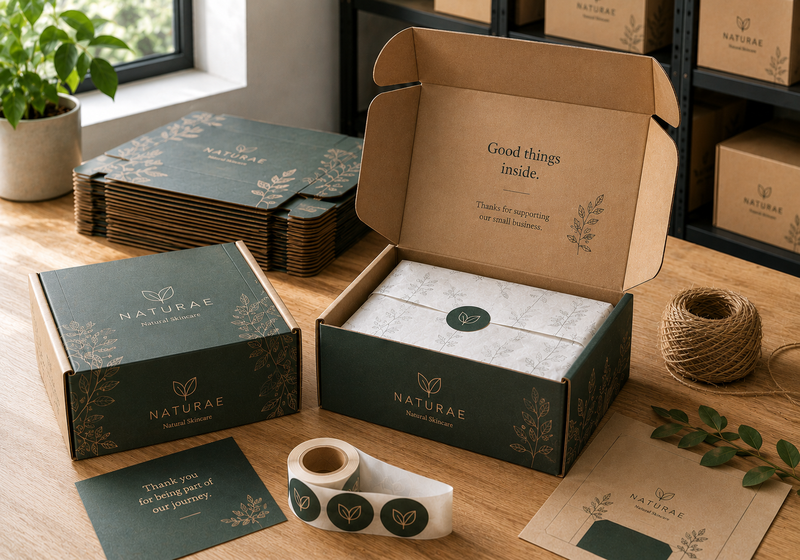
Self-assembling boxes fit perfectly into this scenario. They are cardboard packaging solutions designed to be assembled quickly, without complicated operations, while offering practicality, protection and a more refined presentation than traditional shipping boxes.
In this guide, we will explore what self-assembling boxes are, how they work, when they make sense, what advantages they offer and how to design them intelligently — from choosing the right format to creating effective printed graphics.
What are self-assembling boxes?
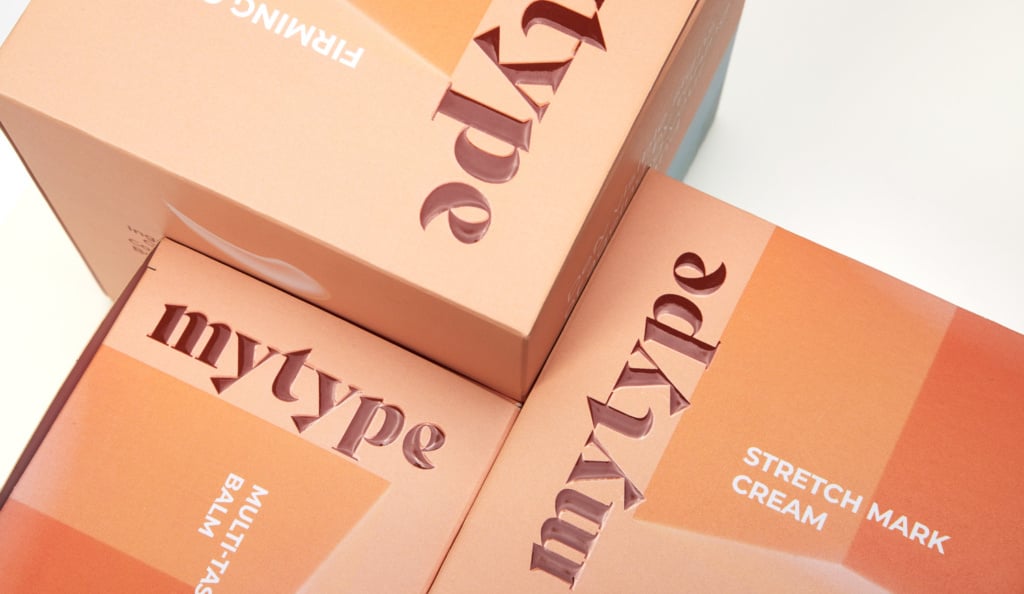
Self-assembling boxes are cardboard boxes designed to be assembled quickly thanks to a predefined structure of folds, tabs and interlocking sections. They are delivered flat, take up little storage space and can be folded into shape in just a few moments when needed.
Their defining feature is the simplified assembly system. In many versions, the base locks automatically into place when the box is opened. In others, tabs and interlocking flaps allow the structure to be assembled without glue, staples or adhesive tape for the main construction.
The advantage is not only technical. It is organisational.
Someone preparing the occasional parcel may barely notice the difference. But businesses handling daily shipments know very well that the time required to assemble packaging affects the rhythm of the entire operation. A difficult box slows work down, increases errors, creates unnecessary steps and can easily become a bottleneck during busy periods.
A self-assembling box is designed precisely to avoid this: transforming packaging from an operational obstacle into a tool for efficiency.
Why are they called self-assembling?
The term “self-assembling” does not mean the box literally assembles itself. It means the structure is engineered to take shape almost automatically, reducing manual handling to a minimum.
In practice, the box is already designed to close correctly thanks to its die-cut structure. Once opened, the base and side sections slot into place following pre-defined folds and interlocking tabs.
This creates a major difference compared to a traditional box, where it is often necessary to:
- open the structure manually;
- fold the lower flaps;
- apply adhesive tape;
- check the stability of the base;
- insert the product;
- seal the parcel again with tape.
With a self-assembling box, many of these steps disappear or become much simpler.
The result is packaging that is quicker to prepare, visually tidier and more consistent in its final appearance.
The difference between self-assembling boxes, regular shipping boxes and die-cut boxes
To choose the right packaging, it is useful to understand a few important distinctions.
Standard shipping boxes
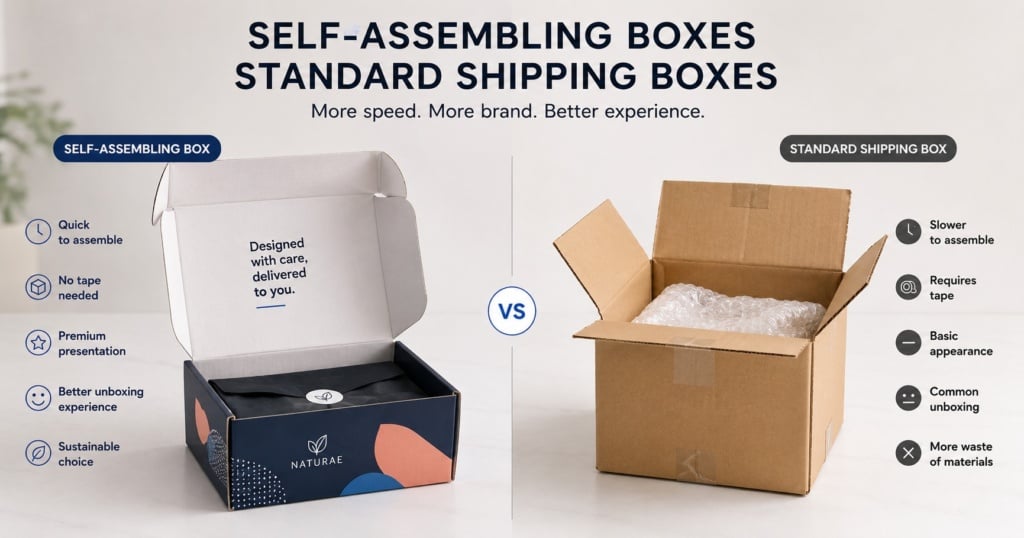
Standard shipping boxes — often known as American boxes or regular slotted containers — are the classic cardboard boxes with four top flaps and four bottom flaps. They are durable, versatile and cost-effective, but almost always require adhesive tape for sealing.
They work perfectly for many logistical purposes, although they usually provide a more basic visual experience and less brand impact.
Die-cut boxes
Die-cut boxes are created from a custom-cut template shaped according to a specific design. They can feature unusual openings, windows, special flaps, custom locking systems or more complex structures.
Self-assembling boxes often belong to this category because they rely on a die-cut structure to achieve their folding mechanism.
Self-assembling boxes
Self-assembling boxes represent a particularly effective balance between practicality, speed and presentation.
They are quicker to prepare than standard shipping boxes while also offering a more polished and branded experience.
That is why they have become one of the most popular packaging solutions for e-commerce, retail and custom shipping projects.
Why self-assembling boxes are so popular in e-commerce
E-commerce has fundamentally changed the role of packaging.
In a physical shop, customers interact with a brand through many different elements: lighting, displays, materials, staff and atmosphere. Online, most of this disappears. What remains is the website, product photography, confirmation emails, shipping updates and finally the parcel itself.
Packaging therefore becomes a crucial part of the customer experience.
A generic or awkward parcel can make even a high-quality product feel ordinary. On the other hand, well-designed packaging can reinforce quality perception, strengthen trust and make delivery feel memorable.
Self-assembling boxes respond particularly well to two needs that matter greatly in e-commerce.
On one side, efficiency. Online stores need to prepare orders quickly, reduce mistakes, handle seasonal peaks and control operational costs.
On the other side, experience. Customers are not simply receiving a product; they are receiving a promise fulfilled. The way the product arrives contributes directly to how the brand is perceived.
For this reason, a custom self-assembling box can become far more than a container. It can become the meeting point between logistics and communication.
The advantages of self-assembling boxes
Faster packing operations
The most immediate advantage is speed.
In a small workshop, warehouse or fulfilment department, repetitive actions consume a surprising amount of time. Opening a box, folding the base, applying tape, checking the closure, filling the parcel and sealing it again may seem simple individually, but repeated hundreds of times they become a major operational task.
A self-assembling box reduces many of these steps. This means more orders can be prepared in less time, with less effort and greater consistency.
The goal is not simply to “work faster”. It is to create a smoother and more stable process. When packaging is easy to assemble, there are fewer mistakes, fewer badly sealed parcels and fewer inconsistencies between shipments.
For a brand, consistency matters. Every customer should receive a similar experience regardless of who packed the order.
Better space management
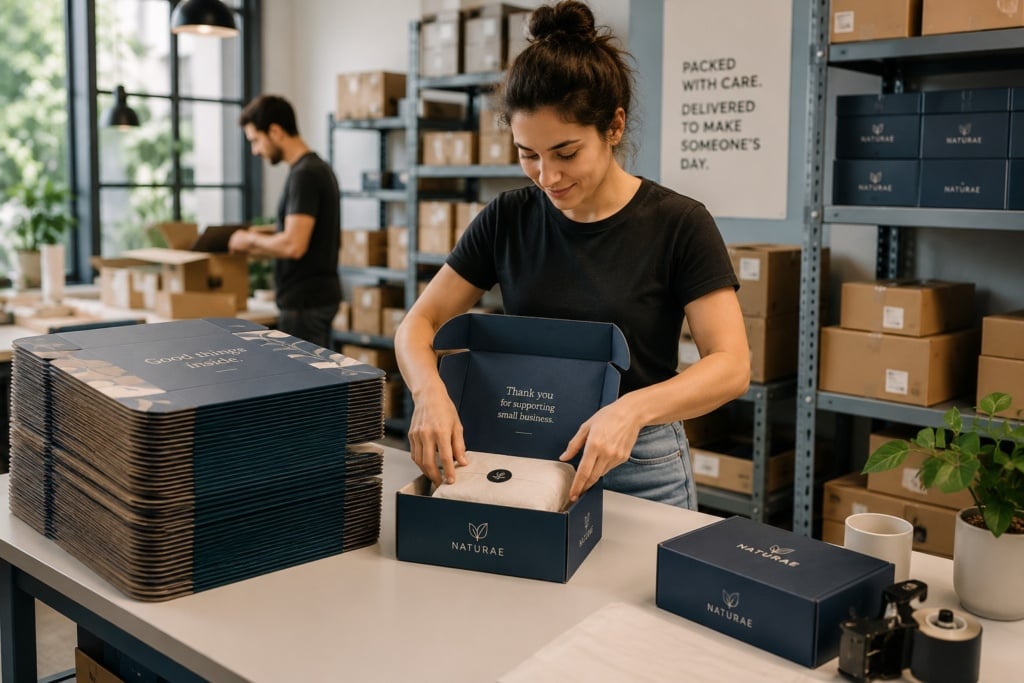
Self-assembling boxes are usually delivered flat-packed. This makes them easier to store and reduces the amount of space required before use.
This is especially useful for:
- small e-commerce businesses;
- physical shops managing online orders;
- artisan workshops;
- marketing teams preparing promotional kits;
- companies with limited warehouse space.
Packaging should not complicate daily operations. If it occupies too much room or is difficult to handle, it quickly creates hidden operational costs.
A good self-assembling box helps separate two important phases: compact storage and fast, efficient use.
A more refined presentation
Compared with a traditional shipping box, a self-assembling box often communicates greater attention to detail.
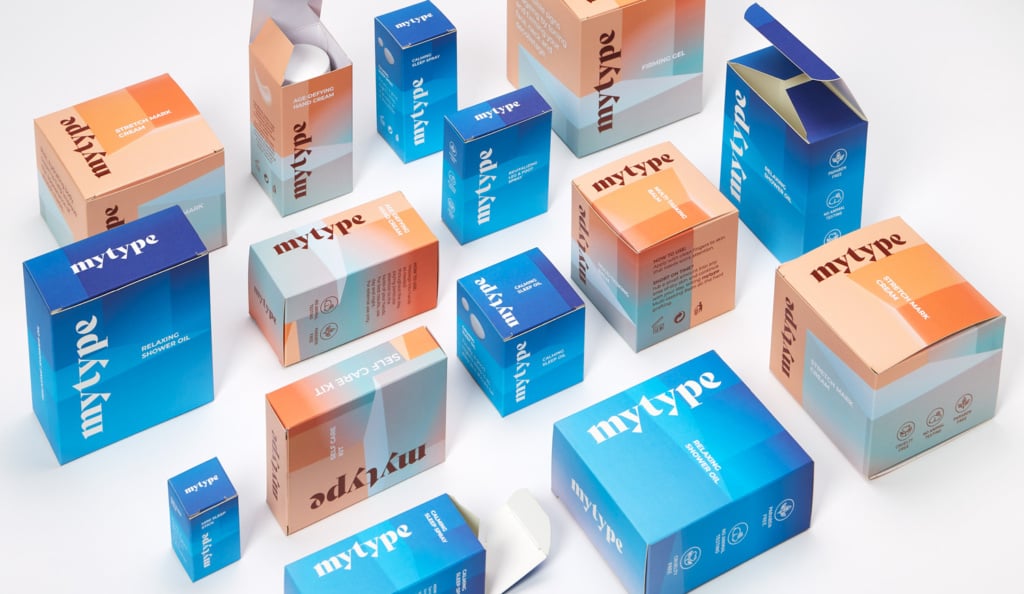
The lines are cleaner, the closure feels neater and the opening experience is more pleasant. This makes these boxes suitable not only for shipping, but also for projects where the packaging contributes directly to product perception.
Think about cosmetics brands, artisan producers, candle makers, premium accessories or businesses sending promotional kits. In all these cases, the packaging does more than protect the contents — it helps present them properly.
The structure of the box becomes part of the message itself.
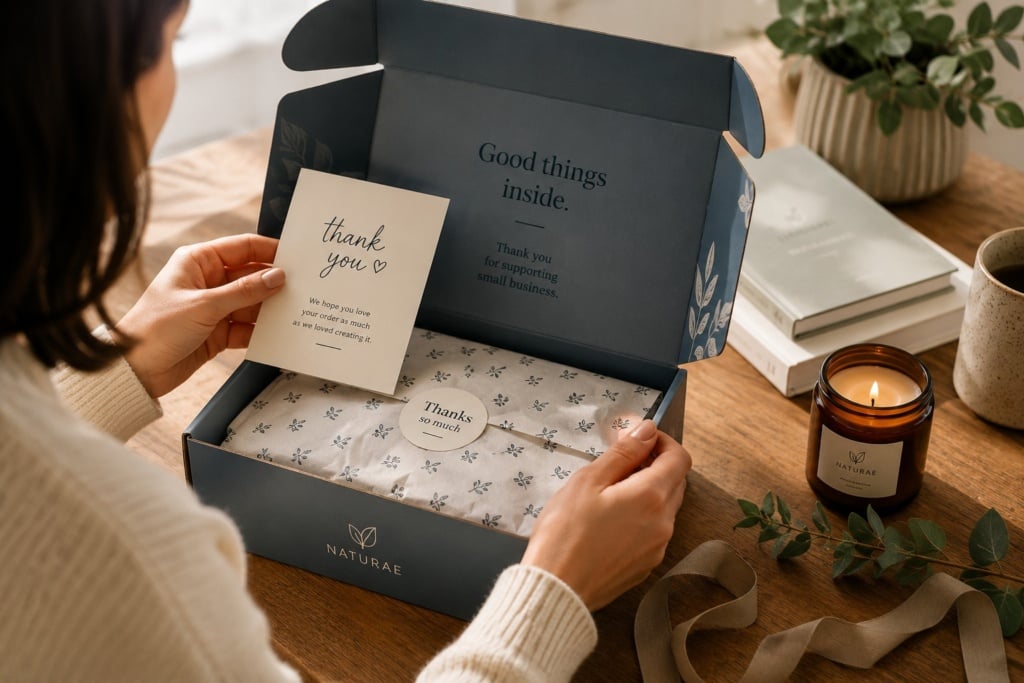
A stronger unboxing experience
Unboxing is not simply a social media trend. It is a specific psychological moment: the transition between anticipation and ownership.
When customers open a parcel, they unconsciously evaluate many details:
- ease of opening;
- internal organisation;
- material quality;
- printed graphics;
- product protection;
- personalised elements.
A well-designed self-assembling box can make this moment feel smoother and more memorable. It does not necessarily require luxurious or overly elaborate packaging. Sometimes a clean structure, coherent graphics and thoughtful details are enough to create a stronger impression.
Unboxing works best when customers feel the product was not merely shipped, but carefully prepared for them.
More effective personalisation
Self-assembling boxes work particularly well for custom printing. They can include:
- logos;
- branded patterns;
- corporate colours;
- illustrations;
- internal messages;
- QR codes;
- seasonal graphics;
- storytelling elements.
Personalisation should not simply mean “adding a logo”. That is only the starting point.
A well-developed packaging project can help:
- strengthen brand positioning;
- differentiate product lines;
- improve recognition;
- create visual consistency;
- build a more memorable customer experience.
In crowded markets, recognisable packaging can become a significant competitive advantage.
When self-assembling boxes make sense
Self-assembling boxes are especially effective when packaging needs to combine practical and communicative functions.
They are ideal for brands aiming to improve both operational efficiency and customer perception.
For e-commerce and regular shipping
Businesses preparing large numbers of parcels benefit greatly from faster assembly times.
Self-assembling boxes are particularly suitable for:
- fashion and accessories;
- cosmetics;
- publishing products;
- gadgets;
- small tech items;
- handmade products;
- homeware;
- promotional kits.
Naturally, the right solution always depends on product weight, fragility and dimensions.
For products with strong brand identity
Some products depend heavily on presentation. Perfumes, artisan candles, premium accessories and gift kits are judged not only by their function, but also by the experience surrounding them.
In these cases, a personalised self-assembling box can help elevate product perception and reinforce brand coherence.

For events and promotional kits
Self-assembling boxes are also highly useful for:
- press kits;
- influencer boxes;
- welcome packs;
- promotional materials;
- events;
- special campaigns;
- client gifting.
In these situations, packaging takes on a narrative role. It should spark curiosity, organise different elements and communicate professionalism immediately.
When they may not be the best choice
A useful guide should also explain limitations.
Self-assembling boxes are not always the ideal solution. In some cases, regular shipping boxes, rigid boxes, padded envelopes or entirely bespoke packaging may be more appropriate.
They may not be the best choice when:
- products are extremely heavy;
- highly specialised internal protection is required;
- minimising unit cost is the main objective;
- industrial transport packaging is needed;
- packaging has no branding function;
- the product shape is highly irregular.
The right choice always comes from balancing product needs, logistics, budget and brand goals.
How to choose the right self-assembling box
Choosing packaging does not mean selecting the “prettiest” box. It means starting with the product and the journey it needs to make.
A good choice balances:
- dimensions;
- durability;
- shipping method;
- opening experience;
- brand identity.
Choosing the right size
A box that is too large creates empty space, requires additional filler material and can increase shipping costs. It may also communicate wastefulness.
A box that is too small can damage the product or make opening awkward.
The best packaging feels as though it was designed specifically for its contents.
Materials: protection and perception
Cardboard is not merely a technical support. It affects:
- protection;
- weight;
- cost;
- durability;
- visual perception.
Before selecting materials, it is worth asking:
- Is the product fragile?
- Is it heavy?
- Should the packaging feel premium or minimal?
- Will customers keep the box or discard it immediately?
- Will shipments travel internationally?
These questions help create more coherent packaging choices.
Closures and opening experience
The closure system influences both security and usability.
An awkward opening experience can feel frustrating. A clean and intuitive one, on the other hand, communicates quality and care.
In contemporary packaging, even the act of opening the box is part of the brand experience.
Designing graphics for self-assembling boxes
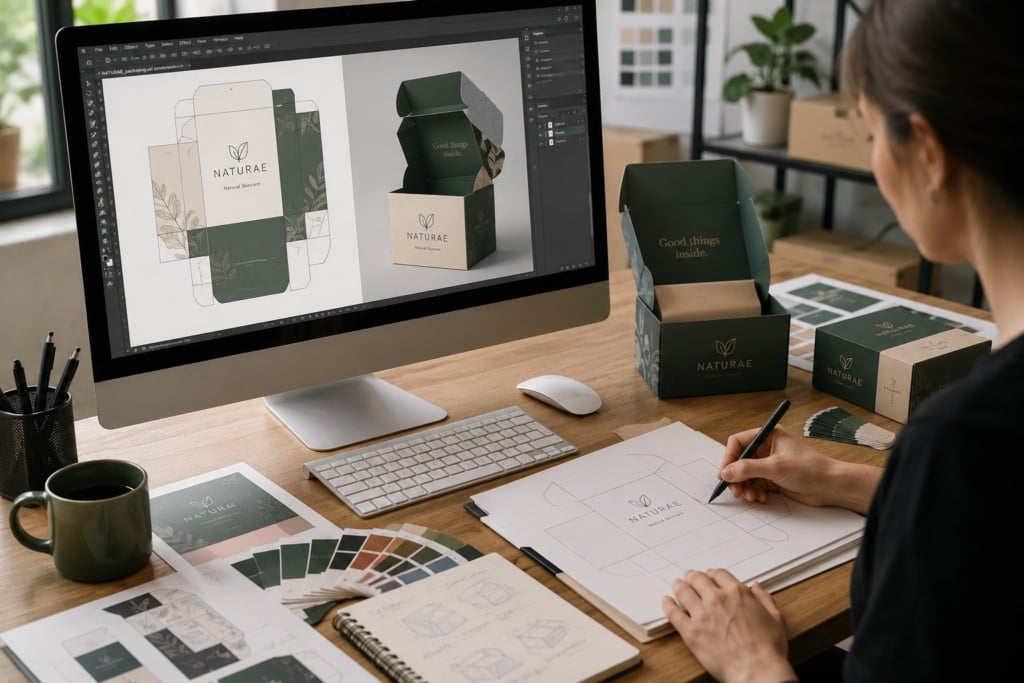
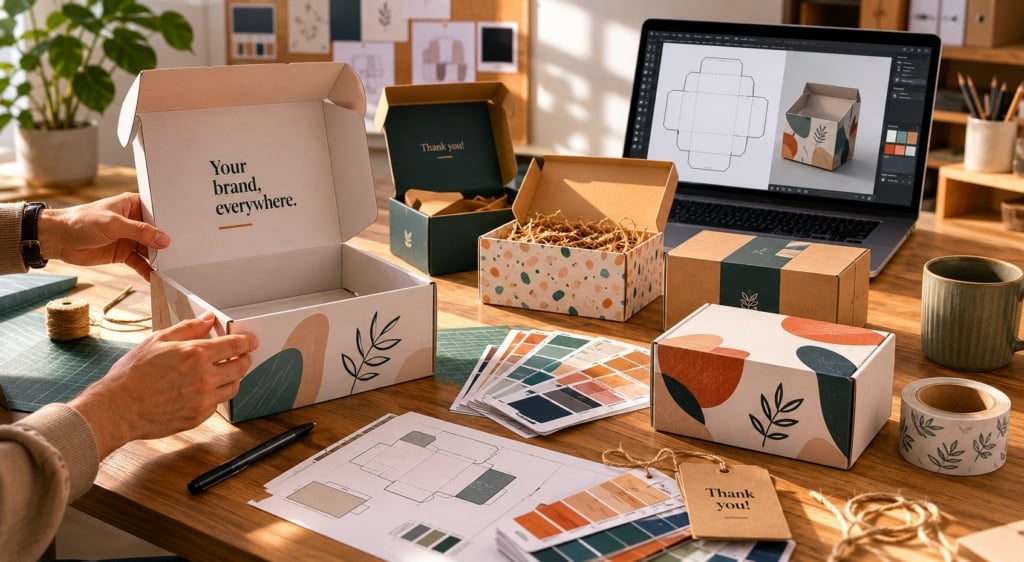
Packaging design is not the same as designing a flat leaflet. Graphics need to work on a three-dimensional structure that will be folded, handled, viewed from different angles and ultimately opened.
This means the design must consider:
- folds;
- visible surfaces;
- opening points;
- orientation;
- visual hierarchy.
A logo alone is not enough
Many custom packaging projects stop at placing the logo in the centre of the box. While perfectly valid, this is rarely enough to create a memorable experience.
More effective packaging considers:
- visual rhythm;
- colour usage;
- graphic consistency;
- relationships between interior and exterior;
- emotional impact during opening.
The question should not simply be: “Where do we place the logo?”
The real question is: “What should customers feel when they receive and open this box?”
Exterior and interior can communicate differently
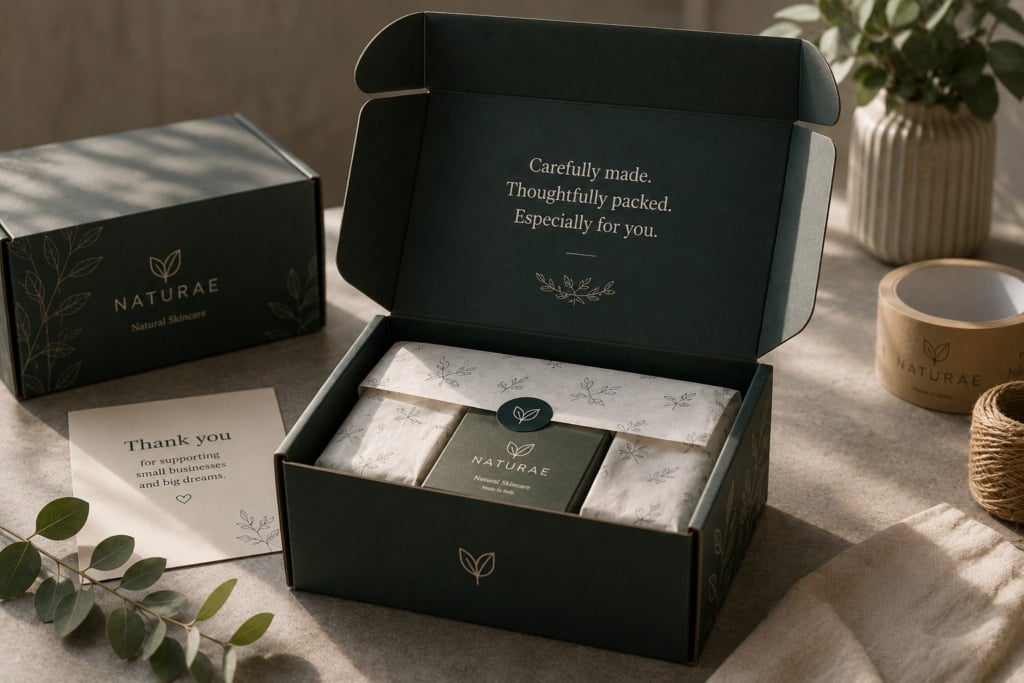
The outside of the box often focuses on recognition and clarity. The inside, however, can be used to surprise, thank or emotionally connect with customers.
An internal message, unexpected colour or subtle graphic detail can transform a simple parcel into a more personal experience.

Preparing print-ready artwork correctly
Creativity matters, but the final result also depends heavily on technical preparation.
When creating artwork for self-assembling boxes, it is important to pay attention to:
- bleed areas;
- safety margins;
- cut lines;
- fold lines;
- image resolution;
- colour profiles;
- panel orientation;
- logo and text placement.
One of the most common mistakes is designing graphics as though the box were a flat surface without considering how it will look once assembled.
Before sending artwork to print, it is worth imagining the fully assembled box: what customers will see first, where the logo will appear and how the opening sequence will work visually.
How to personalise and order self-assembling boxes online
Today, creating custom packaging is much more accessible than it once was.
With Pixartprinting’s custom self-assembling boxes it is possible to configure sizes, materials, print options and quantities in order to create packaging tailored to specific business needs.
The ideal process usually involves:
- defining what the box needs to contain;
- selecting the correct dimensions;
- choosing suitable materials;
- designing artwork carefully;
- reviewing print files thoroughly;
- configuring quantities and timings;
- checking every detail before ordering.
Common mistakes to avoid
Focusing only on aesthetics
A beautiful box that is difficult to assemble or poorly suited to the product is not good packaging.
Appearance matters, but functionality always comes first.
Underestimating packing time
Many brands focus only on unit cost while forgetting the time required to use the packaging.
A slightly more expensive box that assembles faster can often become more efficient overall.
Overcrowding the graphics
Packaging does not need to say everything.
Too many icons, messages and graphic elements can reduce clarity and weaken visual impact.
In packaging, thoughtful simplicity often communicates quality more effectively than visual overload.
Ignoring the opening moment
Many businesses focus only on the exterior and neglect the inside of the box.
Yet the opening stage is where customers experience the strongest interaction with both product and brand.
Self-assembling boxes and sustainability
Sustainability in packaging cannot be reduced simply to using recyclable cardboard.
More responsible packaging comes from a combination of decisions:
- optimising dimensions;
- avoiding unnecessary materials;
- reducing plastic usage;
- improving shipping efficiency;
- making disposal easier.
Self-assembling boxes can support this approach because they often require fewer additional materials and help optimise shipping volumes.
Packaging as an extension of brand identity
A personalised self-assembling box should never feel isolated from the rest of the brand.
It should work coherently with:
- the website;
- tone of voice;
- brand colours;
- social media;
- product photography;
- post-purchase communication.
When all these elements speak the same visual language, the brand feels stronger and more coherent.
Frequently asked questions about self-assembling boxes
Are self-assembling boxes suitable for shipping?
Yes. When the correct size and material are chosen, they provide excellent durability for shipping and transportation.
Do they require glue or adhesive tape?
Usually not for the main assembly. The structure is designed to close through folds and interlocking tabs.
What is the difference between self-assembling boxes and regular shipping boxes?
Regular shipping boxes generally require adhesive tape and have a simpler structure. Self-assembling boxes are quicker to prepare and offer a more refined presentation.
Can they be customised?
Yes. They can be printed with logos, colours, illustrations, internal messages and graphics aligned with brand identity.
Are they suitable for small e-commerce businesses?
Absolutely. Even smaller online stores can benefit from packaging that is quicker to prepare and more visually refined.
Are they sustainable?
They can be, especially when correctly sized and produced using recyclable materials and efficient structural designs.
Conclusion: much more than a simple box
Self-assembling boxes may seem like a simple product. In reality, they respond to many of the most important needs of modern packaging.
They help improve logistics, streamline workflows, reduce operational time, protect products and strengthen brand identity.
But their true value emerges when they are designed thoughtfully.
Because a good self-assembling box is not simply a box that assembles quickly. It is a tool capable of combining efficiency, communication and brand experience within a single physical object.