


Table of Contents
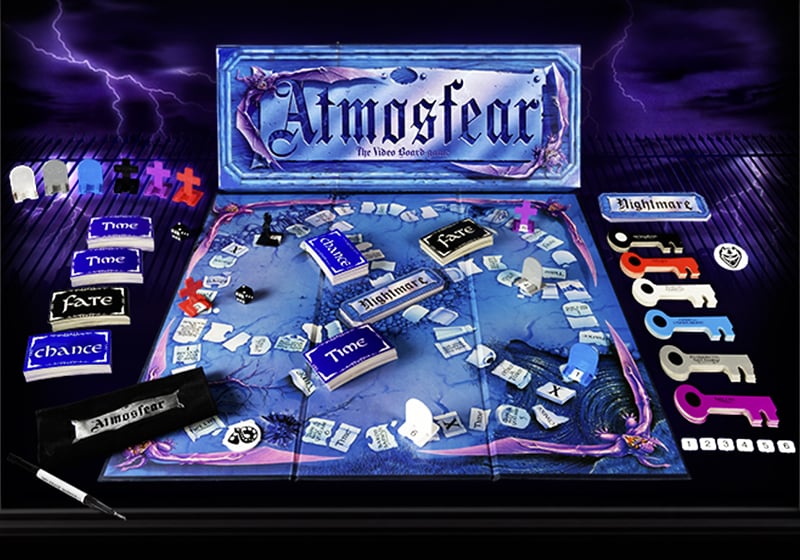
Atmosfear is a board game like no other. Its multimedia design revolutionised gameplay, combining conventional printed components like a board, cards and dice with a novel element: a companion video cassette. On this video, players come face to face with a terrifying character who meddles in gameplay and sets the pace of the action.
Atmosfear’s innovative twist makes it an iconic piece of nineties pop culture, and one of the very first interactive multimedia board games. While Dungeons & Dragons set the mould for collaborative storytelling with pen and paper, Atmosfear introduced the concept of “screen as master“, blending a traditional printed board with video technology.
“Atmosfear is a board game controlled by a video tape. Once you insert the tape in your VCR and press play, the game begins. It is a race against time and the game’s host, The Gatekeeper. Once you press play, you cannot pause or rewind the tape. The Gatekeeper considers it cheating and wins by default.”
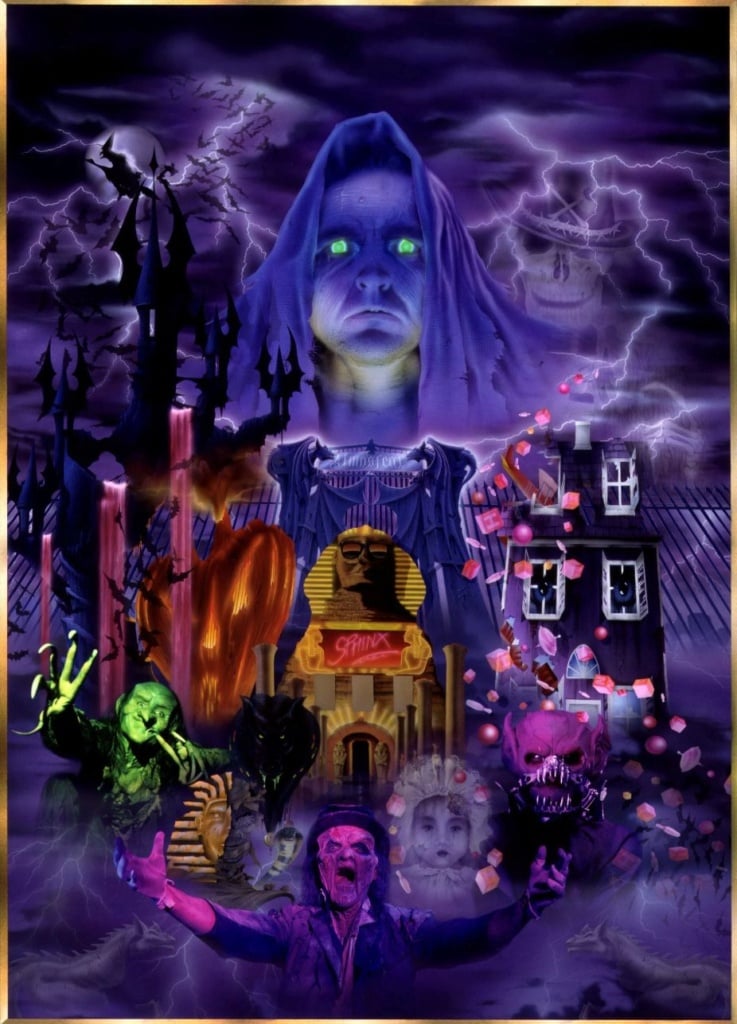
The rules for Atmosfear open with these lines, which neatly sum up the object of this simple yet groundbreaking game.
Once the tape is running, players have exactly 60 minutes to complete the game, all while being constantly interrupted, threatened and bossed around by the creepy figure on the screen known as The Gatekeeper.
An imaginative experiment in gaming, Atmosfear fast became a mainstream phenomenon that sold millions of copies. And as technology evolved, so did the multimedia component, which upgraded from VHS cassettes and DVDs to apps and streaming. The game influenced a whole generation of gamers and paved the way for today’s app-driven board games.
Where it all started: the Atmosfear origin story
The Atmosfear story began when two young TV reporters, Brett Clements and Phillip Tanner, met while working on an Australian children’s TV programme called Simon Townsend’s Wonder World. Inspired by a report filmed at a game distributor, Clements created OZ QUIZ, a Trivial Pursuit-style board game about Australia that came packaged in a cool box. It was a smash hit, selling over 300,000 copies in Australia.
Buoyed by this success, the pair then produced a pilot for a TV show based on the game. When they were pitching to networks, one executive rejected the project out of hand, dismissing the pair as “just a couple of cowboys“. Undeterred, they set up their own production company, which they gave the tongue-in-check name A Couple ‘A Cowboys.
After creating a few more board games, A Couple ‘A Cowboys turned their hands to producing ads and TV shows, too. In 1991, Tanner decided he wanted to make a low-budget horror film. But Clements had the more original idea of combining their TV production skills with their board game experience to create something that could take advantage of the VCRs that were now in every living room. And so NIGHTMARE The Video Board Game! was born.
It took the pair just six months to develop a game that delivered on its strap line of “fast frightening fun”.
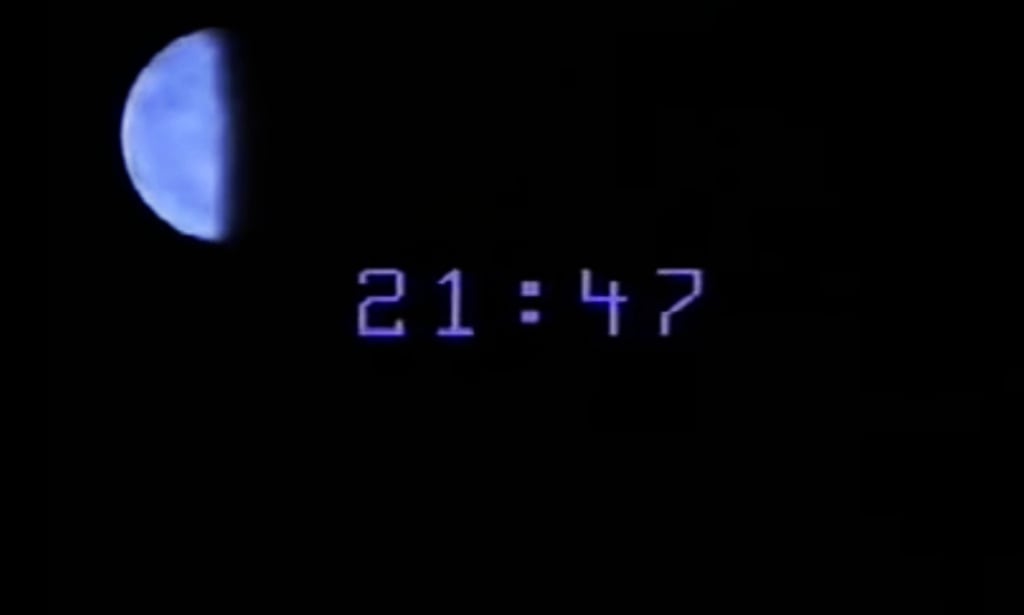
Polish actor Wenanty Nosul was picked to play the Gatekeeper. His iconic performance mixes absurd black humour with a real sense of menace. The video was sound-tracked with eerie music and overlaid with a digital timer. It’s this timer that governs the game.
The prototype was bought by Roadshow Entertainment and, thanks to an aggressive marketing strategy that included trailers in cinemas and on rental videos, the game was an instant hit. At Christmas alone in 1991, it shifted more than 70,000 copies in Australia, smashing industry records. Shortly afterwards, the game was launched in Europe by Spear’s Games. For copyright reasons, in Europe the title was changed to Atmosfear, the original being too similar to that of a horror film franchise. To ensure quality, the actors for local versions were flown out to Australia to shoot the part of Gatekeeper under the strict supervision of creators.
For English-language versions, Wenanty Nosul played the Gatekeeper in a stand-out performance. For the other European versions, the following actors were cast in the role:
Italian version: Enrico Maria Tini Brunozzi.
French version: Philippe Charluet.
Spanish version: Emile Gomez Manzano.
German version: Uwe Karpa.
Dutch version: Maureen Barkey.
The rules of the game: a race against time
Atmosfear is a so-called VCR game that’s simple and compelling. It’s essentially a race game involving luck and resource management that’s played under constant psychological pressure.
The ideal number of players ranges from three to six. Each chooses a Harbinger (a classic horror trope) associated with a specific colour: Gevaudan the werewolf (blue), Hellin the poltergeist (red), Khufu the mummy (yellow), Baron Samedi the zombie (green), Anne de Chantraine the witch (orange) and Elizabeth Bathory the vampire (purple). Participants play against the Gatekeeper, who speaks directly to them when he appears during the game.
There are four phases to the game:
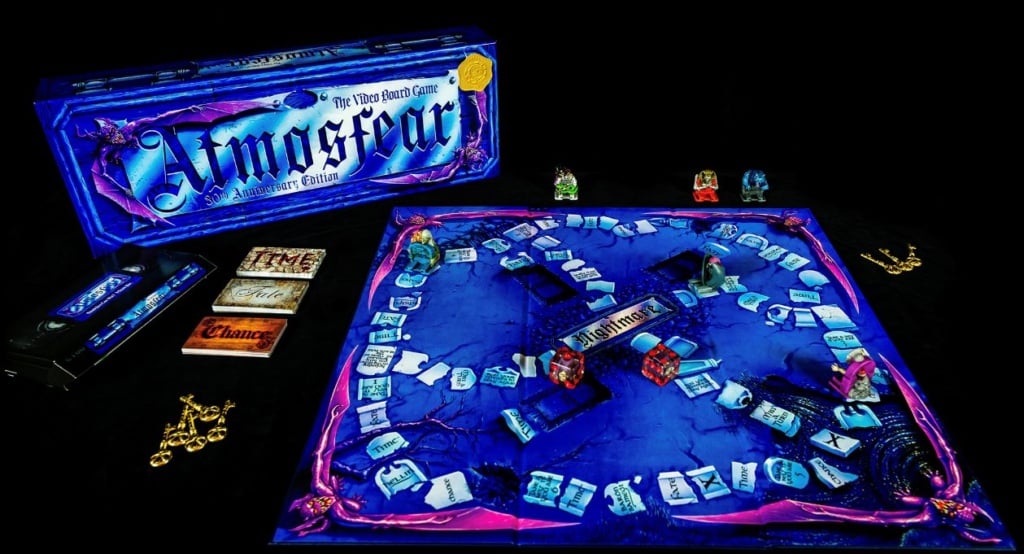
- Preparation: participants place their playing pieces on their respective tombstones in the corners of the board (designed to look like an abandoned graveyard). Each writes their greatest fear on the nightmare card and puts it in the middle of the board. Then someone presses play on the VCR (or DVD player or app in later version) and the video begins.
- Game play: from the moment the Gatekeeper first appears on screen, players have exactly 60 minutes to complete the game. They take turns to roll the six-sided die and move forwards on the board. The goal is to collect six keys, each a different colour, and reach the middle of the board.
- The Gatekeeper: the video keeps running throughout the game. Every so often, the Gatekeeper suddenly appears on the screen, stopping play. He may reward a player, punish another (banishing them to the Black Hole), impose a new rule or tell a certain player to roll the die.
- Winning (or losing): once a player has collected six keys and made it to the middle of the board, they draw a nightmare card. If their personal fear is not on the card, the player wins and stops the tape. If the video timer reaches 60 minutes, the Gatekeeper wins and everybody else loses.
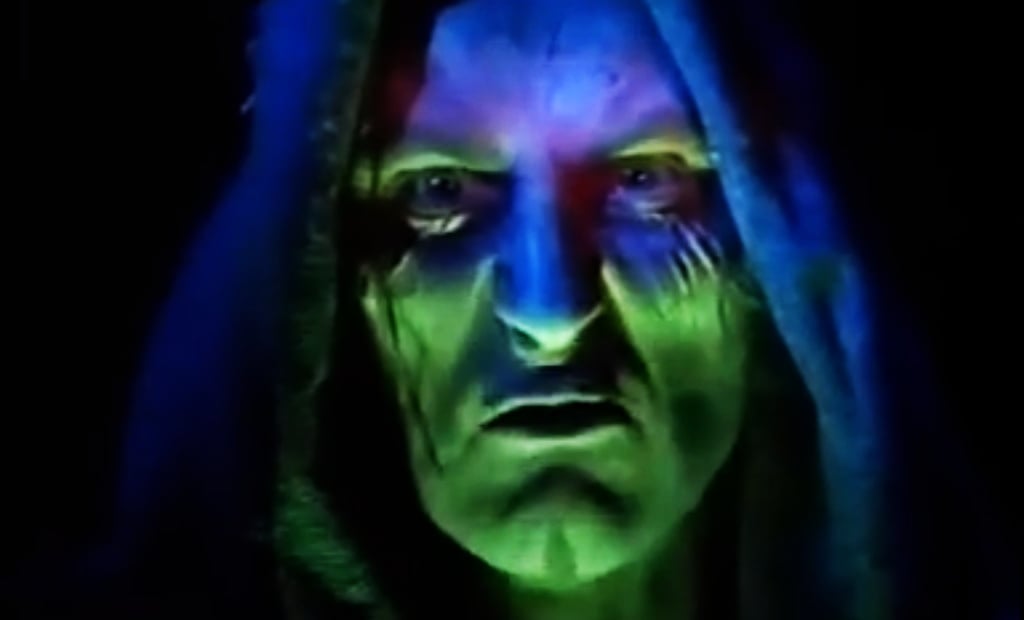
Every game is fraught with tension. The Gatekeeper demands absolute obedience and respect: whenever he speaks to players, they must reply “Yes, my Gatekeeper!”. And as the clock ticks on, the Gatekeeper’s appearance grows ever more monstrous and his voice harsher and more threatening. So with the lights off and your disbelief suspended, the atmosphere is thrillingly immersive and creepy.
As players move around the board, the squares they land on can change the course of their game, for better or worse. They may have to draw a Fate, Time or Chance card. Fate cards give them powers, protect adversaries or set traps. Time cards have effects that are triggered at precise times in the game.
For instance, a player may have to keep a card and wait until the clock strikes a given time before reading the card aloud and unleashing the effect, often to the detriment of other players. As for Chance cards, they help players to get keys or defend themselves against other players and the Gatekeeper.
All the main editions: from VHS to app
The success of the original Atmosfear game, which sold millions of copies worldwide, has spurred the makers to release new versions, expansions and spin-offs over the years, adopting new technologies as they become available. Below we give you a brief summary of every version:
- Atmosfear (1992): the VHS that came with the original version introduced the world to the Gatekeeper, the virtual game master who breaks the fourth wall. This is the template on which the rest of the series is based.
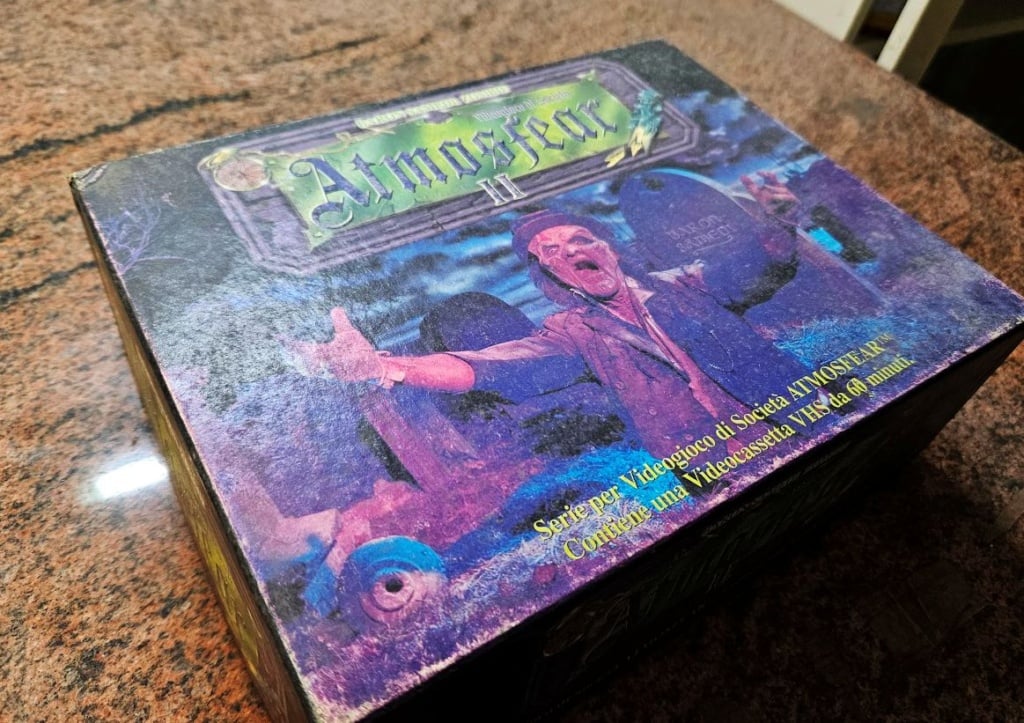
- Atmosfear II: Baron Samedi (1993): another VHS edition, in this first expansion of Atmosfear the zombie Baron Samedi takes the place of the Gatekeeper as game master. Gameplay is faster and a introduces a “zombification” mechanism: if players are cursed by Samedi, they’re subjected to humiliating punishments, like keeping their arms outstretched, or worse, not speaking, which makes communicating with others a frustrating yet entertaining challenge.
- Atmosfear III: Anne de Chantraine (1994): the third chapter in the series is hosted by the witch Anne de Chantraine, who was once burnt at the stake and is now hell-bent on revenge. This time, the punitive aspect of Fate, Chance and Time cards is emphasised. But the biggest difference is the way the witch interacts with players: she asks them questions based on their gender or appearance (like the colour of the clothes they’re wearing), targeting them in an extremely personal manner that creates a climate of paranoia and mutual recriminations. Again, the game is played using a VHS cassette.
- Atmosfear IV: Elizabeth Bathory (1995): hosted by the infamous vampire countess, this expansion takes the difficulty level up a notch. Elizabeth Bathory introduces game mechanics based around blood thirst and vampirisation. Players must survive on ever fewer resources, while the countess has the power to interfere with the path to the middle of the board, making the journey unpredictable and treacherous.
- Atmosfear: the Harbingers (1995): this instalment is a reboot of the original game. Its video boasts superior production values and a new Gatekeeper with an even more hideous appearance. But the biggest innovation is the board: out goes the traditional fixed format and in comes a modular version comprising six separate pieces that can be slotted together in multiple configurations to create a different board every time you play.
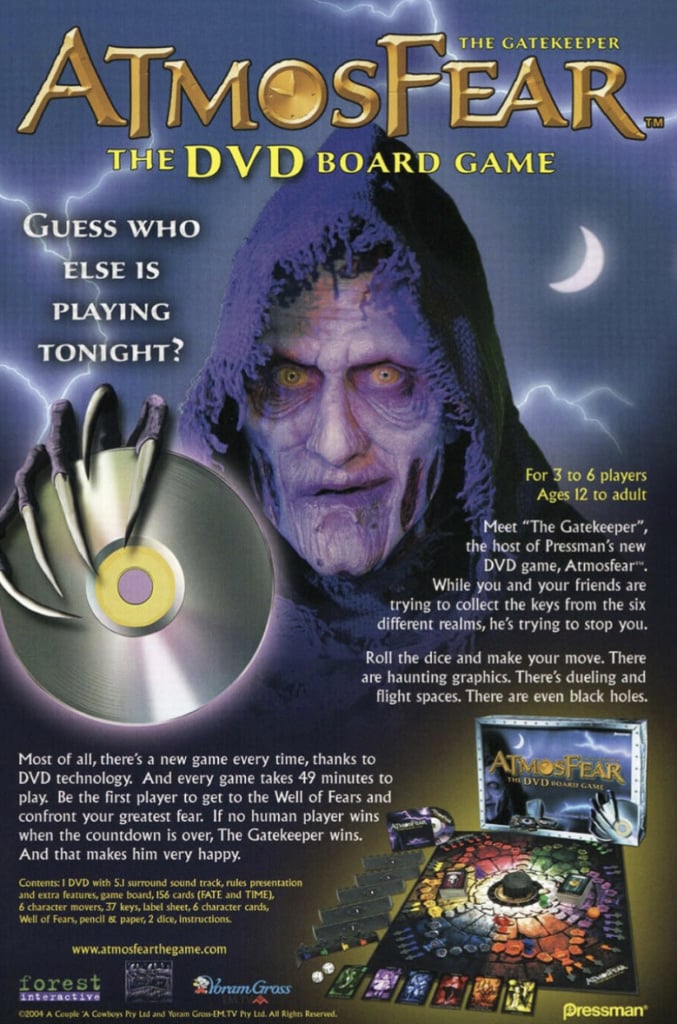
- Atmosfear: the Gatekeeper , DVD edition (2004): as the VHS fast became obsolete, the franchise switched to DVD. It also made a major change to game mechanics that fixed the biggest flaw in previous editions: predictability. With the VHS version, events always occurred at exactly the same time in every game. But with the DVD edition, the system plays hundreds of video clips at random, so that the Gatekeeper always appears at different moments. This means each game is unique, and seasoned players can’t learn the sequence of events on the video by heart.
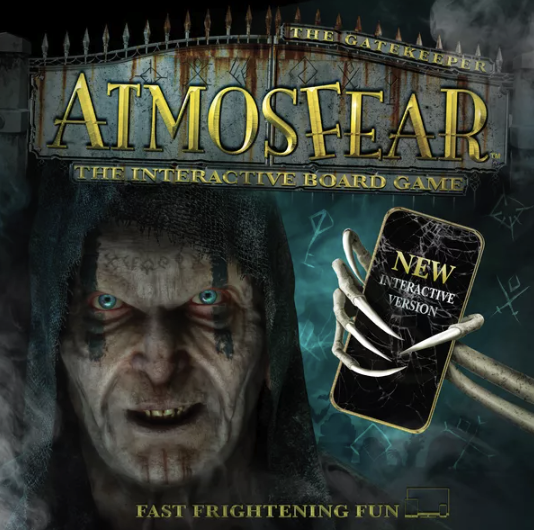
Atmosfear, app edition (2019): with this version, the game embraced the smartphone era, replacing physical media like VHS cassettes and DVDs with am app developed by Creata Entertainment. More than just a timer, the app is a system that completely randomises the experience. It ensures that the Gatekeeper appears in a wholly unpredictable manner, even popping up on the screens of players’ phones.
Atmosfear 30th anniversary (2022): funded through a Kickstarter campaign and produced by the original creators (A Couple ‘A Cowboys), this is a loyal love letter to the 1991 original. For obvious reasons, the video cassette has been replaced with a high-definition streamed video (hosted on Vimeo), but the iconic nineties board and cards return. Backers can also get a special Deluxe Edition with resin dice set featuring the Gatekeeper’s head, a metal coin, the Baron Samedi expansion and “The Lore of the Other Side”, a new graphic novel that explores the origins of the Gatekeeper.
Atmosfear printed materials
What sets Atmosfear apart from other table top games is the way it blends what happens on screen with the physical board game and its printed materials.
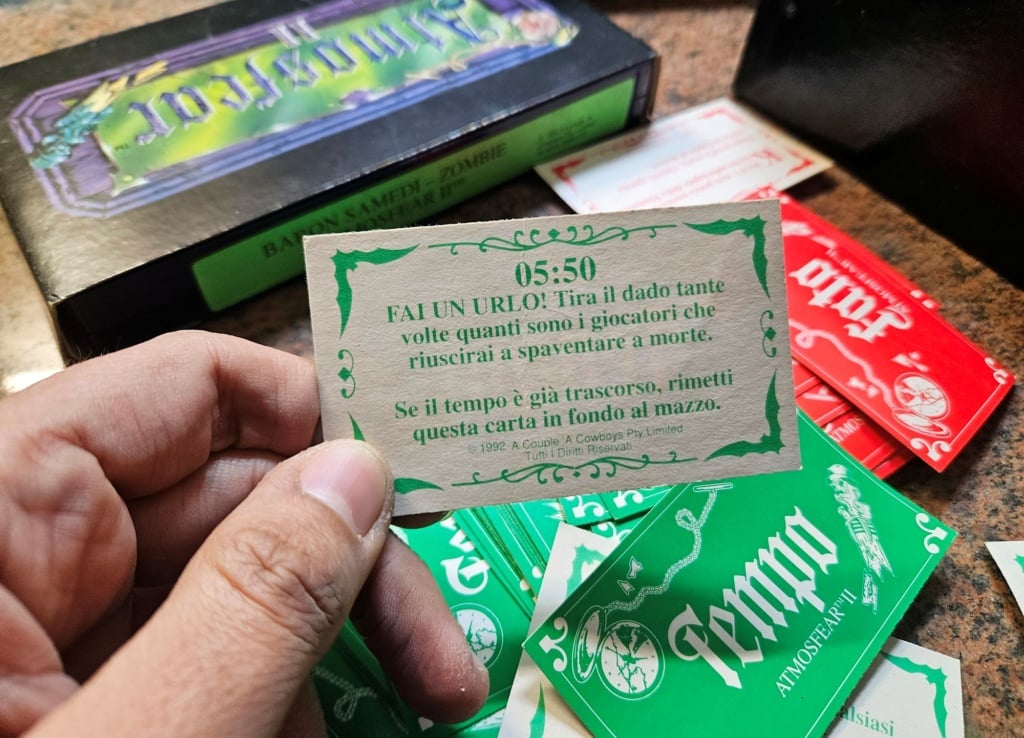
Every edition of Atmosfear is meticulously designed.
- The board: dark and gothic, it’s packed with esoteric symbols. In the first edition, it’s a traditional card board that’s been made to look like a graveyard.
- The keys: these must be collected by players to win. For the first edition, they were printed on a laminated material.
- The nightmare cards: players must write down their greatest fears on these special cards. The backs carry the Atmosfear logo, while the faces are completely white with a special coating that allows writing to be erased at the end of the game (the original box included a grease pencil, so players could write on the laminated cards and erase what they had written with a cloth at the end of the game).
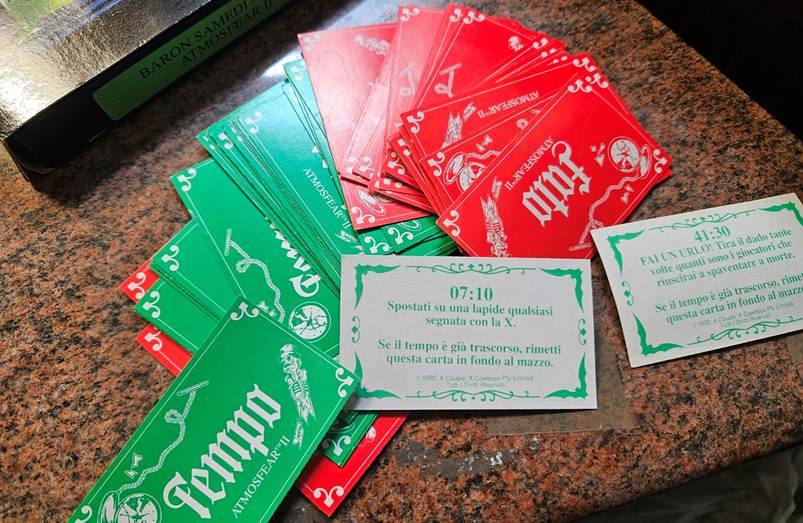
- The Fate, Time and Luck cards: these make up most of the pack of cards and are also printed on lightweight card.
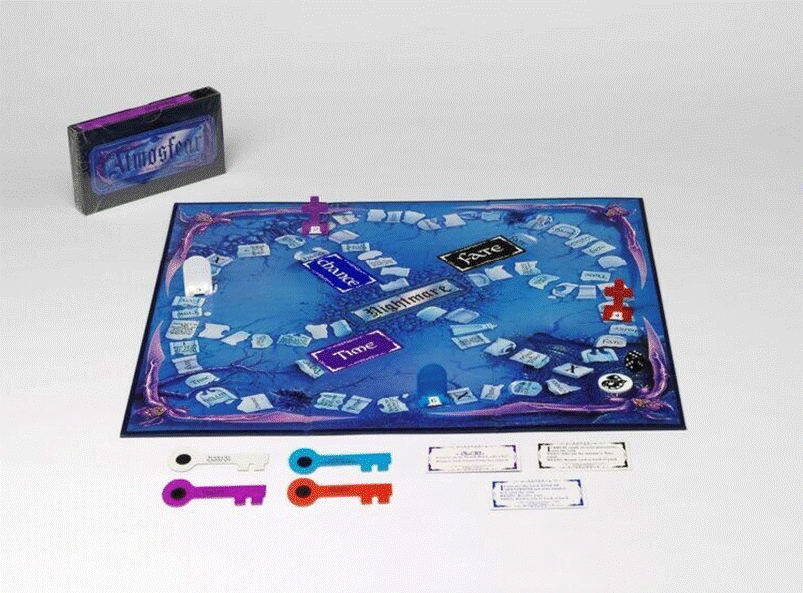
The graphic design for rule books and cards typically uses gothic typefaces and contrasting colours (think dark black, blood red and acid green). Deliberately provocative language is used to amp up fear and tension.
Here ends our peek into the hair-raising world of Atmosfear. We hope it inspires you to design your own multimedia game that blends printed and digital materials for long nights of immersive gameplay with friends.