


Table of Contents
1993 was a watershed moment for role-playing games (RPGs) and collectible card games (CCGs). While children and teens were already accustomed to finding classic sticker packs at newsagents, a new, much more complex publishing product now arrived: Mutant Chronicles, which in time became one of the most broadest transmedial franchises in the history of publishing.
It came at a time when RPGs were trying to move beyond the classic mediaeval fantasy style of games like Dungeons & Dragons. With not only trading cards, board games and 3D wargames with miniatures, but also novels, comics, video game adaptations and even a 2008 film, over the decades Mutant Chronicles became an entire ecosystem, incorporating myriad products of different genres that share the same universe.
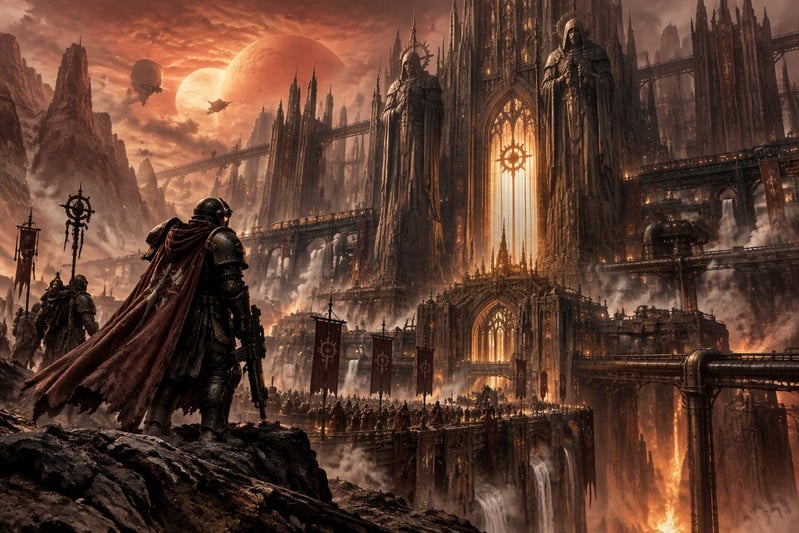
The story is set in a dystopian future, and comes under the umbrella of dieselpunk, a sub-genre of science fiction with a retrofuturist aesthetic.
Join us on this journey through its publishing history, its gameplay, its visual identity – the work of some master illustrators – and finally the printing techniques used in the various editions.
Where it all began: the history of Mutant Chronicles
Mutant Chronicles is originally from Sweden: the publisher Target Games released Mutant, a post-apocalyptic role-playing game, in 1984.
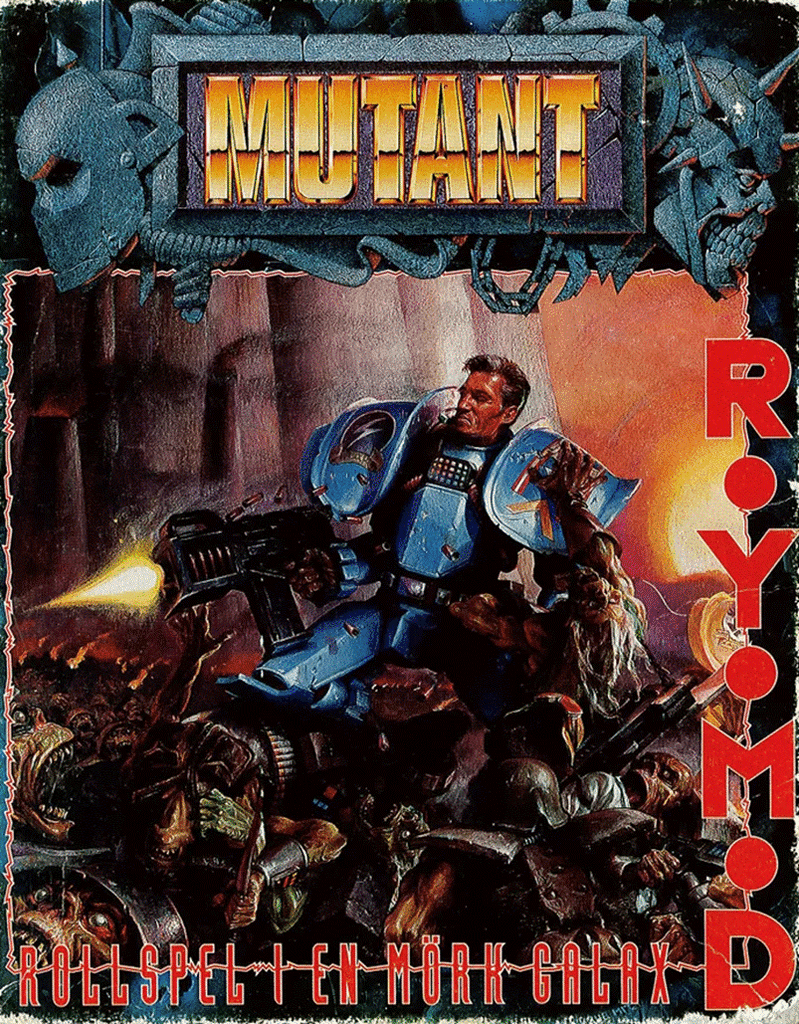
It moved definitively to being set in space in 1992 with the publication of Mutant R.Y.M.D, a boxed game that featured all the main story elements the world would soon come to love: Megacorporations that have supplanted the old nation-states, and Luna City as the political and economic centre. This was the company’s last product destined solely for the internal Swedish market.
Target Games built a family of products around this setting, and decided to launch on the international market.
The Mutant Chronicles RPG made its official debut in 1993, designed by a brilliant collective including Nils Gullikson, Michael Stenmark, Henrik Strandberg, Magnus Seter, Jerker Sojdelius, Stefan Thulin and Fredrik Malmberg.
It was issued in English in a single volume. The RPG was joined that same year by Siege of the Citadel, a board game with miniatures, followed by Doomtrooper, a CCG launched in 1994, and Warzone, a 1995 wargame with miniatures. Other interpretations followed, ranging from comics and novels to video games and films.
Mutant Chronicles is the shared universe; each game takes you to a certain part of it. Doomtrooper turns the characters, weapons and powers into trading cards, while Warzone takes the conflict to the battlefield using miniatures.
It wasn’t always plain sailing. When Target Games experienced financial trouble in the late 1990s, the brand went through various owners and relaunches. These included the third edition of the RPG, published by Modiphus with a 2d20 system – not simply a reprint, but a whole new way of gaming within the same universe. A few communities of players remain today, but the glories of the past are now long gone.
Mutant Chronicles: setting and factions
Mutant Chronicles’ underlying narrative is essentially a criticism of the corporate and capitalist system, combined with elements of horror and science fiction. Humanity has destroyed the Earth by using up the majority of its natural resources, and so it starts to terraform other planets in the solar system. The moon is fully urbanised, and is named Luna City.
As always, humans never stand still, and they continue to explore beyond Pluto, eventually landing on a planet called Nero. Here they discover, and accidentally destroy, an ancient seal, releasing a power called the Dark Symmetry. This is nothing to do with devils, but rather a threat created by aliens from another dimension, who are trying to colonise the planets where humans have settled.
The Dark Symmetry can bring back the dead and use them as soldiers, and, even worse, make all electronic machinery, including computers, go haywire. As a result, humanity has to go back to using obsolete technologies from the past that can’t be infected by the Dark Symmetry’s weapons.
The war is not just between humanity and the Dark Symmetry, but also, even more devastatingly, between the various human factions.
Human society is dominated by huge Megacorporations that absorbed the Earth’s old national identities and took their cultural traits to extremes.
The main factions, locked in a political ecosystem of constant tension, are:
- Capitol: located on Mars and inspired by the USA – a heavily free-market-supporting faction with devastating air forces and heavy assault infantry.
- Bauhaus: based on Venus and inspired by continental Europe, and ruled by a proud military nobility. It excels in heavy engineering, particularly its unstoppable armoured divisions.
- Mishima: a faction with a strong presence on Mercury, descended from ancient noble Japanese families. Its society is governed by strict codes of honour, and it employs deadly Samurai and infiltration forces.
- Imperial: the smallest of the Megacorporations, known as the “damned faction” because it was its members who landed on Nero and destroyed the seal, unleashing the Dark Symmetry out of pure power-hungry greed.
- Cybertronic: the youngest and most mysterious faction, based on the moon (Luna). It is a pioneer in cybernetics and artificial intelligence, and stands in stark contrast to the rigid human technological limitations, attracting everyone’s suspicion.
The Megacorporations do not ‘inhabit’ a single planet; they have bases and spheres of influence across all the planets in the solar system.
A counterbalance to the corporations’ power is provided by The Brotherhood, a supremely powerful religious order based on Luna, which uses a mystical power to fight Darkness. There is also the Cartel, an body positioned above the Megacorporations that acts as a mediator, seeking to avoid conflicts.
The Cartel also has an army of Doomtroopers, elite multinational troops chosen by the Megacorporations.
The rules of the Mutant Chronicles RPG
The first, unforgettable 1993 book edition of the Mutant Chronicles RPG has a particularly complex gameplay system. Participants take on the role of adventurers involved in investigations, dangerous missions and combat. First, a group must get together around a table and share out the roles. The game unfolds like a conversation:
- One person takes on the role of Game Master: their job is to prepare the mission, describe places and situations, determine allies and enemies, and apply the rules;
- The others are players: each person controls one character, and decides how to act, what to say and which objectives – investigations or combat – to pursue;
- The game does not use the multiple polyhedric dice seen in other systems: it is based almost exclusively on a 20-sided die (d20) to resolve actions, using a ‘roll-under’ system, whereby you need to obtain a lower number than your Skill score, and a 6-sided die (d6) to determine the damage inflicted by firearms.
The first character creation task involves their personality.
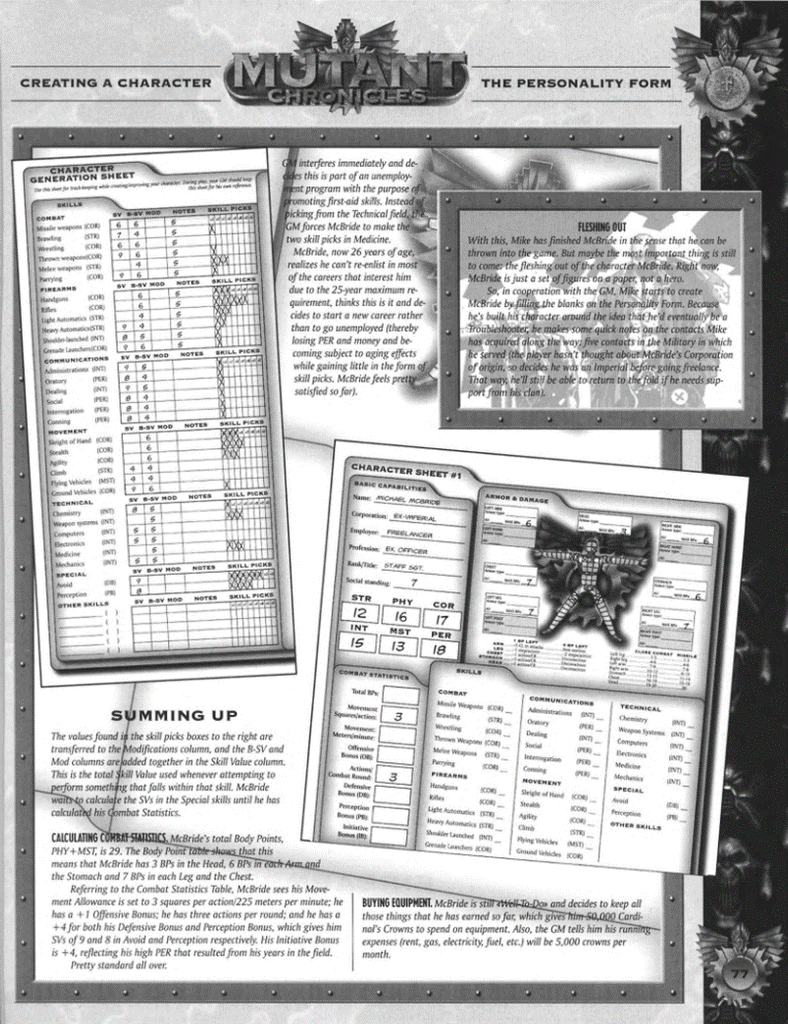
You roll the dice, and use large tables in the rulebook to determine the initial score for each statistic. These help you define the character’s social standing, adolescence and professional background – elements that have a profound impact on your skills, resources and experiences, creating seasoned and multifaceted heroes with a lot of backstory.
The Game Master describes a situation, such as a guarded warehouse you need to enter. The players then decide whether to negotiate with the guards, search for a secondary entrance or attempt infiltration, and the Games Master describes the consequences of their decisions.
Doomtrooper: the rules for the card game
As we mentioned above, the franchise is not limited to the RPG; it also dominated card gaming tables in the 1990s. Launched between late 1994 and early 1995 with a design by Bryan Winter, the Doomtrooper CCG rapidly established its position as one of the era’s most successful card games.
Doomtrooper‘s rules can also be quite complex. Each player has to build a deck, deploy warriors, equip them and take on the opposing forces.
There is no need for a Game Master: you take it in turns, with the goal of achieving a pre-established number of Promotion Points (usually 15 or 25 in standard games, going up to 40 in competitive tournaments), which you mostly receive for eliminating enemies and completing missions.
You need at least two players, each with a deck of at least 60 cards, and counters to record two types of points:
- Destiny Points: the ‘currency’ used for introducing warriors and paying for some effects.
- Promotion Points: the points you need to win the game.
How you manage your Destiny Points is crucial: spending them all straight away will make you stronger, but saving them will allow you to pay for effects later on.
In front of each player, the Doomtroopers form a Team, the warriors of the Dark Legion are placed in a Cohort, and the Tribe are placed in the Outpost.
Each turn involves three steps:
- Draw: keep taking cards until you have seven in your hand. The starting player skips this step on their first turn;
- Act: perform up to three actions. For example, you might meditate to obtain a Destiny Point, deploy a warrior by paying the relevant cost, assign him equipment, or attack.
- Discard: if at the end of the turn you have more than seven cards, you must discard any excess.
You can normally only attack once per turn, as the final action. If a player attacks before using up all their actions, they lose the rest. Nobody can attack during their first turn.
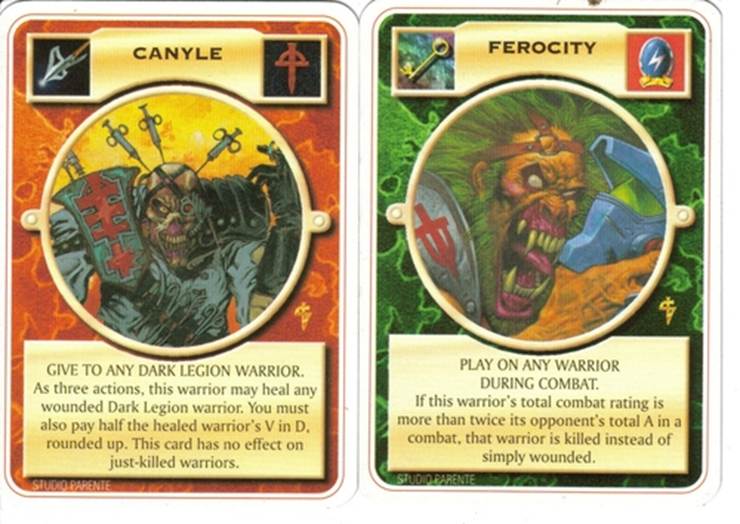
Regular combat does not use dice: you simply compare your warriors’ characteristics with the opponent’s weaponry, taking into consideration the cards already played. The person defending themselves can normally also injure the attacker. The equipment and powers make the fight less predictable than the numbers alone would suggest.
The game’s art and illustrations: from Paul Bonner to Paolo Parente
Mutant Chronicles’ aesthetic came to define the dieselpunk genre visually, combining elements from the First World War like trenches and gas masks with heavy artillery, oversized shoulder pads and horrifically disfigured bodies.
British artist Paul Bonner was given the job of coming up with Mutant Chronicles’ visual identity.
Working in an entirely pre-digital age, he showed his artistic mastery using tube watercolours, expertly mixed with white gouache tempera on paper. This laborious process gave his illustrations high-saturation colours and an incredibly tactile depiction of time- and battle-worn metal surfaces.
In his illustrations – like the Necromutant, for example – he paired deformed faces and monstrous teeth with pipes, heavy weapons and armour bristling with blades. The contrast between flesh and metal recalls the body horror genre: the body is not merely protected or strengthened by the technology, but actually transformed into an instrument of war.
But the franchise also benefitted greatly from the brilliant contribution of the Italian cartoonist and illustrator Paolo Parente. Parente was much more than just a contract illustrator – he was artistic director and lead illustrator for the partworks Hobby & Work issued in Italy. He was part of a 1990s artistic trend dominated by overblown muscularity; the women he drew were always beautiful and curvy, and he also liked to draw weapons with exposed gears and belts.
Parente’s impact went well beyond the rulebooks: he also worked as a concept artist, designing the miniatures’ iconic weapons, and also conquered the US comics market. His covers for Acclaim Comics and his extraordinary work on the 1996 Mutant Chronicles Sourcebook combined the dynamism of comics with the RPGs’ imagery. Parente’s vision, put into practice using a mix of traditional techniques, became the unmistakeable beating heart of the entire global brand.
How the rulebooks and cards were printed
Mutant Chronicles’ production specifications offer a fascinating insight into how printing standards have evolved in the publishing sector over the last 30 years.
The original rulebooks for the first and second Swedish and international versions (1993–1997) reflected the technical limitations and stylistic trends of the era. The volumes were printed in softcover format, with over 240 pages. The internal layout was a good test of players’ eyesight – the text was organised into just two columns, enhanced with plenty of colour and black-and-white illustrations.
It is interesting to compare the approaches chosen by the different European markets. In France, Jeux Descartes opted for a major improvement on this, publishing a hardback volume, while in Spain M+D Editores produced a cheaper softcover format.
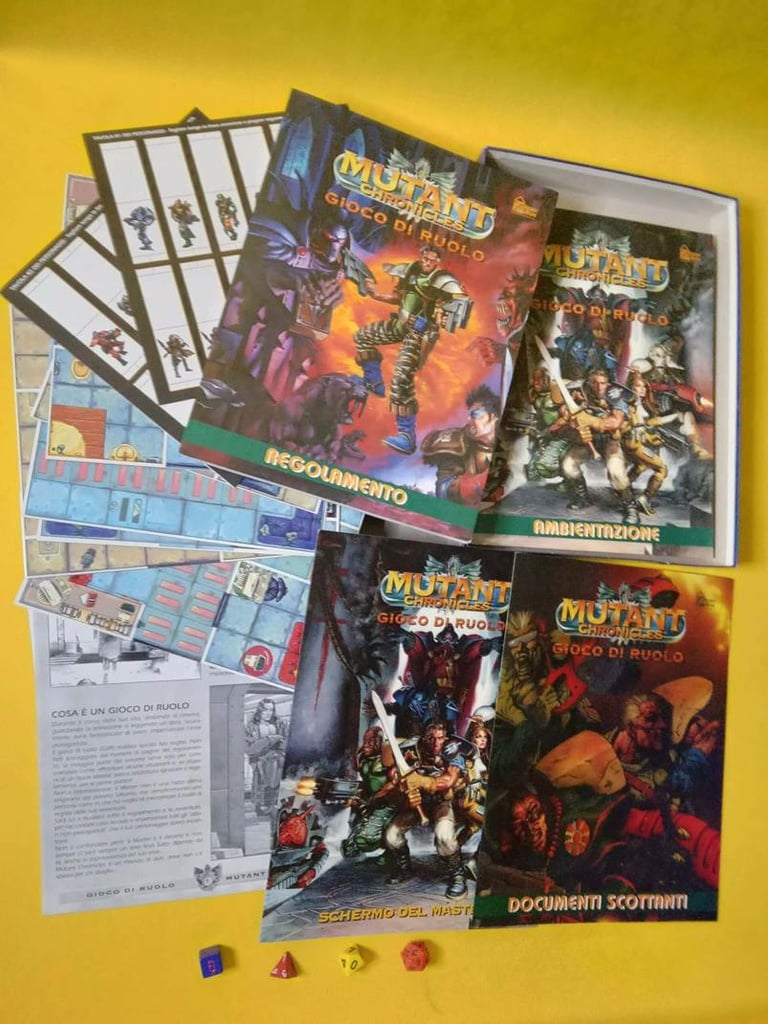
But it was Hobby & Work in Italy that created a real masterpiece. Rejecting the concept of a single rulebook, the publisher decided to divide the text up into a large, luxurious cardboard box (22.5 x 30 cm). The box contained three separate volumes, a cardboard Game Master screen, character sheets and a set of dice: all in all, a high-quality printed product.
Production of the Doomtrooper card game was entrusted to Carta Mundi in Belgium, which chose the classic Poker Size (63 x 88 mm) for the cards.
Mutant Chronicles’ Legacy
Over 30 years after its debut, Mutant Chronicles’ legacy goes well beyond nostalgia for 1990s box games or the Doomtrooper cards. This franchise showed how, with strong unilateral artistic and conceptual direction, it could bend any media type to fit it, creating an enduring world way before ‘cinematic universes’ became a Hollywood fashion.
In an era dominated by classic fantasy, Mutant Chronicles forcefully imposed its dieselpunk aesthetic of trenches, ruthless megacorporations and tangible horror, leaving an indelible mark on the history of entertainment and becoming one of the spiritual fathers of modern grimdark and dieselpunk aesthetics.
Where to find Mutant Chronicles games today
The last official publisher of the roleplaying game was Modiphius Entertainment (which released the 3rd edition in 2014). Following the expiration of the licensing rights and the cessation of official sales, the franchise’s products—including board games, miniatures, and collectible card games—are no longer in regular production or available for purchase in official shops.
For collectors and enthusiasts, however, the titles can still be found through the secondary market and retailers specialising in out-of-print games:
- BoardGameGeek (BGG): The global board game encyclopaedia, useful for researching historical editions (Siege of the Citadel, Warzone) and accessing its international user marketplace (GeekMarket).
- Noble Knight Games: An international retailer specialising in out-of-print games, ideal for tracking down core boxes, 3rd edition hardback rulebooks, and original vintage miniatures.
- eBay UK & Vinted UK: The main online marketplaces to monitor auctions and private listings for collectible card lots (Doomtrooper) and out-of-print editions.
Disclaimer
Mutant Chronicles, Doomtrooper, Warzone, and their respective logos, names, and settings are registered trademarks of Cabinet Entertainment LLC / Heroic Signatures (Funcom group). The last official roleplaying game line was published under licence by Modiphius Entertainment Ltd, whose commercial distribution ceased upon the expiration of the licensing rights. The trademarks mentioned are used in this article solely for informational and editorial purposes. The links provided direct to third-party secondary market platforms and marketplaces with which the company has no affiliation, nor does it assume any responsibility regarding the availability or terms of sale of individual items.