


Table of Contents
How many of you have found an old album, a box of black-and-white photos or a yellowed letter with indecipherable handwriting in a drawer, and not been able to trace the unknown faces or the author?
For centuries, revealing the stories hidden behind a document or photo was a task reserved to scholars and archivists, who, with great patience and a lot of research, tried to piece back together places, people and facts that had become lost in the mists of time. Now, however, all you need is a computer and a platform like MyHeritage to explore the events in your family history and simply and intuitively build your family tree, based on an archive of billions of digitalised documents from around the world and sophisticated artificial intelligence tools.
Recently, the MyHeritage team even managed to uncover the oldest love letter ever recorded in English, dating back to 1477. They transcribed the contents and interpreted them based on the social and cultural context of the time. In the missive, a woman named Mergery Brews passionately described her feelings for her fiancé John Paston, and stated her willingness to marry even if her father refused to increased the dowry, which would have put the marriage at risk.
Thanks to Scribe AI, a MyHeritage function that uses AI to transcribe and interpret both handwritten and typed manuscripts, this fascinating story from the past was reconstructed with surprising accuracy and passed on to Mergery’s direct descendents, allowing them to read their ancestor’s words over 500 years later. Pretty incredible, right?
Let’s take a look at MyHeritage’s origins and how it became one of the world’s top genealogy and family history platforms.
The history of MyHeritage
MyHeritage was founded in 2003, based on an idea by software developer Gilad Japhet. Gilad wanted to create his own family tree, but he didn’t get on with the software available on the market, so he decided to build his own. Then, along with a small team of enthusiasts, he opened a start-up dedicated to genealogy, and continued to develop his software. In 2005 the company launched myHeritage.com, a website where users could create free family trees online in six different languages.
Right from the beginning, Japhet and his team had a clear vision of their mission. They didn’t just want to offer software to a limited group of users; they wanted to provide a service – in part free of charge – for as many people as possible, to help reunite people with their relatives and discover unknown stories about their family members.
The company quickly acquired millions of users, and became one of the world’s leading genealogy platforms. It supported its expansion by buying competitors like Kindo and Geni and through constant technological innovation:
- In 2007 it introduced Smart MatchesTM, an advanced matching system that helps users find relatives in the family trees uploaded by others on the platform.
- In 2012 it launched a search engine for digitalised historical documents from all over the world: photos, family trees, birth, marriage and death certificates, censuses and many other public and private materials.
- In 2016 the company released home DNA tests: a paid kit you order online that reveals your ethnic origins and potentially kinship ties with other users who have taken the same test and uploaded their data to the platform.
- Some very successful photo editing tools were introduced from 2019, including Deep NostalgiaTM, a free tool that animates faces in portraits, and MyHeritage in Color, used for adding colour to black-and-white photos or restoring the colours in faded images.
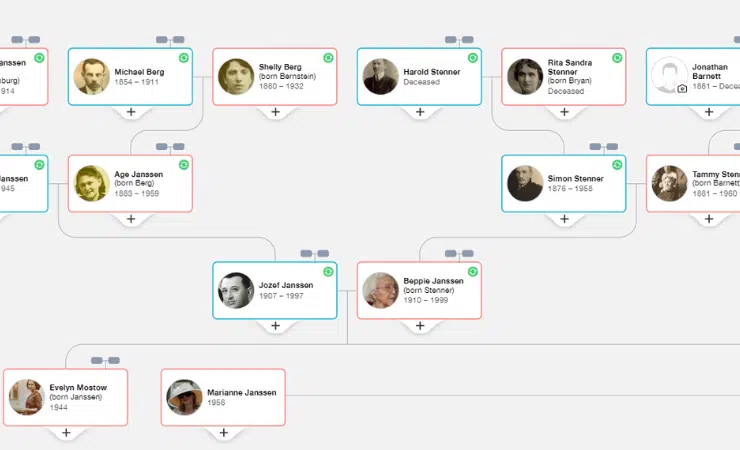
MyHeritage currently has 61 million family trees and 7 billion profiles in 50 different languages on its website. Its database contains 40 billion historical documents, making it one of the world’s largest digital archives. Cutting-edge matching technology and the enormous dataset mean that as well as putting together a family tree and learning about their ancestors, people can also find parents, siblings or biological children they’ve never met.
The platform has a free version that allows you to build a family tree with up to 250 people, upload photos and receive automatic notifications of matches with other trees, plus various subscription plans offering additional functions and content.
Tools for storing and passing on family stories
MyHeritage also has various advanced tools to encourage users to expand their family photo and document archive – a way to preserve memories and pass them on from one generation to the next:
- MyStories: a service that helps users to write and record their memories and preserve them in a printed autobiographical book.
- Scribe AI: users can upload any document, letter or photo and receive detailed information on the people and places it contains and its historical context.
- LiveMemory™: a tool that can convert a static photo into a 6-second video, bringing the photo’s subjects (both human and non-human) to life.
The sophisticated technology on the website therefore gives more meaning to old, forgotten snaps and allows you to interpret public and family documents, enhancing your memories and uncovering new, captivating stories along the way.

How to build a family tree on MyHeritage
Creating your family tree on the platform couldn’t be easier: simply add a few bits of essential information – your first name and surname, your date of birth and your parents’ and grandparents’ names – and the system will automatically start adding other family members. As the tree takes shape, MyHeritage automatically cross-references the data you enter with historical documents and family trees uploaded by other users. You’ll receive an email if it finds any matches, as well as photographs and historical information on your ancestors. You can also search for birth records, obituaries, marriage certificates and other resources within the digital archive for more information on your family history.
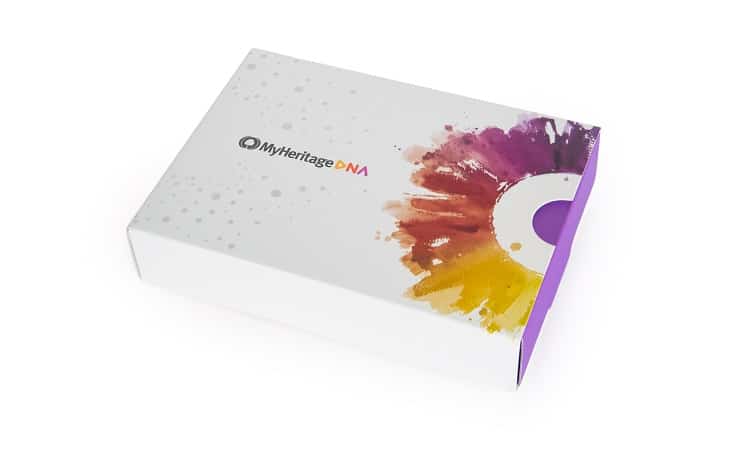
If you want to delve even further into your past, for a very reasonable price you can also buy a DNA test that confirms whether or not the kinship ties reported in your family tree are correct, as well as revealing your ethnic and geographical roots. Here too, the procedure is very simple: the kit arrives at your home, you do a quick cheek swab and send the sample to the MyHeritage DNA lab. Within 3–4 weeks you receive the results online, which show your DNA’s ethnic composition and compare it with other users to see if it throws up any previously unknown family members.
The ‘good’ side of AI
There are numerous testimonials on the company’s blog from people whom MyHeritage has helped to find long-lost relatives and to discover family ties and previously unheard stories about their ancestors, giving them the excitement of exploring their origins and the emotion of embracing their loved ones again.
The company has also provided its technology to support numerous pro bono projects across the world, from returning goods looted by the Nazis during the Second World War to expeditions to document the family histories of tribal communities at risk of cultural extinction. Plus, as part of its DNA Quest initiative, the company has donated thousands of DNA kits to adopted people looking for their biological parents, helping to reunite many families worldwide.
MyHeritage reveals a different side to the technological opportunities offered by AI, showing how this technology can be genuinely useful for people and make a major contribution to building their identity, whether by revealing unknown facts, giving a name and a background to a face, or turning an illegible document into an exciting story.