

Table of Contents
This article was written in collaboration with Verónica Festa, Associate | Performance and Advertising Consultancy at GreatPixel
Paid media is (and always has been) about more than just advertising. It’s a strategic tool for reaching the right audience, at the right time, through the right channel.
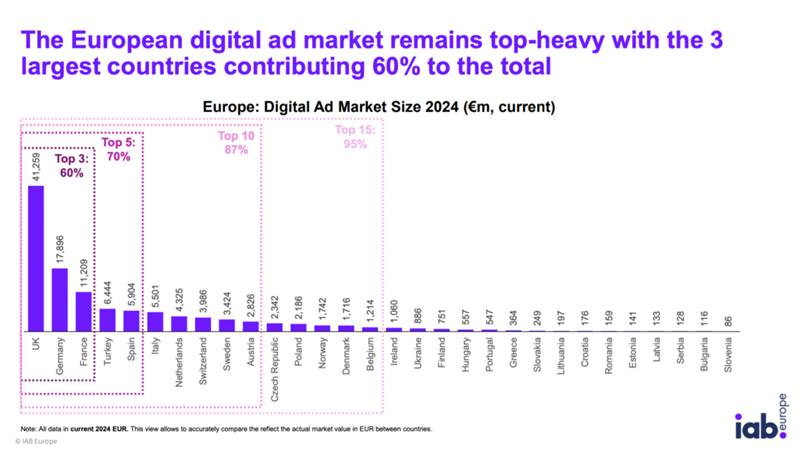
Worldwide, digital advertising spend is $442.6 billion, accounting for roughly 70% total ad investment.
More a relationship shift than a tech shift
Until a couple of decades ago, buying ads meant buying space in traditional media: TV, radio and the print. It was a linear model that was relatively easy to plan and track.
But in the digital era, this landscape has been radically reshaped, with a growing fragmentation of channels and approaches.
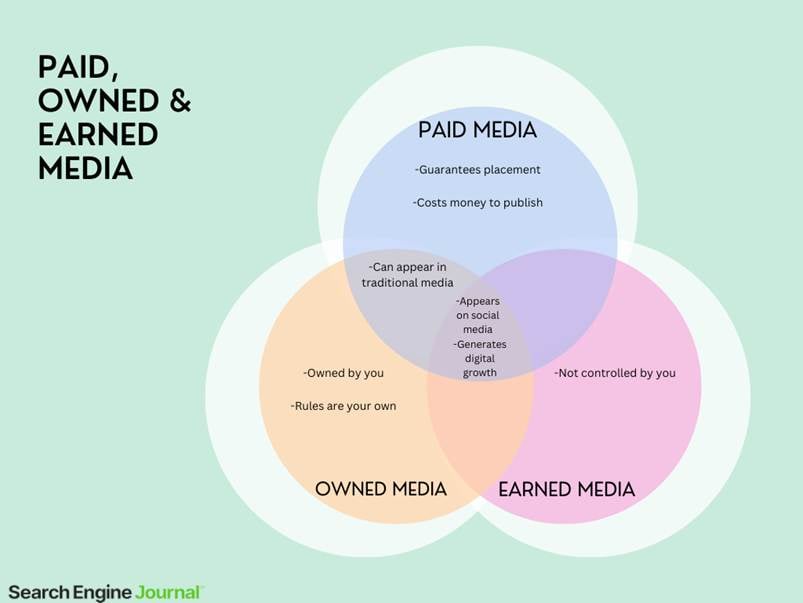
Today, paid media is no longer simply about scheduling ads in specific channels, but involves navigating a complex ecosystem of touchpoints that all interact with and influence one another. So interconnected is this system that the boundaries between paid and organic media are blurrier than ever.
But the biggest change isn’t technological – it’s relational.
Paid media has gone from being a way of reaching people to a way of catching them at the very moment they show an interest, need or intent to make a purchase. It’s not about interrupting users’ experience, but inserting your brand at a relevant moment in their buying journey.
Social media is now one of the main ways that consumers find, evaluate and compare brands and products: one in four people say that they’re discovered a brand through social ads.
When the message is relevant and contextual, advertising is no longer seen as an interruption and becomes an accepted part of the search and discovery experience – an answer to a need.

The brands getting the best results today aren’t necessarily those with the biggest budgets, but those that have understood and adapted to the new dynamics of this digital ecosystem.
Artificial intelligence now powers paid media
Not only has paid media changed its role, but AI is changing how paid media works. It’s no longer just about tools for automating operations or generating content: AI is now at the heart of advertising platforms, reshaping the way that campaigns are built, run and optimised. From targeting to bidding, tasks that were once the job of media buyers are today performed by algorithms in real time.
These algorithmic systems analyse consumer behaviour, intent and micro-signals at speeds and scales that humans can’t match, identifying the most effective combinations of audience, creativity, positioning and timing. As a result, the focus has shifted from static demographic segments to constantly evolving behavioural patterns.
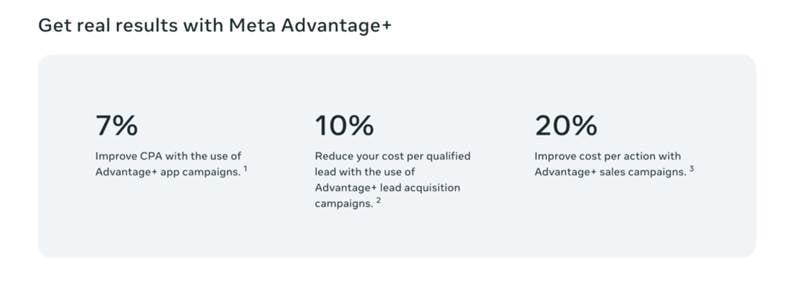
A perfect example of this evolution is the Meta Advantage+ suite, which allows advertisers to choose different levels of automation.
With its Complete Campaign Solutions, manual intervention is limited to setting the budget and uploading creative assets. AI then takes over, managing the entire campaign life cycle and modelling every step to achieve business objectives as efficiently as possible. These solutions are especially suited to achieving two specific outcomes:
- Optimising and maximising online sales, with AI identifying as quickly as possible audience segments likely to buy;
- Incentivising downloads of new apps or in-app actions.
At the same time, Meta also allows advertisers to pick and choose individual solutions: this approach is best for businesses who want greater strategic control over their campaign, by letting them deploy AI only where necessary.
Let’s take a closer look at these automations.
- Audience automation: this system uses simple suggestions given by the advertiser (like existing data, gender, age or interests) to automatically and dynamically expand the audience beyond the criteria provided, while also taking into account any copy and creative. Basically, it understands who likes that type of content and finds lookalike audiences.
- Creative automation: rather than showing everybody exactly the same ad, AI personalises ads in real time based on each person’s preferences and the ad’s placement. It might do this by adapting formats through image expansion for Stories or Reels, applying brightness and contrast filters, mixing and matching headlines, copy and descriptions, and even adding soundtracks and 3D effects to static images.
- Placement automation: the algorithm delivers the ad in real time to the best-performing placements within the Meta ecosystem, which includes Facebook, Instagram, Messenger, WhatsApp, Threads and Audience Network. This maximises the chances of conversion at the lowest cost.
- Budget automation: while in the past a fixed budget was allocated to each group of ads, with budget automation you can shift spending in real time to the ads that are performing best. AI continuously analyses the effectiveness of every single variant, and when it detects a rise in conversions or a lower cost per action, it seamlessly re-allocates the budget to those ads.
- Destination automation: this feature optimises the journey the user takes straight after clicking on an ad. Based on that user’s past behaviour, AI can automatically decide whether to show the user the Instagram/Facebook shop (Meta Shop), send them directly to the website or open a WhatsApp chat, choosing the channel that is most likely to convert.
More than Meta: platforms and the changing role of digital advertising professionals
While Meta’s Advantage+ suite is the clearest example of this transformation, AI-driven automation is now standard across all the main digital platforms. Each has developed its own infrastructure for centralising everything – from audience targeting to creative, from budget to placements – into a single algorithmic workflow, whether it’s LinkedIn with Accelerate campaigns, TikTok with Smart+ suite or Google with Performance Max campaigns. These platforms are morphing from simply spaces for manual scheduling to autonomous predictive engines.
In this new world, the role of professionals is not disappearing, but evolving: they’re spending less time running campaigns and more time making strategic decisions.
And the most valuable resource in modern digital advertising?
It’s creativity, which is now the key differentiator. Because the more varied and relevant your creative assets, the easier it is for automated systems to find the most effective combinations. More than just one plank of your strategy, creativity is now the foundation on which its performance is built.
Advertising trends to watch
Paid media is moving from a stable system for attention acquisition to a fluid model where decision-making is mediated by AI agents. Consumers no longer compare products directly themselves, but increasingly give this task to AI systems that filter information, process data and provide recommendations. Visibility is no longer enough: brands must now be surfaced by the tools that curate information and make recommendations to people.
As a result, an emerging performance metric is share of model: the extent to which a brand is recognised, cited and recommended by LLMs, and a new opportunity to gain competitive advantage.
At the same time, hyper-personalisation has fast gone from ambition to reality, and adapting creative, messages and content in real time is becoming more accessible by the day. All of which means that it’s no longer technology that gives advertisers the edge, but the quality of the strategy they use to apply it.
But there’s a paradox: the more sophisticated the system gets, the simpler advertising gets. Visual minimalism is not just an aesthetic choice, but a reaction to growing information saturation. White space, clean visuals and clear calls to action help messages cut through the noise and tap into the ever scarcer resource that is attention.

When attention is scarce, simplicity beats complexity.
How we measure performance is changing. too. Traditional quantitative metrics – impressions, reach and frequency – are gradually giving way to KPIs that measure attention quality, like average view time, competed views and click-through rate.
It’s a change that will force marketers and stakeholders speak to each other more to decide on what really matters in media measurement.
All this is happening against the backdrop of the EU AI Act. Seeing this legislation as just more rules to follow risks missing the bigger picture. With people increasingly concerned about how their data is used, transparent and responsible AI is emerging as a way for brands position themselves in the market place.
The art of steering the algorithm
The challenge facing advertisers in 2026 is not to do more with the tools they’ve got, but to use them better in an ecosystem where technology plays a fundamental role. AI won’t replace media strategists, but it will raise their profiles, incentivising them to be even more methodical and strategic in their work.
While automation is now the foundation on which everything else is built, the real competitive advantage will lie in our ability to harness these systems effectively. And in a market where technology makes everything more accessible, the key differentiator will be human skill: the ability to steer AI towards goals that aren’t just measurable through about KPIs, but that are also consistent with a brand’s values and reputation.
Using AI responsibly and meeting new standards for transparency, like those set out by the AI Act, should not be seen as a limitation, but as an opportunity to strengthen people’s trust.
Paid media is now a complex organism driven by a deep synergy between algorithmic computing power and the human ability to make every single interaction feel relevant and authentic.