



Table of Contents
Is listening to a book the same as reading it? In recent years, this question has sparked a heated debate among both readers and industry professionals: some claim that audiobooks offer a comparable experience to a paper or digital version, while others highlight the unbridgeable differences between the two.
In recent years, the global audiobook market has grown at a rate of over 10% year on year, driven by giants like Audible and Spotify. According to Audible Compass 2025 data – research conducted by Audible in Italy, France, Spain and Germany – user appreciation of this format has grown significantly: 73% of those interviewed listed to audio content and almost 60% of the sample stated that hey had listened more frequently in 2025 than in the previous year.
But what type of reader prefers audio content, and how is the audiobook market affecting sales of traditional books?
A young, but not exclusively young, audience
Gen Z and Millennials are driving audiobook consumption, but they’re not alone: data on audio content access in Italy show that the format is also widely favoured by older women (age 45–54), who along with the 25–34 age group are considered heavy users, i.e. they listen to audiobooks on a daily basis. Naturally, the user base for each country varies depending on its individual customs, but it’s interesting to note that the average age is also generally increasing in mature markets like the Nordic states too.
Are books and audiobooks in competition?
Statistics published by Audible Compass 2025 reveal that in 80% of cases audiobook listeners are also readers, debunking the common belief that people who listen to literary works don’t also read them. In addition, 68% of the sample interviewed stated that listening to a text has led to them reading more and even buying the paper edition.
These statistics therefore suggest that listening and reading are complementary activities that coexist in people’s everyday routines, with people choosing the format that best suits the context and that particular moment. Some users even like to do both together: Audible launched its Read & Listen function for this very reason, allowing you to read an ebook and listen to it at the same time, with highlighted synchronised text. Spotify has also eliminated the friction between listening to and reading a work with its Page Match function: automatic pairing between the page and the audio recording means users can move seamlessly from a book or ebook to the audio version and viceversa.
Spotify claims that its ‘combined’ access mode stimulates immersion in the work and improves listening rates: those using Page Match on average listen to 55% more hours of audiobooks per week than the others, and finish books up to twice as quickly.
However, it’s important to remember that books and audiobooks are two very different ways of approaching a piece of literature. With this in mind, scientists have conducted studies that analyse people’s ability to learn and memorise information when reading and listening to texts, to try to understand whether the two channels have a different cognitive effect.
Do listening and reading affect our brains differently?
An initial piece of research – published in the journal SAGEin 2016 – sought to find out whether the way someone accessed a text – listening, reading or both simultaneously – affected understanding and memorisation of information in adults aged between 25 and 40. The team of researchers’ tests didn’t reveal any significant differences between the three groups: they all produced equal results in terms of immediate understanding and retention of the information two weeks later.

A second study – published in 2019 in the Journal of Neuroscience– aimed to find out whether the brain represented the meaning of the language differently when reading or listening. The results showed that reading or listening to the same information triggers virtually the same neural representations throughout most of the brain’s semantic system. In other words, the meaning of the language is represented in an ‘amodal’ form within the brain, regardless of which sensory channel is used to receive it.
While the two activities are cognitively comparable, they differ in the way the text is accessed. Let’s take a look.
Books v audiobooks: the main differences
The first difference between the two is somewhat obvious: reading requires almost total concentration, while listening allows you to do other things requiring little brain power like driving, walking or cleaning the house. As a result, with an audiobook you are more likely to be distracted by other stimuli and miss certain passages, while with a digital or paper book it is easier to retain your focus.
When studying and learning, with a book you can slow down when you arrive at the more complex passages, reread certain sentences, underline things and make notes. While Audible does allow you to save fragments of audio and add written notes, many people find writing by hand and reading powerful visual memory aids. On the other hand, audiobooks are perfect for those who wish to perfect their pronunciation and aural understanding of a foreign language, as they are narrated by native speakers.
There is also a substantial difference in the way the text is enjoyed: listeners experience a mediated version of the work, since the narrator interprets it as they see fit, bringing out certain aspects through their intonation and the pace of their narration. If the narrator is good, they can make highly complex texts more interesting and engaging, and so introduce users to new authors. However, listening to a book you have already read can feel alienating, since the narration is different from the version you built for yourself when reading in terms of tone, inflection or the voices of the various characters.
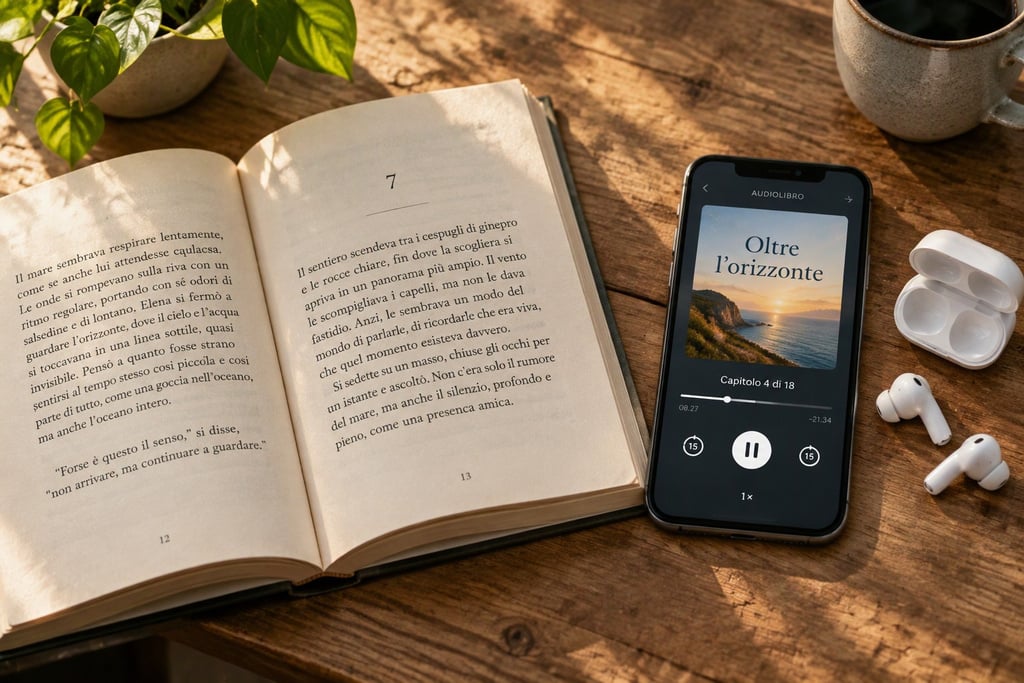
If you read a book yourself, you can ‘get inside’ a work and the author’s mind without any intermediaries, guided by your own sensitivity and inner voice. Reading undoubtedly takes more brain power, but it allows you to get intimately acquainted with the author’s writing style, including the punctuation and breaks. These elements may seem inconsequential, but for some writers in particular they have an important semantic value.
Consider, for instance, a masterpiece like James Joyce‘s Ulysses, where the final chapter comprises over 24,000 words with virtually no punctuation. Or Josè Saramago, who in works like Blindness removed all full stops, commas and quotation marks from his dialogues. How could a narrator – no matter how good – convey that stream of consciousness that makes these novels unique with their voice alone? For the most passionate and attentive readers, the nuances of meaning created by the punctuation and the rhythm of the text can turn a run-of-the-mill book into something memorable.
The advantages of audiobooks
Audiobooks provide some undeniable advantages: first of all, having an audio version offers accessibility to a piece of literature for visually impaired or dyslexic readers. They are also useful when, after staring at a screen all day, your eyes are in need of a rest.

In addition, you can also access thousands of titles from your smartphone, increasing the opportunities to discover new works even while doing activities that prevent you picking up a paper volume or an ebook.
From this perspective, audiobooks shouldn’t be seen as competition to their paper or digital ‘cousins’, but rather as allies that can open new doors to keen readers who want to spend more time discovering literature. The ten reader’s rights Daniel Pennac listed in his book Reads Like a Novel include not only the ‘right to read anywhere’, but also the ‘right to read anything‘, since nobody, he argues, has the right to criticise other people’s reading choices. To extend this concept, you could say that everyone has the right to listen to the audiobooks they want to, since it is not the tool that matters, but the excitement of entering the worlds described by their favourite authors.