


Table of Contents
There aren’t many literary characters that have been loved by multiple generations of readers and reached the modern age without losing any of their appeal, but Winnie-the-Pooh is definitely one of them. This kind and slightly bumbling bear’s story began 100 years ago in a newspaper, and he still enchants millions of young readers all over the world today. In this article, we’ll retrace this endearing teddy bear’s journey to global success, and explore why he became one of the most famous characters in children’s literature.
From London Zoo to bedtime stories
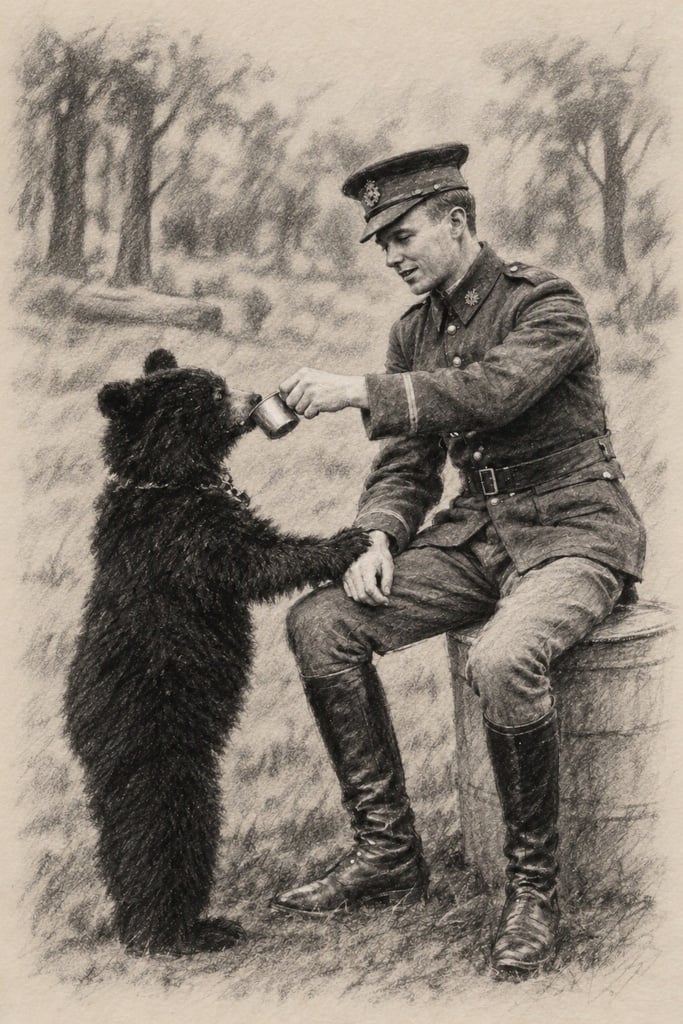
Winnie-the-Pooh’s story began during the First World War, when the veterinary officer Harry Colebourn, on a train ride to a training camp, encountered an orphaned female bear cub and bought it to save it from the hunter who had caught it. In honour of his hometown, he decided to call the animal Winnipeg, which was later affectionately shortened to Winnie.
The bear became the regiment’s mascot and crossed the Atlantic with the soldiers. When the division was called back to the front in France, Colebourn gave her to London Zoo to avoid the risk of her coming to any harm, intending to collect her once the war was over. However, the animal became a major attraction for visitors, and so at the end of the war the officer decided to leave Winnie there.
As a child, Christopher Robin Milne often visited London Zoo with his father, the writer Alan Alexander Milne, and he grew so fond of Winnie he renamed his teddy bear after her. His dad, who loved making up bedtime stories for his son, took inspiration from this bear and the child’s other soft toys to create the characters in his tales: Eeyore the donkey, Piglet, Tigger the bouncy tiger, the kangaroo Kanga and her baby Roo.
The author also took inspiration from real life for the setting of his stories: the Hundred Acre Wood – where Pooh and his friends live – was based on Five Hundred Acre Wood in Ashdown, southern England, where the family lived.
Winnie-the-Pooh made his debut on 24 December 1925, when A.A. Milne’s short story The Wrong Sort of Bees was published in the London Evening News. The story describes a rather bizarre plan the bear concocts to eat the honey in a hive attached to the trunk of a tree. After rolling around in the mud to disguise himself as a black cloud, Pooh borrows a balloon from his friend Christopher Robin to take him up to the hive, singing a song about rain on the way.
However, the bees don’t seem to fall for the trick, and Pooh realises they must be ‘the wrong type of bees’ that make ‘the wrong type of honey’, so he asks Christopher to shoot the balloon, which falls gently back to earth. In the story, Milne also explains the supposed onomatopoeic origins of the second part of the bear’s name, Pooh: because his arms were so stiff after holding the balloon string for so long, for a while he was forced to blow away all the flies that landed on his nose, making a ‘pooh’ sound!
But Winnie-the-Pooh made his proper literary debut in 1926, with the publication of the book Winnie-the-Pooh, a collection of the best stories A.A. Milne had written for his son. The book received great critical and public acclaim, and so the author decided to continue the adventures of the bear and his friends in a poetry collection entitled Now We Are Six, published in 1927, and a second story book, The House at Pooh Corner, published in 1928.
Ernest H. Shephard’s illustrations
Ernest H. Shepard‘s ink drawings immediately gave Milne’s books a unique visual identity, depicting the funny adventures of the bear and his friends with delicate, understated strokes. This style remained at the heart of each subsequent edition of the book, and Walt Disney kept it too, choosing to take inspiration from the London-based artist’s original drawings for its animated films.
Shepard spent some time at Milne’s house in East Sussex to get a closer look at Christopher Robin’s soft toys and Five Hundred Acre Wood. It’s likely that this in-person observation helped him turn Milne’s descriptions into the simple yet poetic images that masterfully depicted Pooh and his friends’ magical and playful world.
Popularity and global success
The incredible success of the first Winnie-the-Pooh story in the London Evening News and subsequent episodes broadcast on the radio encouraged the London-based publisher Methuen to print 35,000 copies of the first book Winnie-the-Pooh, an enormous print run for the time. Over the years, various publishers decided to translate and publish the book, helping to spread the small bear’s fame to readers all over the world.
In 1958, the popularity of the Winnie-the-Pooh books convinced Alecander Lenard, a Hungarian doctor and humanist, to translate Milne’s first book into Latin. Winnie ille Pu is still the only book in Latin to have ever made it onto the New York Times bestseller list – and it remained there for an impressive 20 weeks!
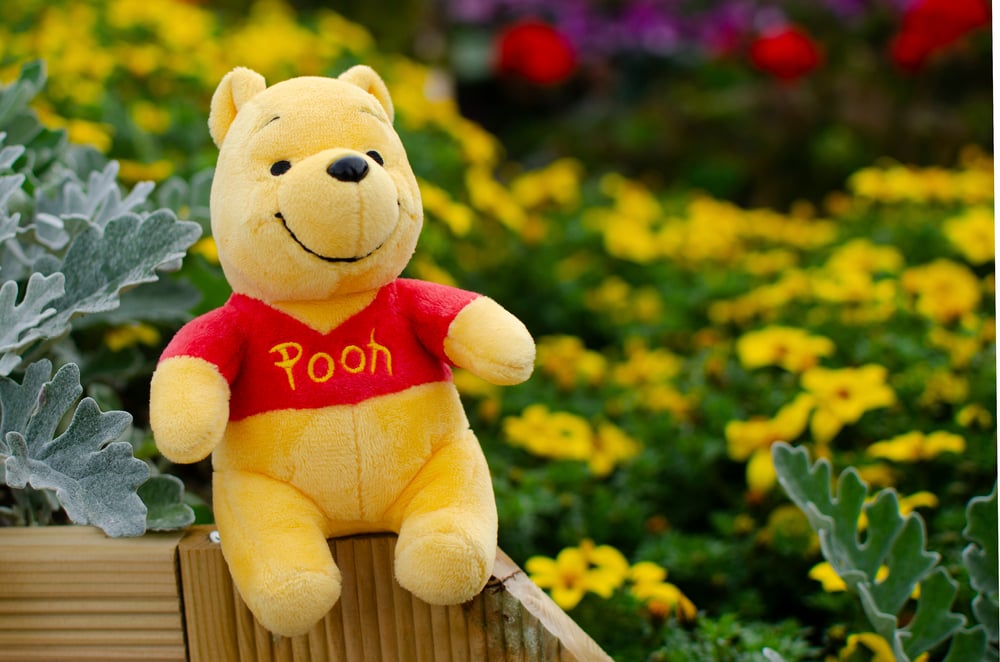
But it was Walt Disney‘s acquisition of the film and television rights in 1961 that really turned Winnie-the-Pooh into a global cultural phenomenon. From that moment on, the bear with the iconic red t-shirt and his friends became part of the imagination of whole generations of adults and children alike, thanks to animated series, films, theme parks, toys and merchandise of every kind.
The Winnie-the-Pooh books have now been translated into over 50 languages and have sold millions of copies all over the world. The honey-mad bear is also one of the highest-earning characters in the history of children’s literature: according to estimates produced by Forbes in 2004, Disney earns more than €5 billion (£4.2 billion) every year from the merchandise, video games, books and films featuring the adventures of Pooh and his friends.
From ink on paper to a wider cultural phenomenon
What makes Winnie-the-Pooh’s story really unique is not only the literary and commercial success the bear achieved, but also the cultural influence he has exerted. In the essays The Tao of Pooh and The Te of Piglet, for example, the writer Benjamin Hoff uses the two characters to illustrate the key concepts of Taoist thinking.
Similarly, in Pooh and the Philosophers, the author John Tyerman Williams sought to show that all of Western philosophy can be found inside Milne’s books. The fact that a character from a children’s book can be used to explain philosophical ideas exemplifies how Winnie-the-Pooh and his friends have become not only a symbol of ‘slow living’ – a lifestyle that prioritises taking things slowly and enjoying the small things in life – but also true cultural icons of the modern age.
A team of developmental paediatricians even published a satirical article in 2000 in the Canadian Medical Association Journal, which provided a clinical analysis of A.A. Milne’s characters, giving each one a psychiatric or neurodevelopmental diagnosis and dealing with it as if it were a true multidisciplinary clinical case. The doctors’ aim was to show, in a fun way, that children’s neurodevelopmental conditions often go unnoticed. Although the study did not have scientific ambitions, it clearly shows how the animals from the Hundred Acre Wood have become a cultural ecosystem that can survive outside their books.
The calendar of events marking Pooh’s 100th birthday
The British publisher Farshore has organised a packed programme of initiatives to celebrate Winnie-the-Pooh’s 100th birthday in October 2026, including new editions of A.A. Milne and E.H. Shepard’s classic books and a new sequel – A Little Boy and His Bear – written by Jane Riordan and illustrated by Andrew Grey. Farshore has also arranged a travelling exhibition based on the original Winnie-the-Pooh books taking in various National Trust and Cheshire East Council properties in the UK from spring 2026, and featuring materials from Shepard’s and Milne’s estates and from the HarperCollins archive.
Disney has also launched various initiatives for the character’s centenary, including the release of a book called Winnie the Pooh: 100 Mindful Moments on 22 September 2026. This book by Nancy Parent, with illustrations by Gonzalo Kenny and Mike Wall, invites readers to live in a more balanced way by adopting Pooh and his friends’ approach to life. Featuring ideas to reflect upon, activities and recipes for creating your own daily ‘mindful moments’, it encourages readers to seize the moment and abandon the frantic nature of modern life.
If you fancy immersing yourself in the magical world of the Hundred Acre Wood, you can also visit Ashdown Forest, home to Posingford Bridge – the bridge where Winnie-the-Pooh played Poohsticks with his friends – a museum and other places inspired by Milne’s books. And at New York Public Library you can see the permanent collection of original soft toys that belonged to Christopher Milne: interesting relics of that sweet and slow world that, a century later, still enchants millions of readers.
In an era that demands unbridled productivity, the endearing adventures of this rather clumsy bear can teach readers both young and old the value of taking things slowly and help them to fully enjoy the present, without worrying about the future. And they are also a reminder that you don’t need much to be happy: just a jar of good honey and the company of your best friends.